Iceland Travel Guides
Laugavegur: Wash Road, Main Street, and the Public Rhythm of Reykjavík
A fuller private guide to Laugavegur, with its wash-road history, central shopping and nightlife role, links to Reykjavík's urban rhythm, and the reason this street matters far beyond retail.
GlaciGo Iceland / May 2026 / 9 min read
Laugavegur is the kind of street that people often underestimate because it is so obviously central. It is easy to think of it as merely Reykjavík's main shopping street, useful for cafés, wool sweaters, bars, and an evening wander before dinner. All of that is true. But Laugavegur matters because it is one of the clearest places where Reykjavík shows its transitions in public: old and new, local and tourist-facing, daytime and nighttime, practicality and style. A strong article about Laugavegur should not flatten it into shopping advice. It should treat the street as one of the main ways the city reveals its own rhythm.
Visit Reykjavík describes Laugavegur as one of the oldest shopping streets in the city and explains that the name translates as 'wash road.' This is more than a charming etymology. The road originally led toward the hot springs and washing grounds in Laugardalur, where the city's laundry was once done. That older function gives the street unusual depth. Before it became a place of storefronts and nightlife, it was a route tied to domestic labor and the practical life of the town. You can feel, in that name alone, how Reykjavík's most visible commercial artery grew out of something ordinary and necessary rather than ceremonial.
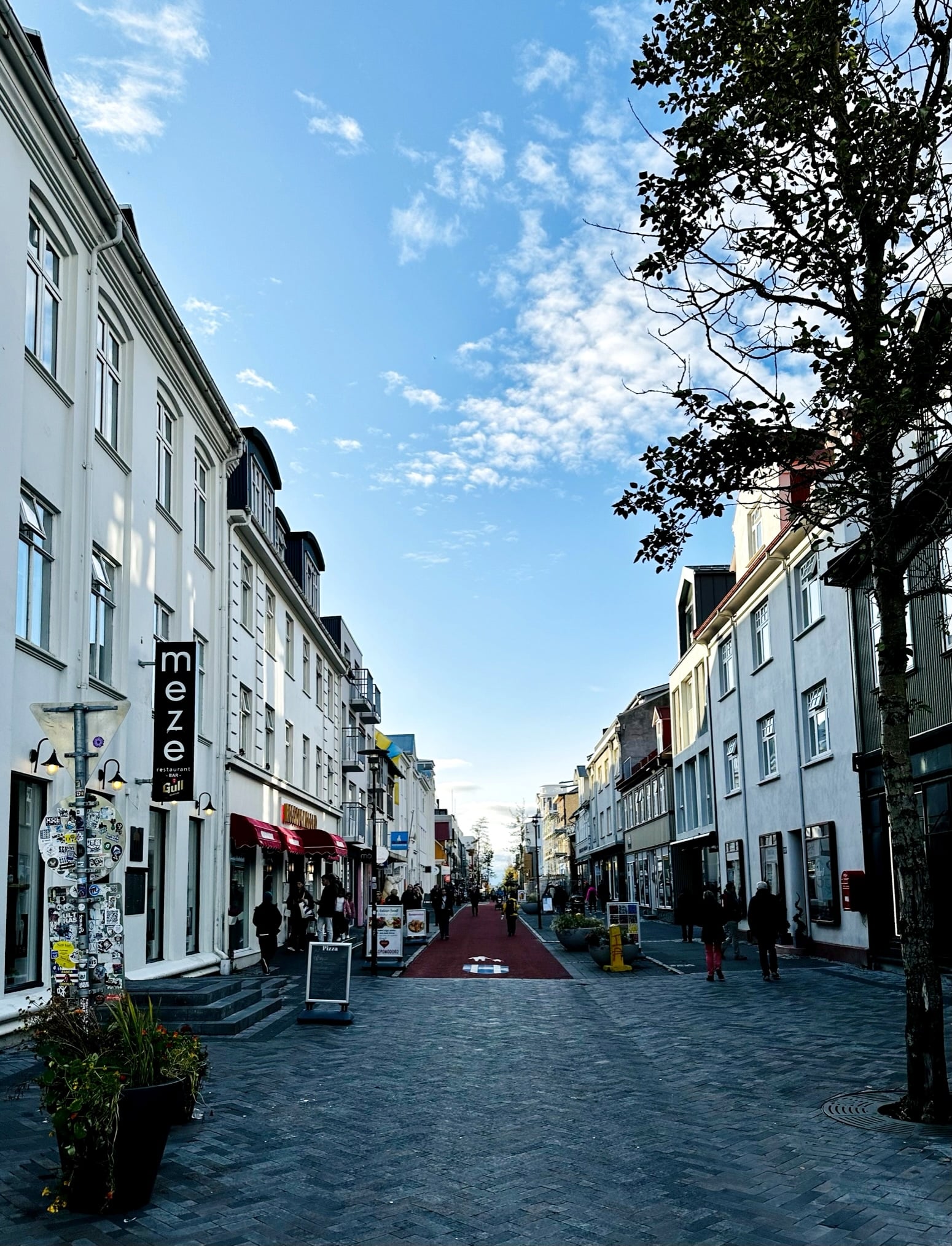
That practical origin still matters to the feeling of the street. Laugavegur does not carry itself like a grand European boulevard designed to impress from the start. It feels pieced together, adapted, and lived in. This is part of its charm. Reykjavík is a capital, but it is also a city with a comparatively intimate scale, and Laugavegur preserves that intimacy even while functioning as one of the busiest and most recognisable streets in the country. Visitors can browse, stop for coffee, duck into design stores, notice street art, and still feel that the city has not become abstract around them.
Visit Reykjavík's city-centre guide also makes an important distinction: while the street's historic component adds charm, its popularity with locals and tourists today comes largely from its mix of prestigious shops and exclusive stores. That phrasing helps us avoid romanticizing the street into a frozen heritage strip. Laugavegur is commercially alive. It changes. Businesses come and go. New aesthetics arrive. Old facades persist. The street works because Reykjavík has allowed it to remain a place of exchange, not just memory.
For tourists, this means Laugavegur is one of the best places to understand central Reykjavík without overplanning. You can use it as a spine. From there, the city begins to unfold into side streets, cafés, bakeries, bars, record stores, bookstores, and routes toward Hallgrímskirkja, Hlemmur, Austurvöllur, or the old harbor. Some streets are destinations in themselves. Laugavegur is both destination and orientation device. That double role is one reason it stays useful even after the first walk.
The street also changes character significantly over the course of a day. In daylight, especially in the slower morning and early afternoon hours, Laugavegur feels like an easy place to read the city through windows and foot traffic. The shops, cafés, and architecture do most of the work. Later, as Visit Reykjavík notes, the bars, clubs, and restaurants open up and draw both locals and visitors. The street's evening identity is not incidental. It is part of what makes Laugavegur feel genuinely urban by Icelandic standards. You do not simply shop there and leave. The social life of the city gathers along it.
This day-to-night shift gives the street more depth than many visitors expect. Some come for Icelandic design and wool, others for people-watching and coffee, others for cocktails and music, and others simply because every walk in central Reykjavík seems to touch Laugavegur eventually. All of these are valid, but the real pleasure lies in noticing how comfortably the street contains them together. Reykjavík is not large enough to split every mood into a different district. Laugavegur therefore becomes a place where multiple versions of city life overlap in plain view.
Another reason the street matters is that it places Reykjavík's older and newer ambitions close together. Around Laugavegur you can feel traces of a smaller town that grew incrementally, yet you can also see the capital's contemporary confidence in fashion, hospitality, tourism, and creative business. Unlike capitals built to overwhelm, Reykjavík's urban self-image still depends on streets where shops and bars sit within reach of one another and where walking remains the natural way of encountering the city. Laugavegur captures that unusually well.
The relationship between Laugavegur and Skólavörðustígur is also worth mentioning, because together they create one of the most readable urban pairings in central Reykjavík. Visit Reykjavík notes that Skólavörðustígur runs from the corner of Laugavegur up toward Hallgrímskirkja and has become one of the city's most attractive shopping streets in its own right. This matters because it shows that Laugavegur is not an isolated strip. It is part of a network of central streets that each carry a different mood. Laugavegur has the broader commercial pulse. Skólavörðustígur has the more curated uphill elegance. Moving between them is one of the simplest ways to feel Reykjavík become legible.
Laugavegur also works especially well for travelers who are not trying to maximize landmark count. If you have only a little time in Reykjavík and want to absorb something real rather than rush from site to site, the street offers an efficient kind of immersion. You can learn a surprising amount about the city simply by walking its length at different hours, stepping inside a few local businesses, and noticing how the crowd changes. A street this central could easily have become generic. The fact that it still feels like Reykjavík is part of its achievement.
There is also something revealing in the fact that so many visitors remember the street through mood rather than one image. Hallgrímskirkja has its tower, Harpa has its glass, the Sun Voyager has its silhouette. Laugavegur is less about a single emblem than about atmosphere accumulated over time: wet pavement reflecting lights, windows full of knitwear and books, voices outside bars, coffee steam in winter, and the sense that central Reykjavík is compact enough to be companionable. That is not a lesser form of memorability. In many ways it is the more durable one.
Laugavegur is broader than a shopping-street label. Some travelers come for shops, some for nightlife, some for street history, and some simply need city-center orientation. The fuller answer is that Laugavegur matters because Reykjavik's everyday life, visitor culture, old routes, food, design, and street-level texture remain visible together there.
What stays with many visitors after Laugavegur is not necessarily what they bought or where they stopped. It is the feeling of the street as a pulse line. By the time you have walked it in different weather or at different hours, Reykjavík begins to make sense not only as a destination, but as a city with habits. Laugavegur lingers because it turns the capital from a collection of landmarks into a place with rhythm.