Iceland Travel Guides
Lóndrangar: Basalt Towers, Bird Cliffs, and Volcanic Survival
A fuller private guide to Lóndrangar, with crater-plug geology, bird cliffs, lava context, climbing history, and the folklore that gives these sea stacks their strange authority.
GlaciGo Iceland / May 2026 / 10 min read
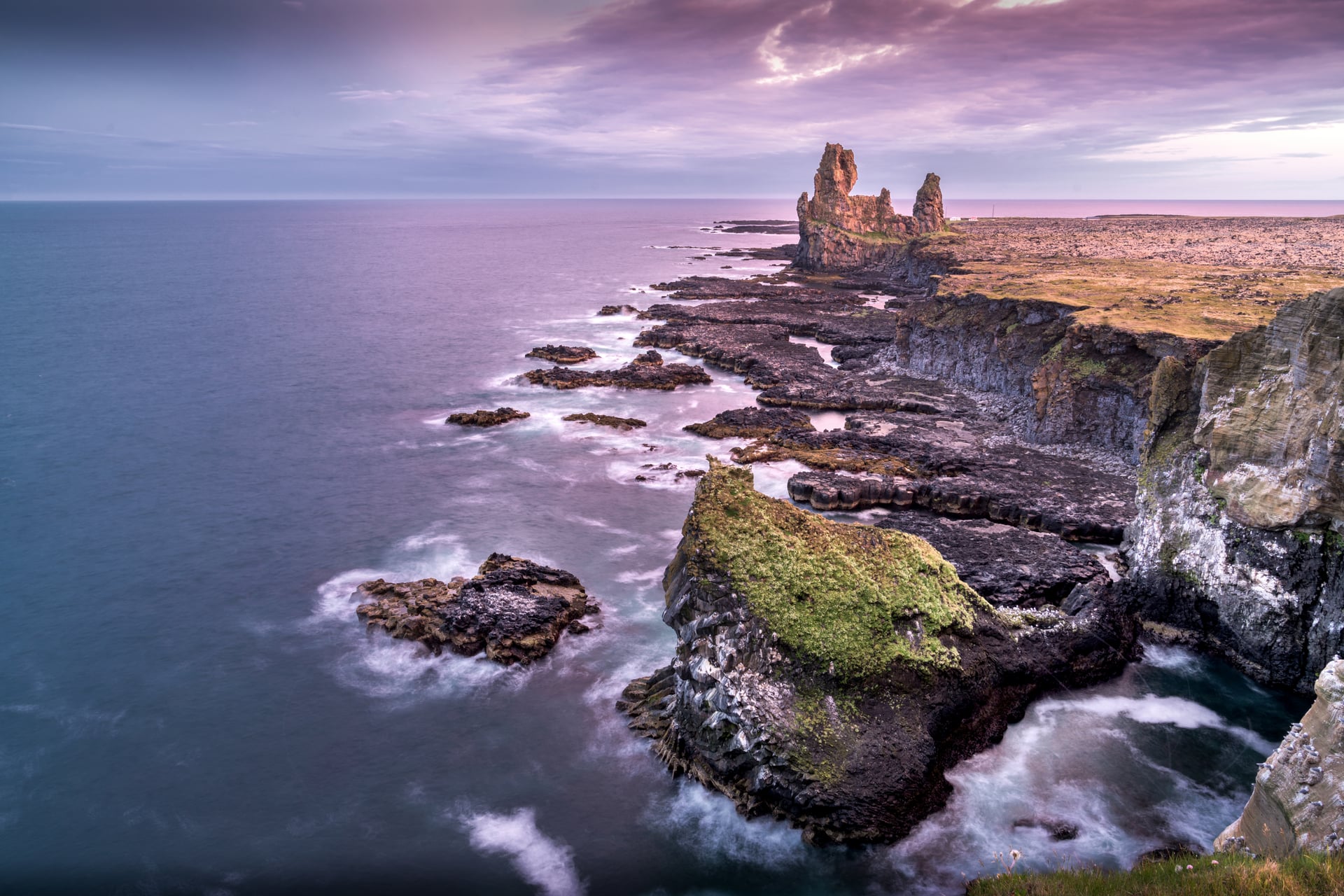
Lóndrangar does not look like a place that needs explanation. Two dark sea stacks rise from the coast with such confidence that most travelers understand the basic attraction at once. But places like this can be misleading in their simplicity. From a distance, Lóndrangar looks like pure form: vertical rock, open sea, and one clean dramatic statement on the edge of Snæfellsnes. Up close, it becomes much richer. It is geology, bird habitat, crater-remnant, folklore ground, and one of the best places in western Iceland to feel how volcanic history can survive as architecture.
West Iceland describes Lóndrangar as uniquely formed remnants of ancient basalt volcanic dikes sticking out from the sea. That is already a more interesting phrase than the usual language of pretty cliffs. These are not random rocks left by chance. They are remains, fragments of a volcanic structure after immense loss. The same source explains that Lóndrangar and the nearby hill Svalthúfa are the remains of a crater that has been eroded into its present form by the sea. So what you see standing now is not the whole thing, but what the Atlantic allowed to remain.
The Environment Agency's park brochure sharpens that geological reading further. It states that Svalþúfa is thought to be the easternmost part of a crater that erupted under the sea, and that Lóndrangar are crater plugs. That detail matters because it changes the imagination of the place. These towers are not simply scenic pinnacles at the coast. They are the hardened inner parts of an older eruption, now exposed after surrounding material was stripped away. Lóndrangar therefore feels less like ornament and more like a skeleton of volcanic process still standing upright.
That helps explain the emotional effect of the site. Some landmarks impress because they feel large; Lóndrangar impresses because it feels stubborn. The stacks rise as if they refused to go down with the rest of the crater. The result is not only beautiful but strangely moral in tone. Erosion has already done most of its work here, and yet these dark forms remain, abrupt and vertical against sea and sky. It is one of those Icelandic places where geology reads almost like character.
The scale is also deceptive. Lóndrangar often photographs as a clean silhouette, which can flatten the experience into graphic beauty alone. But West Iceland notes that the higher pillar is about 75 meters and the lower about 61 meters, and that the higher one was first climbed in 1735 while the lower followed in 1938. Those dates are wonderful because they add a human measure to the stone. For a long time the pillars were treated as essentially unclimbable. The first ascent history makes them feel less like roadside scenery and more like respected presences in the local landscape.
The coast around the stacks gives them context. Younger lava fields surround this older crater ruin, according to West Iceland, which means Lóndrangar sits inside a layered volcanic conversation rather than in isolation. You can feel that in the landforms nearby: mossy lava, rough surfaces, changing edges, and the broader Snæfellsjökull district pressing its logic all the way down to the sea. The park brochure makes the same point at a larger scale by describing the national park as full of both ragged block lava and smoother ropy lava, much of it tied directly to Snæfellsjökull's system. Lóndrangar is therefore not a stray monument. It belongs to a much wider volcanic grammar.
Birdlife gives that grammar movement. West Iceland notes that puffins and fulmars nest on these cliffs, while the Environment Agency's flora and fauna page adds that black guillemots can be seen around Malarrif and Lóndrangar. This matters for the feel of the place as much as for biodiversity. Lóndrangar would already be striking if it were only stone. The presence of nesting seabirds turns it into a living vertical neighborhood. The stacks are not just seen; they are occupied. In season, the cliffs gain motion, sound, and urgency.
That living presence helps keep Lóndrangar from becoming too abstract. Sea stacks can sometimes feel like landscape sculpture admired at a distance. Here, the birds pull the eye back into use and seasonality. The cliffs matter because creatures are inside them. This is one reason the place works so well for travelers who want more than a quick photo. Stand there long enough and the stacks stop being symbols and start becoming habitat.
Folklore deepens that sense that the area is inhabited in more than one way. West Iceland notes that farmers did not make hay on Svalþúfa because it was said to belong to the elves living there. It also points to Þúfubjarg below the hill, where a folktale says the poet Kolbeinn Jökla skáld had an encounter with the Devil. These are not random superstitions pasted onto a dramatic view. They make local sense. Lóndrangar is exactly the kind of place where people would imagine boundaries between ordinary and otherworldly life becoming thin.
This is part of why Lóndrangar should not be reduced to a geology lesson, even though the geology is excellent. The stacks are also about how Icelanders have historically lived with landforms that seem almost too forceful to be neutral. Elves, devils, impossible climbs, nesting birds, sea-eroded crater remains: the categories overlap naturally here. A strong tourist article should let that complexity stay intact. The place is not only explainable. It is also suggestive.
On a private itinerary, Lóndrangar works best as a stop for attention rather than speed. It can be paired with nearby Malarrif, birdlife, lava walking, or a wider Snæfellsjökull route, but it rewards a few extra minutes of stillness more than many visitors give it. The light changes quickly, and the stacks respond dramatically. Under bright conditions, they can seem almost cleanly drawn. Under cloud, they become heavier and older. In lower sun, they look like ruins from a forgotten coastline. The subject stays the same; the mood does not.
Londrangar becomes much more memorable once its layers are named. Travelers often want to know what the stacks actually are, whether they are volcanic plugs or eroded cliffs, what birds can be seen nearby, and how local folklore belongs to the site. Without that context, the towers risk becoming another dramatic photo stop. With it, they become one of Snaefellsnes' clearest expressions of deep earth history turned into visible coastal form.
What stays with many travelers after Lóndrangar is a sense of uprightness. The stacks do not spread or soften. They rise. They make the sea feel wider, the birds more precise, and the surrounding lava older. They are remnants, but they do not feel defeated. That is the particular dignity of Lóndrangar. It shows erosion, survival, and imagination all in one frame, and it does so without needing anything extra. The rock is enough.