Iceland Travel Guides
Meradalir: The Valley That Proved Reykjanes Was Not Finished
A fuller private guide to Meradalir, with the 2022 eruption timeline, valley-specific identity, gas and access reality, and why this middle chapter on Reykjanes deserves its own name.
GlaciGo Iceland / May 2026 / 10 min read
Meradalir is one of those Icelandic names that became globally recognizable very quickly and then almost immediately got folded back into a larger label. Most travelers now remember the 2022 eruption on Reykjanes under the broader headline of Fagradalsfjall, which is understandable. The valleys are close, the eruptive story is connected, and the public memory of 2021, 2022, and 2023 often compresses into one shared lava chapter. But Meradalir benefits from being explained on its own terms because the 2022 eruption had its own geography, its own tone, and its own meaning inside that sequence. It was not simply a repeat. It was the moment the volcanic awakening of Reykjanes proved it could reopen nearby and continue rewriting the landscape.
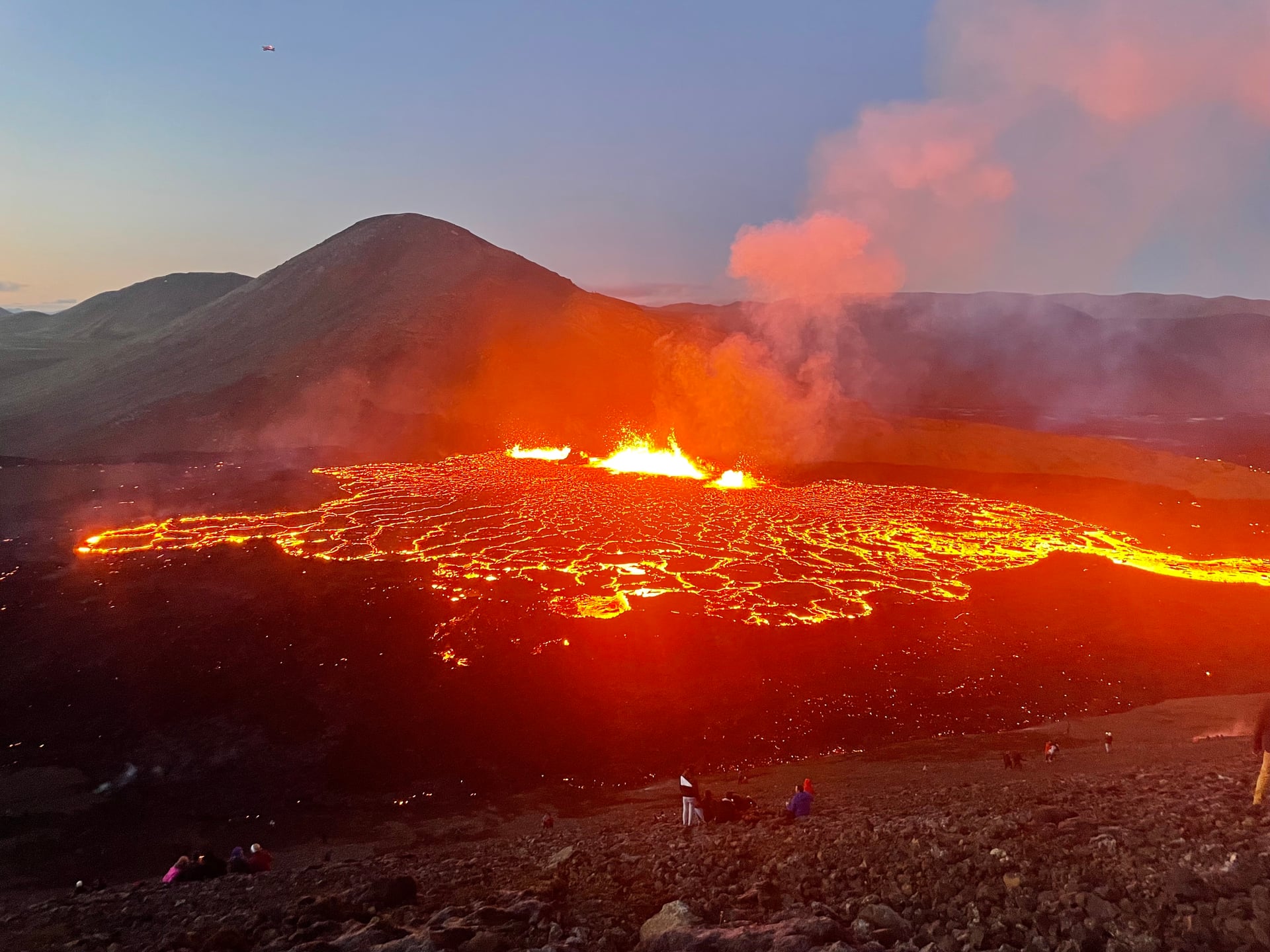
Visit Reykjanes is very clear on that point. Its eruption-site overview explains that the second eruption began in the valley of Meradalir on 3 August 2022, with fissures opening roughly one kilometer north of the 2021 site, and that the eruption lasted up to three weeks. Those dry facts matter because they establish Meradalir as a place name with real volcanic identity, not just a footnote to Geldingadalir. The valley entered public language because lava entered it. Once that happened, Meradalir became part of the contemporary map of Icelandic volcanic memory.
The Icelandic Meteorological Office gives the chronology even more sharply. In its 3 August 2022 update, the IMO recorded that lava began flowing from a ground fissure near Fagradalsfjall at 13:18 GMT and identified the exact location as Meradalir, about 1.5 kilometers north of Stóri-Hrútur. Later updates in the same official notice confirmed that the eruption ceased to issue lava on 21 August 2022. That date range matters. Meradalir was brief compared with the long-lived 2021 eruption, yet long enough to become a full event in its own right rather than a one-night flare.
What makes Meradalir interesting is precisely that balance between continuity and difference. It belongs to the same larger volcanic reactivation on Reykjanes that made Fagradalsfjall famous, but it did not feel identical. Visit Reykjanes frames the first three eruptions near Mt. Fagradalsfjall collectively because they share the same general fissure system, yet the valleys themselves matter. In 2021, much of the public imagination attached to the novelty of accessible lava in Geldingadalir. In 2022, Meradalir shifted the story from surprise to recurrence. The question was no longer whether Reykjanes had woken up. The question was how the waking would continue.
That change in public feeling was important. A first eruption can be narrated as exception. A second nearby eruption starts to feel like pattern. Meradalir therefore mattered not only geologically but psychologically. It made the peninsula's unrest feel less like a singular gift to spectators and more like a living sequence with its own momentum. For Icelanders, scientists, guides, photographers, and returning visitors, the valley became proof that the 2021 event had not exhausted the volcanic system's capacity to act.
There is also a topographic reason the name stuck. A valley is never just empty space waiting for lava. Once lava arrives, the shape of the valley begins to determine how the eruption is seen and remembered. Meradalir gave the 2022 event a contained stage, one that still felt tied to the earlier landscape but visually distinct enough to be named and tracked separately. Valleys in volcanic country are not passive backgrounds. They direct flow, focus sightlines, and help the mind sort one eruption from another.
The IMO's updates also underline something that many weaker travel articles tend to blur: Meradalir was spectacular, but it was not casually safe. Gas pollution could exceed danger levels at any time, especially under light winds when gases accumulated in low-lying terrain. The official warning was explicit that circulation in the valleys could trap hazardous gas and that people needed to move to higher ground rather than remaining on slopes just above the eruption. That detail is essential to the identity of Meradalir. Because it is a valley, it offered visual enclosure and drama, but that same enclosure could also intensify gas risk.
That duality shaped the real experience of the site. Meradalir was beautiful because the landscape gathered the eruption into a readable form: fresh lava, dark ridges, rising plume, a contained basin of fire. Yet the same containment meant the valley could not be approached with the naive logic of a postcard. Official guidance mattered. Wind mattered. route choice mattered. Meradalir helped remind the world that accessible volcanic tourism in Iceland still sits inside a hazard-managed environment, not a fantasy of unrestricted closeness.
Seen from a broader Reykjanes perspective, Meradalir also sharpened the internal geography of the volcanic district. After 2022, names like Geldingadalir, Meradalir, and later Litli-Hrútur stopped feeling like specialist references and started becoming part of general travel language. This is one of the subtler cultural effects of the Reykjanes eruptions: valleys and ridges that once lived mostly in local or scientific vocabulary entered global itineraries. Meradalir became one of those names that travelers learned not because of old folklore or centuries of tourism, but because lava made the geography suddenly urgent.
Photographically, Meradalir offered a different kind of volcanic image from the more first-wave mythology of 2021. By 2022 the audience was already more informed, more prepared, and perhaps a little more serious. The drama was still there, but the visual language had changed. Fresh fissure fire in an already recently altered landscape gave the eruption a sequel-like quality, though not in a trivial sense. It looked like an area continuing a sentence it had already started. That continuity is one reason Meradalir remains so satisfying to think about. It was both a new eruption and an answer to the first one.
People searching specifically for Meradalir are usually not asking for a generic Reykjanes volcano guide. They want to know what happened there in 2022, how it differed from 2021, whether the valley is part of Fagradalsfjall, and why the name keeps appearing in eruption timelines. A good visit has to resist two bad habits at once: treating Meradalir as too minor to deserve separate attention, or treating it as if it were disconnected from the Fagradalsfjall sequence. The truth sits in between. It is distinct and connected at the same time.
Compared with the larger Fagradalsfjall article, Meradalir is less about the whole three-eruption arc and more about one decisive middle chapter. Compared with the Sundhnúkur events closer to Grindavík, it feels less infrastructurally tense and more like part of the open volcanic district that changed how people hiked Reykjanes. Compared with Blue Lagoon-era tourism on the peninsula, it belongs to a much more recent and geologically immediate imagination of the region. These distinctions help keep the valley from dissolving into generalized volcano-brand language.
There is also something moving about Meradalir's brevity. Because the eruption lasted just over two weeks, it carries a compressed intensity in memory. It was long enough for people to respond, walk, watch, warn, photograph, and interpret, but short enough to feel fragile in retrospect. Meradalir did not try to become permanent. It arrived, altered the map of understanding, and stopped. That rhythm suits volcanic Iceland well. Not every place matters because it lasted longest. Some matter because they made the sequence legible.
For private travelers today, Meradalir works best as a chapter of interpretation rather than a promise of spectacle. Even when lava is no longer flowing, the valley still matters because it helps explain what happened on Reykjanes after 2021. A strong guide or article can use Meradalir to tell the story of recurrence: how nearby ground reopened, how official agencies tracked it, and how a place name became part of modern Icelandic volcanic literacy almost overnight.
What stays with Meradalir, in the end, is not just the image of lava in August 2022. It is the sense that one valley helped prove the new volcanic era on Reykjanes was real, ongoing, and geographically more intricate than a single headline could hold. Meradalir matters because it turned an eruption story into a district story.