Iceland Travel Guides
Múlagljúfur Canyon: A Southeast Iceland Hike That Keeps Opening
A fuller private guide to Múlagljúfur Canyon, with its hidden-feeling trail, Hangandifoss and Múlafoss, Öræfi and glacial context, and the reason this Southeast Iceland hike feels larger than the map suggests.
GlaciGo Iceland / May 2026 / 10 min read
Múlagljúfur Canyon is one of those Southeast Iceland hikes that still manages to feel discovered even though it is no longer secret. The photographs often arrive first: steep green walls, a dark cut in the land, a river threading below, and one of the most cinematic viewpoints in the country opening toward glaciers and mountain ridges. But the real power of Múlagljúfur is not just that it is beautiful. It is that it gathers several Icelandic scales into one walk. The canyon is intimate enough to feel personal, the surrounding mountain world is large enough to feel alpine, and the distant glacial views keep reminding you that this quieter path belongs to the edge of one of Europe's biggest ice caps.
Guide to Iceland describes Múlagljúfur as a somewhat hidden canyon on the edge of Southeast Iceland, near Fjallsárlón and under the wider influence of Öræfajökull and Vatnajökull. That is a useful starting point, because one of the best things about Múlagljúfur is where it sits. Some Iceland hikes are dominated by the destination alone. Here the destination keeps expanding. As you rise, the canyon itself matters, then the waterfalls matter, then the glacier lagoons and mountain forms beyond begin to enter the composition. The result is a hike that keeps re-editing its own frame.
The wider district helps explain that feeling. Visit South Iceland's material on Öræfi describes the region as one shaped by glacial erosion and water, with floodplains, outlet glaciers, and the heavy memory of eruptions from Öræfajökull. That description does not refer specifically to Múlagljúfur, but it gives the right geological and emotional context. This is a landscape built by ice, water, and volcanic force over very long time. The canyon does not sit outside that system as a decorative little side valley. It belongs to a region where relief, erosion, and glacial presence are the governing facts of space.
What makes Múlagljúfur especially attractive for travelers is that it feels wilder than its access might suggest. It lies not far from Ring Road, but the atmosphere shifts quickly once the walk begins. You leave the roadway world behind, move onto a narrower trail, and the canyon starts to hold your attention more than the itinerary does. This is not one of those stops where most of the experience is contained in a parking lot overlook. You have to walk for it, and that investment changes the tone immediately.
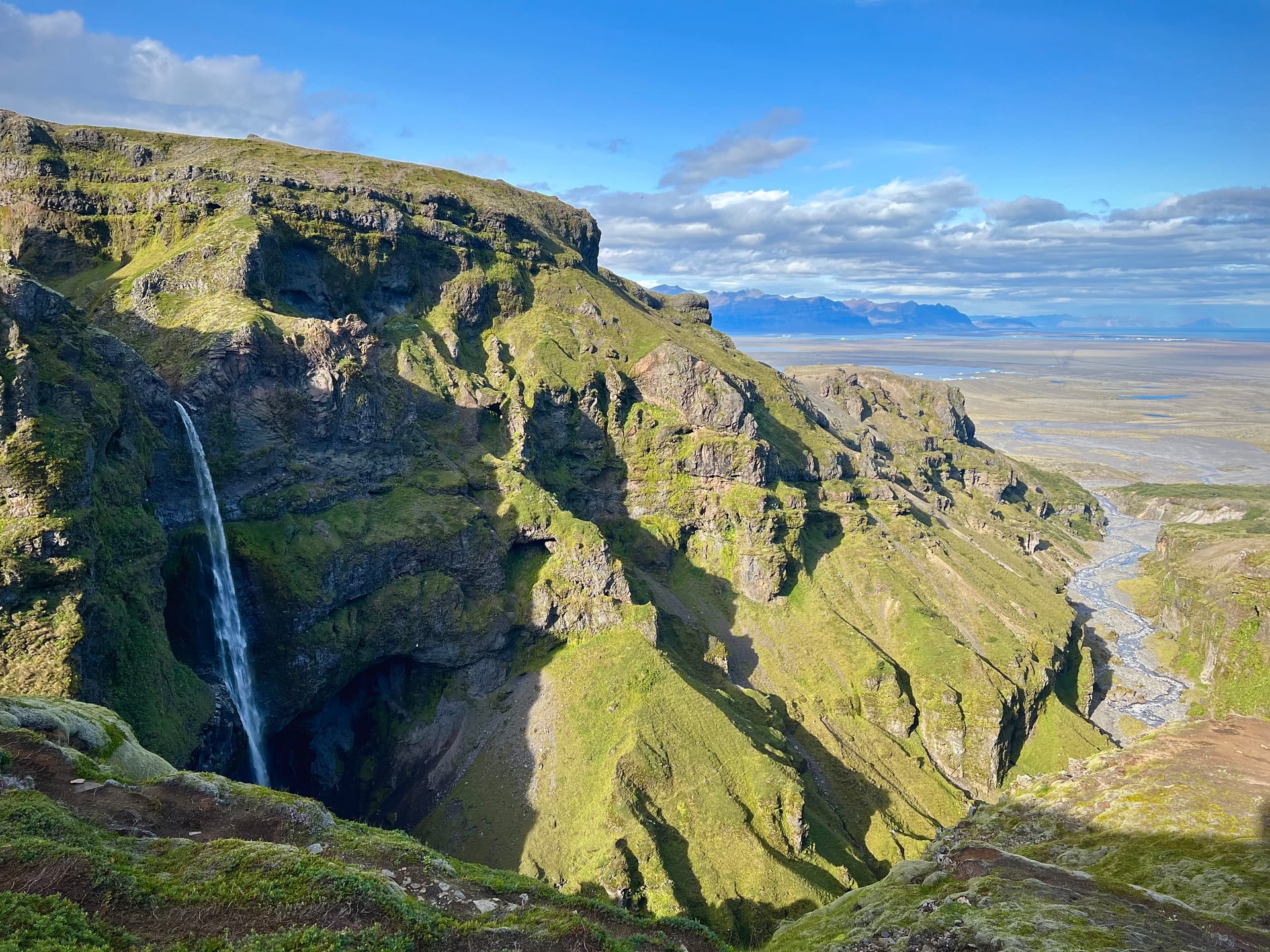
The two waterfalls, Hangandifoss and Múlafoss, are a major part of the canyon's identity. Guide to Iceland describes Hangandifoss as dropping more than 120 meters and places Múlafoss slightly farther along the trail, both often overlooked despite their dramatic setting. That pairing matters because Múlagljúfur is not a single-point destination in the way some famous Iceland sites are. It is a sequence. Waterfalls appear as part of the canyon's architecture rather than as separate standalone attractions with their own parking areas and viewing decks. The eye keeps moving between vertical water, sloping walls, and distant ice.
This creates a different rhythm from other canyons in Iceland. Fjaðrárgljúfur is winding and textural. Stuðlagil is geometric and river-centered. Múlagljúfur feels more like a lifted corridor opening toward high country. Its power comes not only from depth, but from direction. You walk into a landscape that keeps pointing your attention forward and outward at the same time. That is one reason so many people remember the viewpoint at the upper section so vividly. The canyon is not closing around you. It is delivering you toward a wider southeastern panorama.
The glacial context is essential. Visit South Iceland's pages on Öræfajökull and the wider region emphasize that this is the southern edge of Vatnajökull's great system, where outlet glaciers descend between mountain ridges and the highest peak in Iceland rises under ice. Even when the trail itself feels grassy and relatively calm, that larger glacial world is doing silent work in the background. Fjallsárlón and the ice beyond are not just bonus views. They are part of the reason the canyon feels so charged. Múlagljúfur is a hike where intimacy and remoteness coexist without canceling each other out.
This also makes the trail emotionally different from the busier South Coast highlights. There is no sense of arriving at a landmark already pre-explained by signage, crowds, and the same established photo platforms. Múlagljúfur still asks the visitor to do a little more interpretive work. You notice line, height, distance, and weather. You feel the route changing under your feet. You become more aware of pace. For many travelers, that is exactly the kind of Iceland moment they are looking for once the biggest famous sites have already been seen.
Photographically, Múlagljúfur is unusually generous but only if you let it breathe. The obvious wide frame is excellent: canyon walls, river, waterfall, glacier beyond. But the place often becomes more memorable in layers. A narrow section of the path with the valley dropping away. The difference between near green slopes and the cold blue-white of distant ice. A human figure giving scale to Hangandifoss. Low cloud moving across the upper ridges. Because the canyon carries several depths at once, it rewards restraint better than frantic over-shooting.
Weather matters here in the useful Icelandic way. Bright conditions can make the greens and glacier blues sing, but softer or moodier weather often gives the canyon more seriousness. Cloud lowers the ceiling, the waterfalls stand out more strongly, and the valley begins to feel less decorative and more elemental. Good hiking weather is ideal, of course, but Múlagljúfur does not need postcard sunshine to succeed. It already contains enough structure to hold attention in flatter light.
From a practical perspective, this is a stop that asks for honesty. It is not an extreme expedition, but it is also not a five-minute roadside look. Good shoes, weather awareness, and realistic timing all matter. That is part of why it works so well in a thoughtfully built private journey through the Southeast. If the day is too crowded, Múlagljúfur turns into a rushed hike and loses much of what makes it special. If the day is built with room, it becomes one of the richest landscape experiences between Skaftafell and Jökulsárlón.
Múlagljúfur also belongs to a broader shift in how people travel through this part of Iceland. More visitors are looking for places that still feel less processed, less explained, and slightly off the immediate South Coast script. This canyon answers that desire without becoming a false 'hidden gem' cliché. It is known now, yes, but it still feels earned. The walk filters the experience just enough that the place keeps some dignity.
Mulagljufur Canyon benefits from a fuller explanation because traveler questions around it combines hiking questions, photography expectations, waterfall curiosity, and regional orientation. Many travelers want to know if it is really worth the effort when Fjallsarlon, Jokulsarlon, Skaftafell, and other major stops are nearby. The fuller way to understand it is yes, especially if they want a hike that gathers canyon, waterfall, mountain, and glacier into one coherent experience rather than delivering only one spectacular object.
What stays with many visitors after Múlagljúfur is the feeling that the canyon keeps widening in memory. At the time, the walk may seem focused on one path and one viewpoint. Later, what lingers is the whole layering of it: green walls, falling water, distant ice, the sense of standing between shelter and exposure. That is why Múlagljúfur Canyon matters. It is not just another beautiful Iceland hike. It is one of those rare places where the land keeps opening after you thought you had already seen it.