Iceland Travel Guides
Mývatn Nature Baths: Geothermal Calm Inside North Iceland's Volcanic Mind
A fuller private guide to Mývatn Nature Baths, with their geothermal lagoon, steam-bathing tradition, Bjarnarflag water source, North Iceland setting, and the reason they feel rooted in the volcanic district rather than detached from it.
GlaciGo Iceland / May 2026 / 10 min read
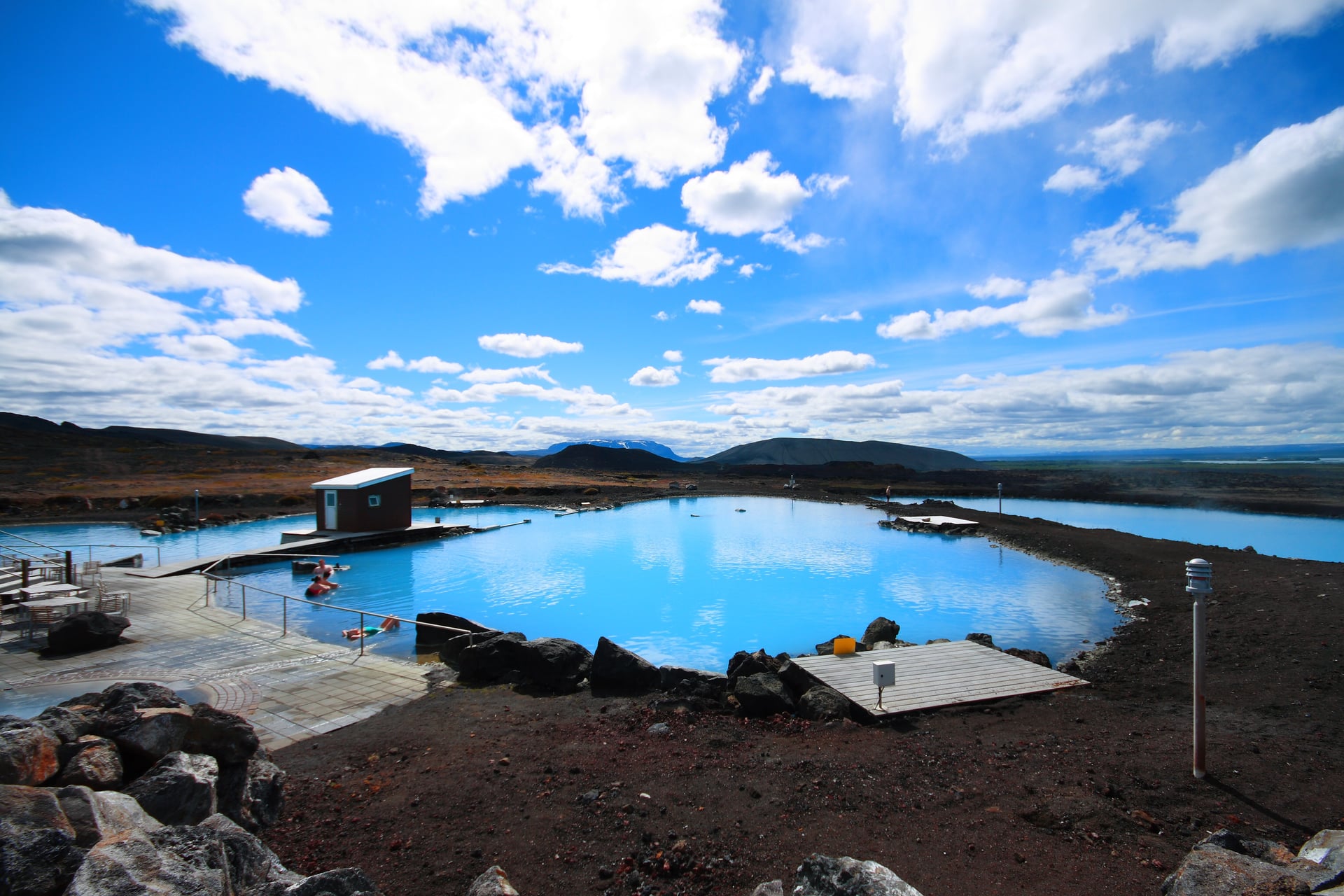
Mývatn Nature Baths work best when they are not described as a northern substitute for somewhere else. Yes, people often call them the Blue Lagoon of the North, and that shorthand can be useful in the most basic logistical sense. But it misses the deeper personality of the place. Mývatn Nature Baths feel less like an isolated icon and more like a geothermal pause built honestly into a volcanic district. The lagoon, steam baths, and surrounding views make sense because of where they are: on the edge of the Mývatn world, in a landscape of lava, birdlife, fissures, geothermal heat, and long North Iceland weather.
The baths' own official site leans into exactly that relationship. It describes the experience as drawing on a centuries-old tradition, beginning with a relaxing dip amid steam rising from a fissure deep in the earth and ending in a lagoon filled with geothermal water drawn from depths of up to 2,500 meters. That is strong language, but it is stronger for being specific. Mývatn Nature Baths are not trying to hide the mechanics of geothermal bathing behind vague spa fantasy. They openly belong to the volcanic system around them. The water, the steam, and even the air all keep the geology in the foreground.
That makes their location matter more than it does at many thermal destinations. The official site says the baths sit in the heart of Northeast Iceland, near Lake Mývatn, in an area known for unique nature and rich birdlife. That context is important because Mývatn itself is a protected, delicate ecosystem where tourist services have deliberately been developed with minimal disruption. The baths are therefore not simply a commercial add-on next to a famous region. They are part of the ongoing argument about how people can enjoy geothermal resources while staying in some kind of respect-filled relationship to a fragile volcanic landscape.
History helps deepen that feeling. According to the baths' official lagoon page, the use of geothermal water for bathing and steam baths has been part of life in the Mývatn area since the settlement of Iceland. The same page reaches back into the saga tradition, naming Guðmundur the Good in the early twelfth century and Bishop Gísli Oddsson as figures who recommended or praised geothermal bathing in the region. Whether a traveler reads those references as devotional history, bathing culture, or simply evidence of continuity, the point is clear: soaking in this district is not a brand-new tourist invention. It belongs to a much older local habit of living with heat in the ground.
This older continuity is one of the reasons the baths feel more grounded than many first-time visitors expect. Mývatn Nature Baths opened on 30 June 2004, according to the official site, and have since become one of the major employers and institutions in the Mývatn area. Yet despite that modern opening date, the place presents itself as a continuation rather than a rupture. The complex is designed, certainly, and the infrastructure is unmistakably contemporary. But the core idea remains simple and old: water, steam, cold air, open sky, and the body settling down inside a volcanic district.
The water itself deserves a more attentive explanation than most short articles give it. The official FAQ says lagoon temperatures are generally in the 36 to 40 degrees Celsius range, while the lagoon page explains that the geothermal water comes straight from a National Power Company borehole in Bjarnarflag. It arrives at around 130 degrees Celsius to a basin beside the lagoon before being mixed and made suitable for bathing. That detail matters because it reveals how close the baths remain to the energy logic of the region. This is not decorative warm water drifting in from nowhere. It is geothermal infrastructure transformed into hospitality.
That transformation is one of the most interesting aspects of the place. Mývatn Nature Baths sit in a district where Krafla, Hverir, Leirhnjúkur, pseudocraters, and wetlands all keep reminding visitors that North Iceland is geologically alive. After a day spent among steam fields, mud pots, young lava, or the broad intelligence of the Mývatn landscape, the baths offer not an escape from geothermal reality but a gentler entry into it. That is why they work so well on a private itinerary. They do not interrupt the logic of the region. They complete it physically.
The steam baths reinforce that feeling. The official site emphasizes natural geothermal steam rising through vents in the floor while guests look out through large panoramic windows over the Mývatn area. This is one of the strongest design gestures in the complex because it avoids turning steam into a sealed indoor abstraction. You remain in visual contact with the district while sitting inside one of its most elemental gifts. The experience becomes less about luxury in the generic spa sense and more about being held briefly inside the same volcanic system you spent the day exploring.
That said, the baths are not anti-comfort or ascetic in tone. The swim-up bar, changing facilities, café, and calmer setting all matter. The point is not that the place is raw. The point is that its comforts feel proportionate to the landscape rather than detached from it. Even Café Kvika, on the official site, reflects this nicely by recommending traditional geyser bread with smoked Arctic char, a local food that ties geothermal heat back to food culture and region. This may sound like a small detail, but it helps explain the atmosphere. The baths fit North Iceland by allowing pleasure to remain local and legible.
The rhythm of a visit also matters. Mývatn Nature Baths are not necessarily the centerpiece of a day in the same way that Dettifoss or Krafla might be. Often they are the place where the day resolves. They are where cold wind on a crater rim, sulfur in the air, miles driven between volcanic stops, or the nervous alertness of hiking rough terrain finally settle into the muscles. That restorative role is not secondary. It is often what makes the rest of the region land more deeply in memory.
Weather makes the baths even better. North Iceland's climate can shift quickly, and the official site goes out of its way to celebrate that seasonality: long summer light, autumn golds and browns, winter frost, and frequent northern lights. Few experiences in the Mývatn district summarize those changes as gracefully as sitting in geothermal water while the air stays cold around you. This is one reason the baths can feel especially memorable at the shoulder between day and night, or in quieter weather when the district seems to widen around the lagoon rather than compete with it.
The sustainability language on the official site is also worth noting because it aligns with the wider ecological seriousness of the Mývatn region. The baths state that they use 100 percent renewable energy, sort waste, reduce single-use plastics, use water-saving showers, and return geothermal water back into the ground. They also note local community support and purchases from local producers where possible. This does not turn the baths into a moral lesson, but it does help explain why the place feels less awkwardly inserted into the region than some tourism infrastructure can. The complex is trying, at least explicitly, to behave like part of the district rather than an exception to it.
A current practical detail matters too. On its home page and about page, the baths explain that a completely new facilities building is being opened in 2026 and that construction may cause minor disturbances in the meantime. This is exactly the kind of detail a careful article should include gently. It keeps the piece current without letting it become newsy. More importantly, it tells travelers that the baths are not static. They are growing in response to use, and the experience may continue to sharpen in coming seasons.
From an itinerary perspective, Mývatn Nature Baths are one of the smartest North Iceland stops for travelers who want a human-scaled geothermal experience after active sightseeing. They are not trying to outshout the landscape around them. They belong especially well after Hverir, Leirhnjúkur, Krafla, or a circuit around the lake, when the region's volcanic and ecological complexity has already entered the day. Then the lagoon stops being a spa stop and becomes a form of interpretation through the body.
the baths deserve their own treatment because people searching for them are usually asking questions different from those behind a general Myvatn search. They want to know whether the baths are worth doing, how they compare in mood to other lagoons, what makes them distinct in North Iceland, and whether they feel rooted in the region or merely convenient. The fuller way to understand it is that Myvatn Nature Baths matter because they are one of the clearest ways to experience geothermal North Iceland as both comfort and context.
What stays with many visitors after Mývatn Nature Baths is often not one perfect image of blue water but a feeling of fit. The district outside is volcanic, bird-rich, windy, and alive with geological memory. The lagoon does not cancel any of that. It gathers it, warms it, and gives it back to the body in a more livable form. That is why Mývatn Nature Baths linger. They are not only relaxing. They make North Iceland make physical sense.