Iceland Travel Guides
Perlan: Heat, Height, and Reykjavík Explained from Above
A fuller private guide to Perlan, with its geothermal water-tank origins, Öskjuhlíð setting, interpretive role, sweeping city views, and the reason it explains Reykjavík as much as it overlooks it.
GlaciGo Iceland / May 2026 / 10 min read
Perlan is one of those Reykjavík landmarks that keeps changing category depending on how you approach it. From a distance, it can look like a futuristic dome on a hill. From inside, many visitors first experience it as a museum. From the deck, it becomes a viewpoint. From its history, it turns into a story about hot water, urban infrastructure, and the odd Icelandic talent for making utility beautiful. A good article about Perlan has to hold all of those identities at once, because the building works precisely by refusing to be only one thing.
Perlan's own official history page begins with the essential fact: the building, designed by Ingimundur Sveinsson and inaugurated on 21 June 1991, rests under a huge glass dome placed on top of six district-heating tanks. Each tank can hold around four million litres of geothermal water. That one detail is enough to separate Perlan from most city landmarks. It is not a decorative shell built to imitate significance. It grew out of the systems that make Reykjavík livable. In Iceland, hot water is not background. It is a civilizing force, a domestic technology, and part of how the city became itself. Perlan turns that invisible foundation into a visible landmark.
That alone would make the building interesting, but its prehistory gives it extra depth. Perlan's official account notes that painter Jóhannes Kjarval imagined, as early as 1930, a beautiful mirrored building on Öskjuhlíð hill that would gather northern light and night symbolism. The site quotes his vision in language that feels uncannily close to what was built decades later. Whether you treat that as prophecy, poetic coincidence, or simply a strong cultural intuition, it matters because it shows that Perlan was not only engineered into existence. It was also imagined. Reykjavík had, in some form, long wanted the hill to carry something luminous.
The old tanks beneath the building are part of that longer city story. According to Perlan's history, the first district-heating tank was built on Öskjuhlíð in 1939, and the height of the site was chosen because it could provide the pressure needed to pump water high enough through the city, even to the level associated with Skólavörðuholt where Hallgrímskirkja stands. Five more tanks were added over the following decades. Later, in the late 1980s, they were rebuilt. That history matters because it places Perlan inside Reykjavík's physical metabolism. The building is not a monument laid on top of the city. It rises directly from the systems that warm it.
This gives Perlan a different personality from many museum buildings. In other capitals, a landmark may symbolize the nation's relationship to art, statehood, or commerce. Perlan symbolizes something more specifically Icelandic: the transformation of geothermal infrastructure into public imagination. That is a very local kind of grandeur. It also explains why the place can feel strangely intimate despite its scale. Hot water in Iceland means showers, swimming pools, radiators, greenhouses, sidewalks kept passable in winter, and the practical comfort of daily life. Perlan is monumental, but what it monumentalizes is ordinary warmth.
Its setting on Öskjuhlíð deepens the experience even further. Perlan's official site describes the hill as a natural gem in the heart of the capital, with more than 176,000 planted trees and geological traces of the ice age. This matters because the building does not stand on a bare urban pedestal. It rises from a wooded hill that already offers a small shift of atmosphere away from the downtown grid. Going to Perlan is not just going into a building. It is also a movement upward and outward, toward trees, paths, history, and broader air. That approach changes the mood before the museum even begins.
The hill carries its own historical gravity too. Perlan's history page points out that several wartime remains still lie hidden in Öskjuhlíð from the British occupation during the Second World War, when the hill served as a defence post. This is easy to miss in quick tourist summaries, but it matters for the emotional texture of the place. Perlan is not standing on empty scenic ground. It occupies a layered hill where geology, infrastructure, military history, and contemporary cultural life all overlap. Reykjavík often feels light and manageable to visitors. Perlan reminds you that even its gentler-looking places contain deeper strata.
Visit Reykjavík is right to frame Perlan as 'Wonders of Iceland' because one of the building's strengths is interpretive concentration. The city page emphasizes the striking architecture and the value of the visit itself, while Perlan's own materials describe exhibits such as the man-made ice cave, the planetarium, and interactive displays of Icelandic nature and culture. In practical terms, this makes Perlan one of the best places in Reykjavík for travelers who want a compressed, curated understanding of the country before or after seeing it in the field. It does not replace landscapes. It helps organize them in the mind.
That role is particularly useful for first-time visitors. Iceland can overwhelm people with disconnected excellence: glacier here, lava field there, black beach elsewhere, hot spring in another region entirely. Perlan offers an interpretive bridge. If you visit before a wider trip, it can sharpen what you will later see. If you visit after driving or touring, it can help put scattered impressions back into one story. That is why Perlan often works better than travelers expect. It is not only about spectacle inside the dome. It is about orientation.
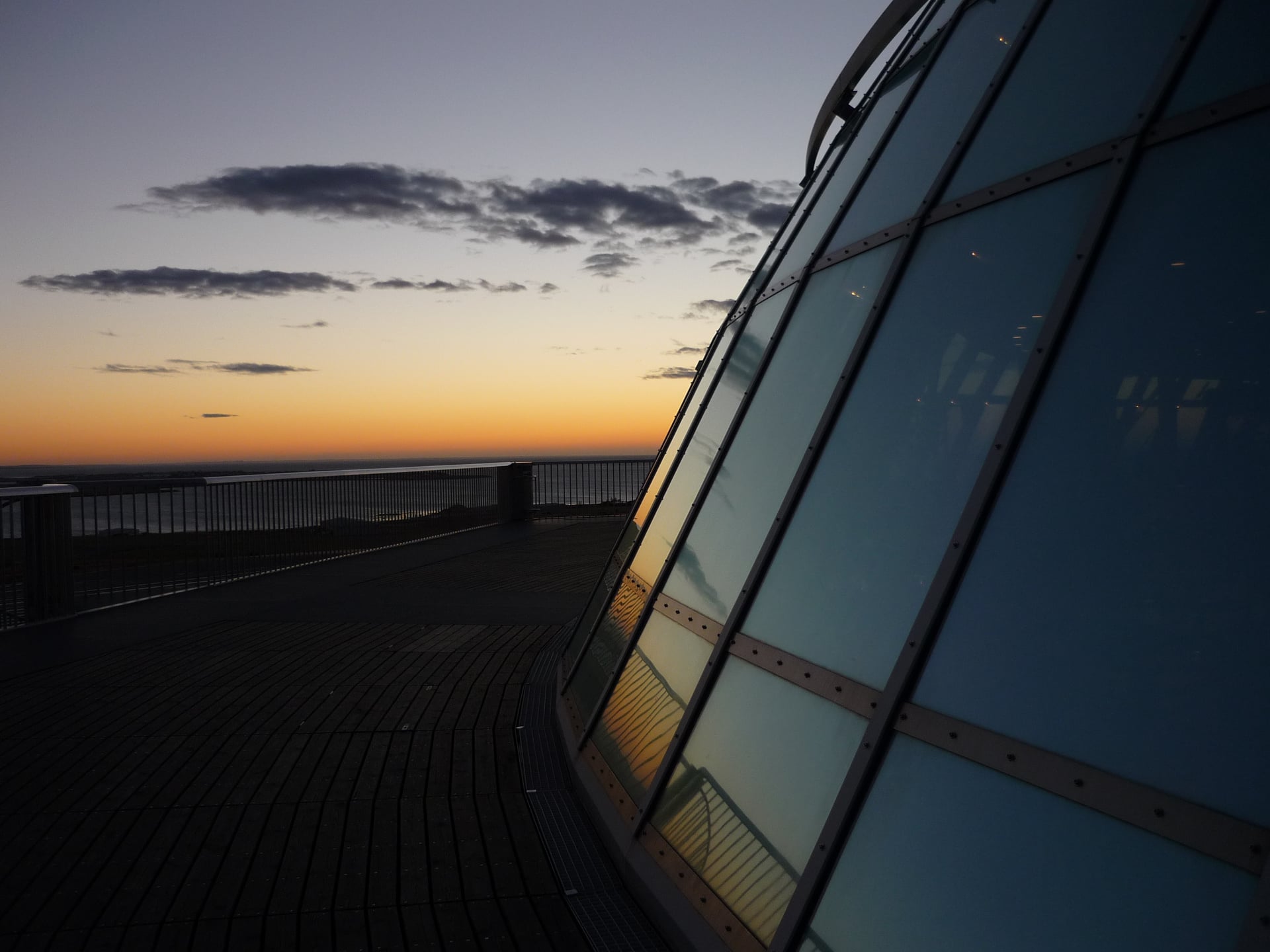
Then there is the view. Visit Reykjavík's own guide to the city's best views calls Perlan one of the most spectacular viewpoints in Reykjavík, with a 360-degree panorama of the city, ocean, and surrounding mountains. That description is fair, but the deeper appeal lies in what kind of city Perlan reveals. From there, Reykjavík does not read as a monumental capital in the continental sense. It reads as a low, weather-shaped settlement between sea, lava, and distant heights. Perlan teaches scale beautifully. It shows how small the city is against the land, and how coherent it becomes when seen from above.
This is one reason Perlan belongs in the same conversation as Hallgrímskirkja and Harpa while still being distinct from both. Hallgrímskirkja gives Reykjavík a vertical spiritual center. Harpa gives it a modern glass face at the harbor. Perlan gives it elevation with explanation. It is the place where panorama and interpretation meet. The city below becomes readable, but so does the wider Icelandic logic around it: heat drawn from underground, weather moving fast, mountain lines holding the horizon, and human settlement adapting rather than dominating.
For tourists, Perlan can be approached in several ways. Some come mainly for the observation deck, some for the museum and ice cave, some for the architecture, some because they want a weather-proof Reykjavík stop that still feels connected to nature. The building supports all of those motives without collapsing into any single one. That versatility is part of its success. Even travelers who think they are only going for a view often leave thinking more deeply about how Iceland works as a lived environment.
Photographically, Perlan is interesting both as object and as perch. The dome itself has a kind of late-twentieth-century optimism that looks especially strong against Reykjavík skies. But the more enduring images are often those taken from Perlan: colored roofs, shoreline curves, distant Esja, weather bands, and the smallness of the capital under a huge northern sky. The building is one of the rare landmarks that rewards looking out more than looking at.
Perlan becomes most useful when it is understood as more than a museum with good views. Travelers often ask whether it is worth the ticket, whether it is mainly for children, whether the view alone justifies a stop, and what makes it special in a city with several landmarks. The fuller answer is that Perlan sits where infrastructure, interpretation, and outlook meet. It helps explain not only what Iceland looks like, but how Iceland has been made habitable.
What stays with many visitors after Perlan is a sharpened sense of relationship: city to hill, warmth to weather, museum to landscape, engineering to imagination. The dome may be what first catches the eye, but the building's real achievement is subtler. Perlan makes Reykjavík's hidden systems visible and turns a practical story about geothermal water into one of the capital's most human and generous landmarks.