Iceland Travel Guides
Rauðisandur: Color, Tide, and the Quiet Width of the Westfjords
A fuller private guide to Rauðisandur, with its shifting shell-colored sands, low-tide walks, seals, seabirds, nearby cultural history, and the reason this Westfjords beach feels unlike anywhere else in Iceland.
GlaciGo Iceland / May 2026 / 10 min read
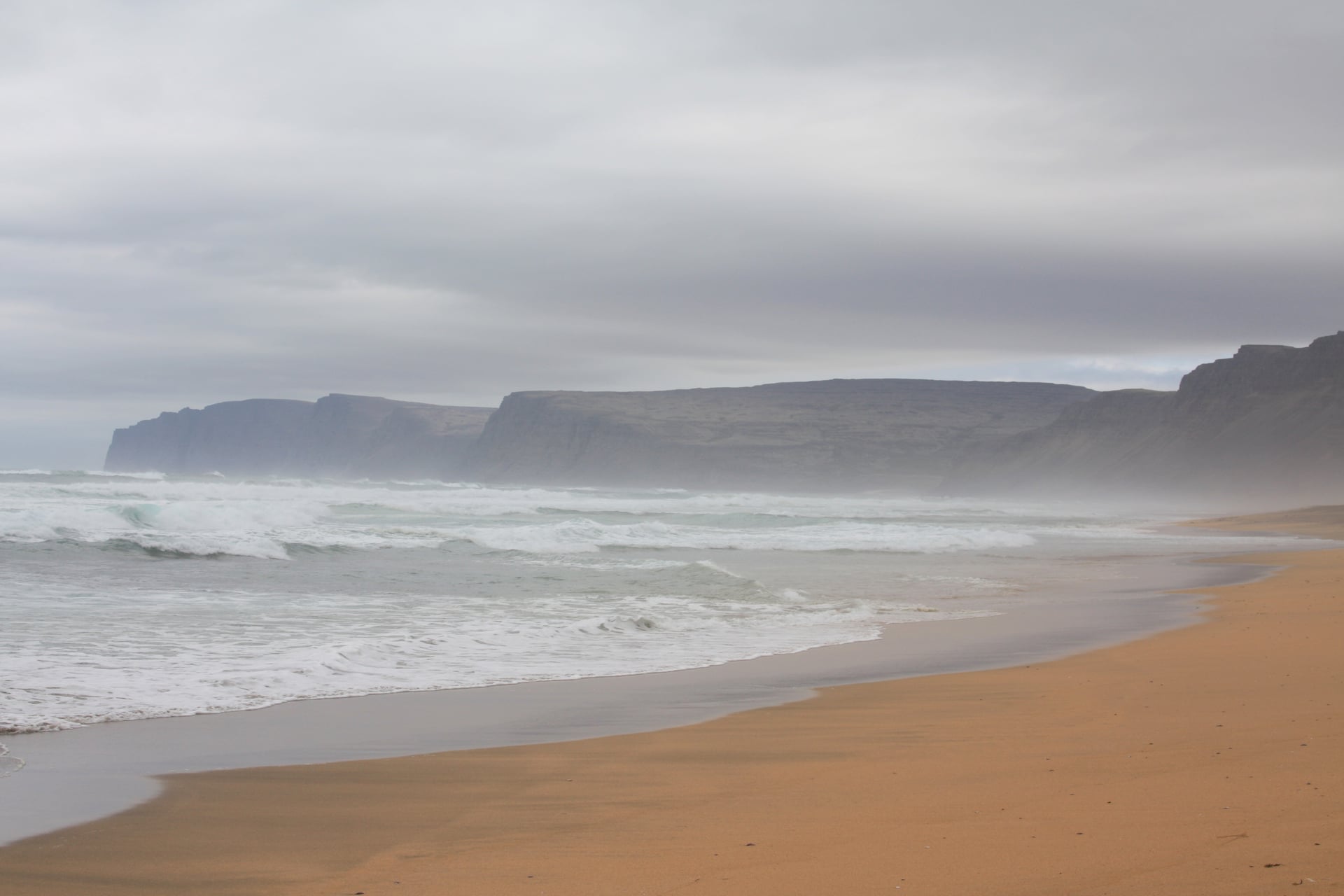
Rauðisandur is one of those Icelandic places that feels almost as if the country momentarily changed its mind about its own visual identity. Most travelers arrive in Iceland expecting black sand, basalt, glacial gray, moss green, and the cold palette of water and sky. Then suddenly, in the remote southern Westfjords, there is this vast shore of red, gold, ochre, pale yellow, and sometimes near-white tones shifting under weather and tide. Rauðisandur does not just look different from other Iceland beaches. It changes the way the Westfjords themselves feel. The region's usual drama of steep roads, cliffs, and fjords gives way here to breadth, softness, and a kind of quiet that is almost disorienting.
Visit Westfjords gives the place a beautifully plain introduction: Rauðasandur is precisely that, a beach with endless red sand. Then it immediately improves the picture by noting that the beach is about ten kilometers long and that the tones shift with the light and weather. That official description is worth holding onto because it tells the truth about what makes the beach special. The color is real, but it is not fixed. Rauðisandur is not one perfectly stable shade of red waiting for your camera. It is a moving scale of tones that changes hour by hour and season by season.
The same official material explains something even more important. Rauðisandur is the biggest pearl in a string of coves whose sands range from white to yellow to red to black, and whose texture ranges from very fine grains to sharp shell fragments. That detail is crucial because it stops the beach from becoming a gimmick in the mind. Rauðisandur is not just unusual pigment spread over ordinary sand. It is a coastal system, textural as well as visual, made legible through variation. The place rewards the body as much as the eye. You notice the beach not only by looking at it, but by how it changes underfoot.
The Icelandic-language Westfjords material adds a geological clue that helps explain the color more precisely. It says the red tone likely comes from shell fragments, especially from scallop shells. This matters because it gives the beach a very different origin story from the volcanic assumptions many visitors bring to Iceland. Rauðisandur's magic is not simply another version of lava meeting sea. It is partly marine accumulation and fragmentation, time working through shells and surf until the shore becomes a painterly surface. That softer, slower origin suits the emotional character of the place.
Tide matters enormously here. The same official Icelandic description recommends visiting at low tide and walking out into the breadth of the sand. That advice is not a small practical tip. It changes the whole scale of the experience. At low tide, Rauðisandur opens. The beach becomes expansive enough to feel almost abstract, and the human figure shrinks into the tones and distance. The place begins to work less like a seaside stop and more like a horizontal landscape meditation. If you come only for a quick look from above or from the edge of higher water, you understand much less of it.
This is one reason Raudisandur benefits from a fuller explanation rather than only a paragraph in a Westfjords itinerary. traveler questions here is very specific. People want to know whether the beach is really red, whether it is worth the drive, what makes it different from Iceland's black beaches, and whether it offers more than a strange photo. The better answer is yes. Raudisandur matters because it is not only a color event. It is one of the Westfjords' clearest lessons in slowness, tide, and perceptual change.
The official Westfjords pages also keep returning to the wildlife dimension, calling the beach a haven for seabirds and seals. That detail helps explain why the place feels so alive even when it seems empty. Rauðisandur is not empty in the dead sense. It is empty in the breathing sense, the kind of emptiness where animal life, weather, and distance remain the real authorities. That is a very Westfjords quality. Human presence is possible and meaningful, but never dominant.
The relationship with nearby Látrabjarg deepens this further. Visit Westfjords' itinerary material pairs the two naturally: first the great bird cliffs, then the immense red beach. That pairing reveals something subtle about this corner of Iceland. Látrabjarg is vertical, noisy with birds, dramatic, and edge-driven. Rauðisandur is horizontal, spacious, tidal, and quiet. Together they form a nearly perfect contrast in the same wider landscape. Travelers who reach both in one day often remember not only the individual places but the emotional swing between them.
There is also a cultural layer at Rauðisandur that should not be ignored just because the beach itself feels elemental. Visit Westfjords' page on Saurbæjarkirkja notes that there has been a house of God in Saurbær since the middle of the sixteenth century, and that the church standing there today has a remarkable history. This matters because it prevents Rauðisandur from being read as pure emptiness untouched by human memory. People have lived, worshipped, and stayed rooted in this landscape for centuries. The beach may feel beyond settlement logic, but it is not beyond history.
Small human details make the place better, not smaller. The Westfjords material mentions the French café and the possibility of sitting with coffee while looking toward Snæfellsjökull on the Snæfellsnes peninsula in good weather. That is a lovely detail because it captures the actual rhythm of a visit. Rauðisandur is not a site to dominate through activity. You walk, stop, look, notice the colors changing, perhaps watch seals or birds, and then you sit with the space a little longer than planned. The place loosens the itinerary in a healthy way.
From a photographic perspective, Rauðisandur is stronger than many famous beaches precisely because its beauty is unstable. It does not always hand over the same image. Light can pull the sand toward gold, copper, rust, pinkish beige, or even muted gray. Weather can make it glowing or austere. Mist can flatten the distance in a way that makes the shore feel almost endless. In clear weather, the line toward Snæfellsjökull sharpens the horizon and adds another plane of scale. This instability means Rauðisandur resists cheap certainty. You cannot fully pre-own the image before arriving.
The drive and remoteness are part of that resistance too. Rauðisandur is not meant to feel easy in the same way as Iceland's heavily trafficked South Coast beaches. In the Westfjords, roads themselves shape the meaning of destinations. The journey asks for commitment, and that commitment changes how arrival feels. A remote beach that takes intention to reach can retain a different emotional density from one that sits minutes from a crowded main road. Rauðisandur still feels found rather than consumed.
That is also why the beach often lingers in memory as a mood rather than a checklist stop. People may remember the color first, but what stays longer is the sense of spacious stillness. The beach does not overwhelm through height or force. It works through subtlety and scale. In a country famous for spectacle, that is one of the rarest things a landscape can offer.
Raudisandur benefits from a fuller explanation because too much writing about it remains trapped in the novelty sentence: Iceland has a red beach. What matters on the ground is a more layered explanation of why the place matters in the Westfjords, how tide and light transform it, what role seals and seabirds play in the atmosphere, and why the area feels so emotionally different from the more familiar black-sand narratives of Iceland travel. The stronger answer is that Raudisandur is not only photogenic. It is one of the country's most quietly transformative coastal landscapes.
What stays with many visitors after Rauðisandur is often the feeling that Iceland briefly became softer without becoming less wild. The shells, the long shore, the seals, the low-tide openness, the changing light, and the distance from the country's busier routes all keep working in memory. Rauðisandur lingers because it proves that remoteness does not always arrive as severity. Sometimes, in the Westfjords, it arrives as color, silence, and a beach wide enough to think on.