Iceland Travel Guides
Reykholt: Snorri, Snorralaug, and Private West Iceland Depth
A fuller private guide to Reykholt in West Iceland, with Snorri Sturluson context, Snorralaug history, church culture, saga memory, and Silver Circle planning.
GlaciGo Iceland / May 2026 / 10 min read
Reykholt is not the kind of Iceland stop that overwhelms people at first glance. It does not arrive like a crashing waterfall or a smoking rift in the ground. Instead, it asks for a slower kind of attention. The village sits quietly in West Iceland, and only after a few minutes does its weight begin to show itself. This was one of the great intellectual and ecclesiastical centers of medieval Iceland, the place most closely linked to Snorri Sturluson, and one of those rare landscapes where literature, hot water, faith, memory, and local life still stand close together.
West Iceland describes Reykholt as one of Iceland's most notable historical sites and identifies it first of all with Snorri Sturluson, who lived there from 1206 to 1241. That is the essential starting point. Snorri was not only a famous name from schoolbooks. He was a chieftain, politician, storyteller, and one of the most important figures in preserving the narrative world that later generations would come to call Norse mythology and saga literature. Walking through Reykholt with that in mind changes the tone immediately. The village stops feeling small and starts feeling consequential.
Snorrastofa's own material deepens that sense of consequence. Their institutional history and exhibition texts present Reykholt as a place where medieval learning, church life, political power, and literary work converged. The Icelandic Literature Center goes even further, calling Reykholt one of the most remarkable historical sites in Iceland and describing Snorrastofa as a center dedicated to medieval culture, local history, and the works of Snorri Sturluson. This matters for travelers because Reykholt is not famous by accident. It became important because thought itself happened here in visible, durable ways.
Snorri's life gives the village its strongest dramatic line. Snorrastofa notes that he moved to Reykholt in 1206, when the location was strategically convenient and centrally placed in terms of transport and influence. From here, he built power networks across Iceland and beyond it. Their biographical material also credits him with some of medieval Iceland's greatest literary achievements, including Snorri's Edda, Heimskringla, and Egil's saga. Even allowing for the normal scholarly caution around attribution, the larger truth remains stable: Reykholt is one of the most important places in the story of how Icelandic literary culture entered world history.
What makes that especially moving for modern visitors is that the place still feels legible. You are not standing at a purely abstract memorial. You can walk between Snorrastofa, the church, the old church, the graveyard, the geothermal pool known as Snorralaug, and the surrounding paths with a clear sense that these are connected pieces of one long cultural landscape. Reykholt is unusually good at making medieval Iceland feel spatial rather than merely textual.
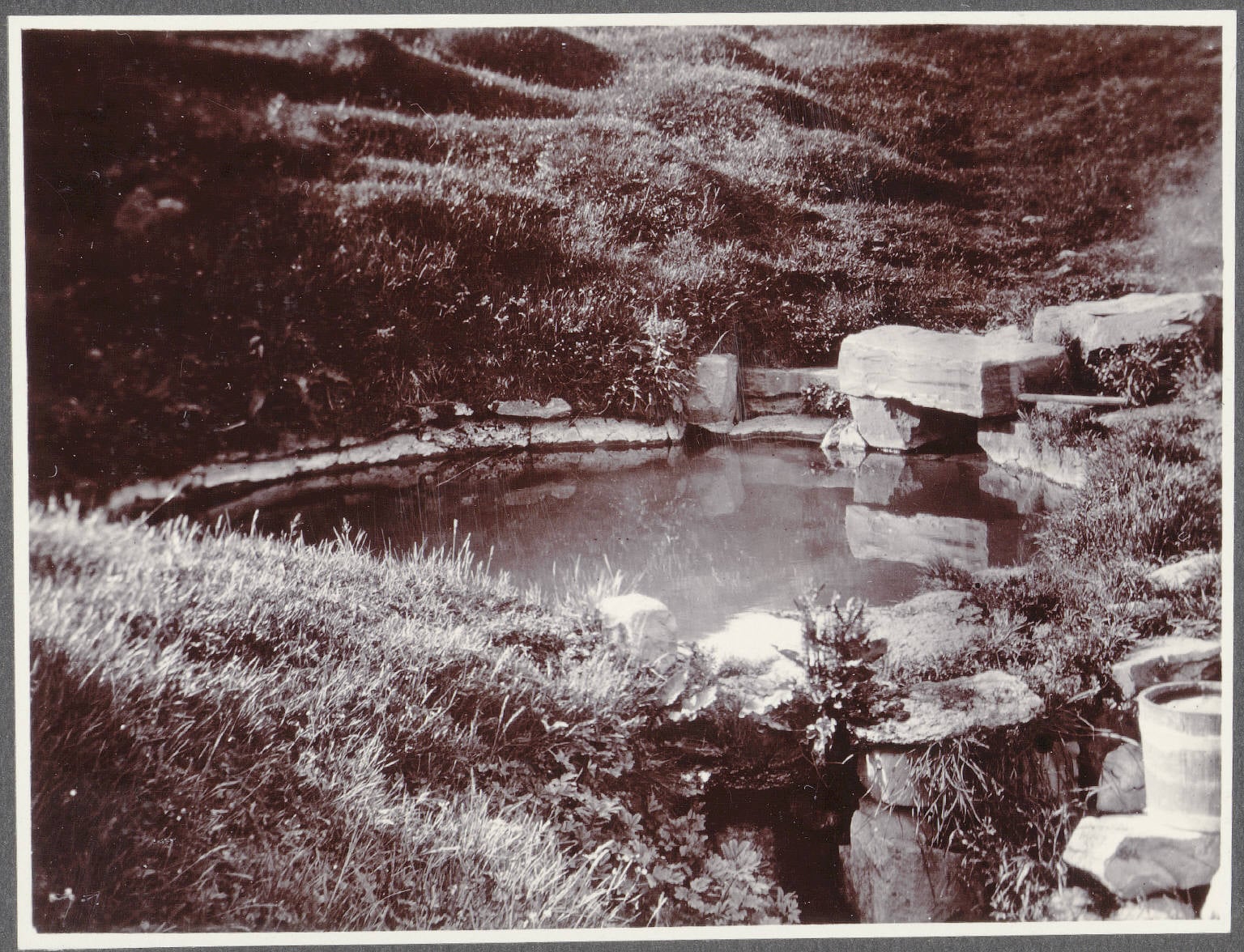
Snorralaug is often the moment when that history becomes physical. West Iceland describes it as an ancient protected pool named after Snorri Sturluson, and the Saga Ring Trail page adds a deeper layer by citing Landnama and noting that a pool existed there as early as 960. The Icelandic Literature Center calls Snorralaug the oldest man-made structure in Iceland that is accessible to visitors, and notes that water from the hot spring Skrifla was channeled into it. That combination of archaeology, geothermal engineering, and literary association is hard to beat. This is not a modern spa borrowing medieval atmosphere for branding. It is a genuinely old bathing place inside a long historical continuum.
West Iceland's Icelandic-language material on Snorralaug adds another haunting detail: part of the underground tunnel structure beside the pool has been preserved and is thought to have led toward Snorri's homestead, perhaps as a protected passage or escape route in his time. Whether a traveler comes for saga history, medieval infrastructure, or simply the eerie intimacy of the site, this is where Reykholt often becomes unforgettable. Hot water, enclosed paths, political tension, and literary memory meet in one compact place.
That tension matters because Snorri's story did not end peacefully. Snorrastofa's biographical account says he was killed at Reykholt in September 1241 after years of political entanglement, conflict, and shifting loyalties tied to both Iceland and Norway. Reykholt therefore carries more than scholarly prestige. It also carries the atmosphere of a power center that became a murder site. For travelers who care about story, that gives the village unusual emotional density. It is not simply where important books are associated with one man. It is where ambition, learning, religion, diplomacy, and violence all touched the same ground.
The church landscape strengthens that feeling of continuity. Snorrastofa notes that churches have stood in Reykholt for centuries. The current church was consecrated on July 28, 1996, and is known for its acoustics, while the older wooden church from 1885 to 1887 survives and is open to visitors as part of the National Museum's historical building collection. The Icelandic Literature Center adds that the burial ground likely contains the remains of Snorri Sturluson. So even if a visitor arrives with literature in mind, Reykholt quickly expands into something larger: a place of worship, burial, scholarship, and music as well as writing.
That musical thread is not incidental. The Literature Center notes that Snorrastofa organizes concerts in Reykholt Church and hosts the annual Reykholt Festival, a classical music festival in late July. This gives the village an unusually elegant modern afterlife. It is not preserved as a dead medieval display. It is still a place where words, sound, and interpretation gather. A private traveler who arrives on an ordinary weekday may not hear a performance, but the knowledge that the church remains an active acoustic and cultural space changes how the site is felt.
Reykholt also works beautifully for travelers who do not want their history only indoors. West Iceland's Saga Ring Trail is a short, easy walk of about 1.64 kilometers with modest elevation, designed to connect visitors to Reykholtsskógur, the churches, Snorralaug, and the educational landscape around the village. That matters because Reykholt is best experienced by moving through it rather than only reading signs. The route gives the place rhythm. You walk a little, stop a little, look, remember, and then connect one layer to the next.
There is also a quieter local truth in Reykholt that makes it more than a monument to Snorri. Geothermal water is still part of the life of the area. The Literature Center notes that water from Skrifla is used not only for Snorralaug but also for the hotel's systems, residential buildings, and greenhouses. West Iceland's broader regional material makes the same cultural point from another angle: geothermal bathing in this district is not a novelty but a longstanding way of living. That gives Reykholt a continuity many historical sites lack. The same heat beneath the ground that shaped the medieval bathing pool still belongs to everyday local reality.
For private travelers in West Iceland, Reykholt is one of the best places to change the pace of a route. Deildartunguhver shows geothermal force at its rawest. Krauma turns that heat into a contemporary bathing ritual. Hraunfossar and Barnafoss show lava and river in motion. Vidgelmir takes you underground. Reykholt does something none of those places can do in the same way: it gives the region a mind. It is the stop that explains why West Iceland is not only scenic, but also intellectually and culturally formative.
That is why Reykholt fits so well in a carefully built Silver Circle day. It can function as an opening note before waterfalls and hot springs, or as a reflective pause after them. Travelers often discover that once they have stood beside Snorralaug, walked past the churches, and entered Snorrastofa, the rest of the district starts to feel less like a string of attractions and more like a living historical geography. The valley begins to read as a place where people did not merely survive but argued, prayed, wrote, governed, remembered, and used the earth's heat with skill.
Reykholt rewards a visitor who can slow down enough to let significance accumulate. It is not about spectacle. It is about presence. A pool fed by hot water, a village tied to one of the great medieval writers of the North, a churchyard carrying deep memory, preserved traces of underground movement, and a modern cultural center still interpreting all of it: these are subtle materials, but together they create one of the richest stops in Iceland. For many thoughtful travelers, Reykholt ends up being the place they continue thinking about long after the bigger sights have blurred together.