Iceland Travel Guides
Reynisfjara: Black Sand, Basalt, and Atlantic Respect
A fuller private guide to Reynisfjara in South Iceland, with black-sand geology, basalt columns, Reynisdrangar folklore, real wave safety, and current coastal change.
GlaciGo Iceland / May 2026 / 10 min read
Reynisfjara is one of the few places in Iceland where beauty and danger are not two separate themes you can discuss politely in different paragraphs. They are the same experience. People come for the black sand, the basalt columns, the sea stacks, the cave, the photographs, and the feeling of standing in a landscape that looks older and rougher than ordinary coastlines. But if the place is described honestly, it must also be said from the beginning: Reynisfjara is powerful in part because the Atlantic is still fully in charge there.
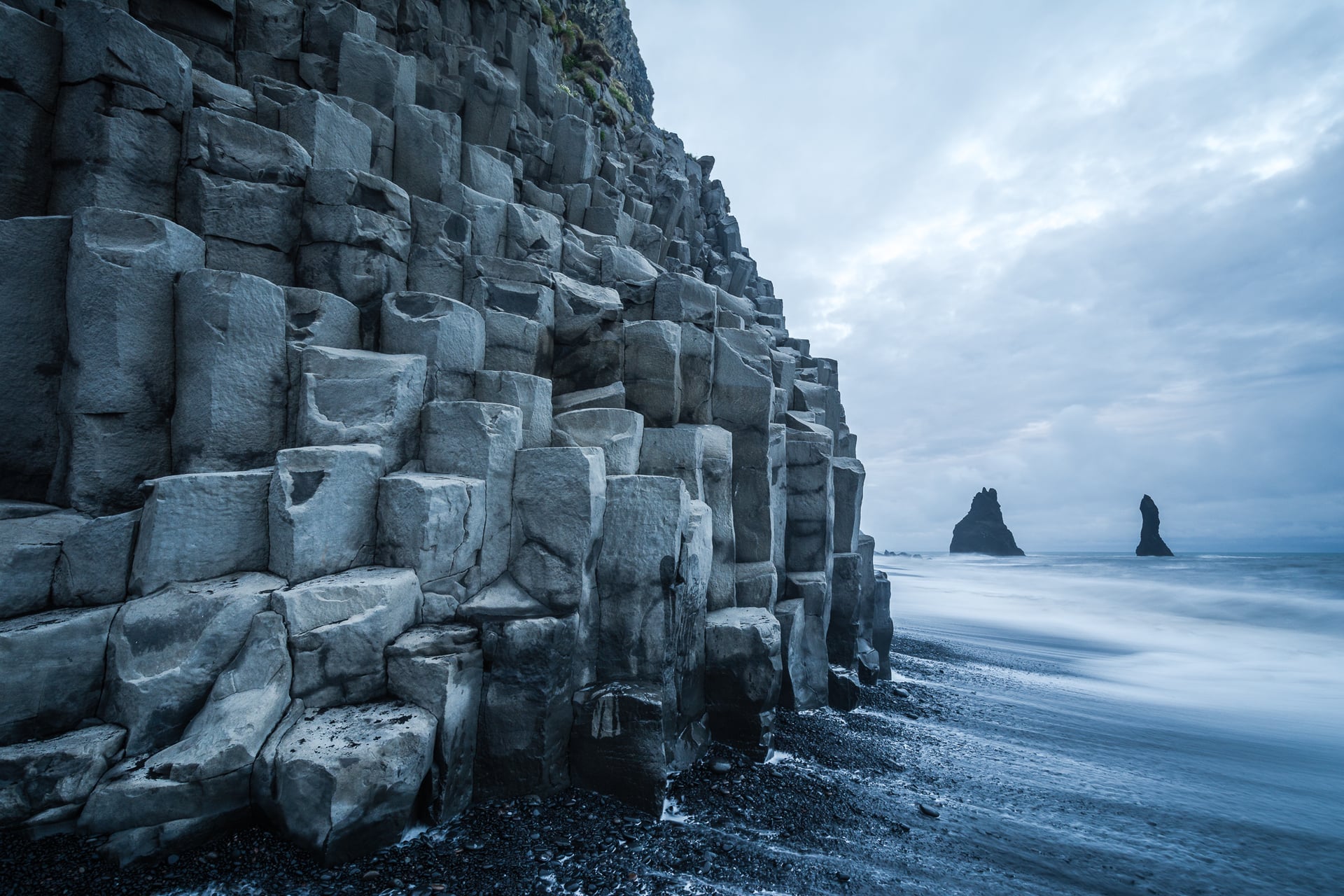
Visit South Iceland’s official overview of Reynisfjara, Reynisfjall, and Reynisdrangar begins with geology. Reynisfjall is described as a 340 meter high tuff mountain formed in a volcanic eruption under a glacier in the penultimate Ice Age, with alternating layers of tuff, pillow lava, and columnar basalt veins and loops. That matters because it explains why the site looks so dramatic even before the sea enters the picture. Reynisfjara is not simply a beach with dark sand. It is the exposed edge of a volcanic and glacial story that runs through the whole district.
The same official source notes that the Reynisdrangar sea stacks rise 66 meters out of the ocean and belong to the same geological formation as Reynisfjall. From the beach, they do not feel like decorative offshore rocks. They feel like the remnants of something larger, as if the coastline has been torn away and those dark needles were the part too stubborn to disappear. That impression is one reason the place photographs so strongly. The stacks give the horizon tension.
Then there is Hálsanefshellir, the cave set among the basalt columns on the south side of the mountain. Visit South Iceland calls it exceedingly beautiful, and that is one of those rare pieces of tourism language that undersells rather than overstates. The cave and the hexagonal columns around it give Reynisfjara a strange architectural quality. The beach is famous for open space, but one of its most memorable moments is actually this encounter with structure: geometric rock, dark interior, surf noise, and the sense that volcanic process has briefly learned to resemble design.
Yet any serious article about Reynisfjara has to hold onto the safety reality with equal force. Visit South Iceland says plainly that the waves here are deceiving and have caused the deaths of a number of visitors in recent years, even in the best of weather. The Katla UNESCO Global Geopark map repeats the same warning almost word for word. That repetition across official sources is meaningful. It tells you the risk is not seasonal rumor or generic caution text. It is one of the defining facts of the site.
This is where Reynisfjara differs from many other dramatic coastlines. The danger is not always loud enough to educate a visitor by instinct. A towering cliff, a falling boulder, or a fenced precipice often explains itself immediately. Reynisfjara can look open and walkable right up to the moment when a sneaker wave proves otherwise. The beach therefore asks for a more mature kind of attention. People who come only for a thrilling photograph often misread what they are standing inside.
Recent official reporting makes that even clearer. Visit South Iceland published an update on February 16, 2026 explaining that Reynisfjara has changed due to a combination of weather conditions, sustained wave energy, and unusually high sea levels over an extended period. The shoreline shifted quickly, large volumes of black sand moved, and parts of the infrastructure required adjustment. That update is important because it reminds readers that Reynisfjara is not a static attraction. It is a dynamic coast still being actively reshaped by the ocean. Even repeat visitors cannot assume the same beach they remember is waiting for them unchanged.
That dynamism is part of what makes the place worth visiting in the first place. Reynisfjara is not a preserved postcard. It is a living Atlantic edge. Storms move sand. Waves redraw the shoreline. Cliffs erode. Platforms need rebuilding. What visitors encounter is always a version of Reynisfjara, not a final edition. Once you understand that, the black beach becomes more interesting, not less. Change stops feeling like damage to a tourist product and starts feeling like the essential truth of the place.
Folklore gives that truth a human voice. Visit South Iceland’s Dyrholaey material preserves the well-known legend that the Reynisdrangar stacks were once trolls trying to drag a three-masted ship ashore before daylight turned them to stone. This story belongs naturally with Reynisfjara because the stacks are among the beach’s strongest visual anchors. It would be easy to use that folklore cheaply, but it deserves better than that. The legend is memorable because the coast already feels animate, resistant, and morally charged. The rocks stand there like figures because the landscape itself encourages that reading.
For private travelers, Reynisfjara works best when it is not isolated from the places around it. Dyrholaey gives the coast from above: bird reserve, sea arch, long structural views. Reynisfjara gives it from below: wave energy, columnar basalt, sea stacks, cave, and risk at eye level. Vik adds the human settlement perspective. Together they form one of the richest coastal chapters in Iceland. Separately, each is strong. Combined, they become legible.
That wider context also helps prevent lazy writing. Too many descriptions of Reynisfjara flatten it into one adjective: dramatic, otherworldly, black, wild. All are true, but none are enough. The beach is geologically precise, visually famous, culturally storied, and physically hazardous. It also belongs to a district shaped by Katla, by glacial and marine processes, and by the daily practicalities of people living on a severe coast. The strongest article is the one that lets all of those dimensions coexist.
Photographically, Reynisfjara almost invites excess. The temptation is to make every frame maximal: black sand, white surf, basalt columns, cave, stacks, moody sky, tiny people, maybe a bird in flight if the universe cooperates. Sometimes that works. But often the best image comes from choosing one governing relationship. Column against sky. Stack against foam. Human figure against basalt wall. Cave mouth against wave light. The beach gives you enough. It does not need to be forced into spectacle.
Season changes Reynisfjara sharply. In quieter light, the beach can feel meditative despite the surf, especially when fewer people are around and the color contrast between basalt, water, and sky sharpens. In stormier or darker conditions, the same beach becomes much harder-edged and more obviously hazardous. The official 2026 shoreline update is a useful reminder that weather is not only atmosphere here. It is active authorship. The coast you see is partly the result of what the Atlantic has been doing recently.
Reynisfjara works best when a guide answers several reader questions at once: what the black sand beach is, why the basalt columns and Reynisdrangar matter, how it relates to Vik and Dyrholaey, and why safety advice is not optional. The strongest visit holds all of those together. It lets the beach remain visually astonishing without softening the fact that the Atlantic here deserves serious distance and respect.
That is why honesty is the most useful tone here. Reynisfjara is not a beach for carefree posing at the waterline. It is not just the place where the sand is black. It is one of Iceland’s great examples of how volcanic form, glacial history, folklore, and raw Atlantic force can occupy one narrow strip of coast at the same time. On the right private South Coast itinerary, Reynisfjara becomes the moment when the shoreline stops being scenic background and becomes a presence you have to respect.