Iceland Travel Guides
Selfoss Waterfall: The Wider, Calmer Face of Jökulsá á Fjöllum
A fuller private guide to Selfoss Waterfall, with its wide horseshoe form, easy approach from the Dettifoss trail, canyon geology, and the reason it deserves more than a passing glance upstream of Dettifoss.
GlaciGo Iceland / May 2026 / 10 min read
Selfoss has the kind of problem many beautiful Icelandic places would gladly accept: it stands too close to Dettifoss. One of Europe's most forceful waterfalls is only a short walk away, and naturally it takes most of the headlines. But that closeness can make travelers underestimate what Selfoss actually offers. Seen on its own terms, Selfoss is not a lesser version of the bigger waterfall downstream. It is a different mood in the same river system, a wider and more distributed expression of the Jökulsá á Fjöllum, where the energy of the canyon becomes legible in shape rather than sheer violence.
Vatnajökull National Park's official trail information explains that the route from the west-side Dettifoss parking area first reaches Selfoss and then continues to Dettifoss, with the first stretch taking roughly ten minutes on foot. That practical detail matters because it affects how the waterfall is experienced. Selfoss often arrives before the traveler's senses are overwhelmed. It becomes an introduction to the river's architecture. You see water spreading across a broad broken edge, dropping in multiple white curtains, with canyon rock and open sky holding the scene together. It is easier to look, easier to understand, and in some ways easier to love slowly.
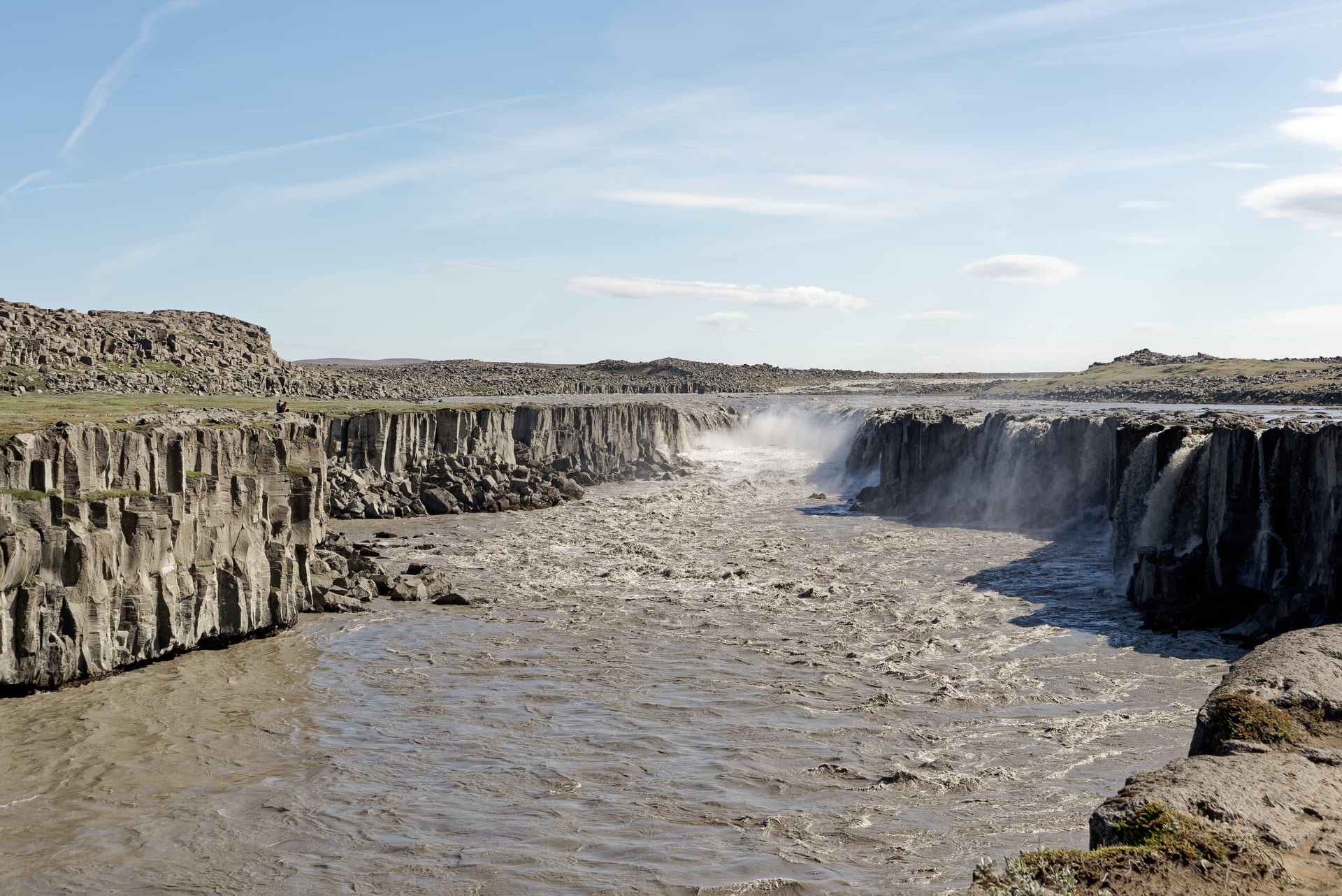
Visit North Iceland describes Selfoss as a horseshoe-shaped waterfall upstream from Dettifoss, around 10 to 11 meters high and roughly 100 meters wide. Those numbers are modest by Icelandic superlative standards, but they tell only part of the story. What makes Selfoss distinctive is not height. It is the way the river seems to loosen and fan out before gathering again farther down. The waterfall reads less like one central blow and more like a long curved sentence written across the canyon rim. That makes it one of the most photogenic and compositionally satisfying waterfall forms in North Iceland.
This difference in form creates a difference in feeling. Dettifoss can feel abrasive, bodily, almost punishing in its force. Selfoss feels more readable. You can still hear the power of the river, but the waterfall invites attention instead of overpowering it. The water breaks into several channels and drops over a semicircular cliff, so the eye moves laterally instead of simply downward. That creates a calmer but not weaker experience. In fact, Selfoss is often the place where travelers begin to understand the river system that Dettifoss later dramatizes.
The wider geological setting matters just as much here as it does downstream. Vatnajökull National Park explains that the waterfalls of Jökulsá á Fjöllum are part of an evolving canyon system, and that waterfalls in Iceland are not permanent in some timeless postcard sense. They erode, retreat, and change over long stretches of time. Selfoss is especially good at making that process visible. Because the drop is wide and segmented, you notice the river not only as spectacle but as a shaping force, testing rock across a larger front. The landscape feels actively made rather than simply inherited.
This is why Selfoss benefits from being explained on its own terms rather than a passing paragraph inside Dettifoss. traveler questions here is often different. People who ask about Selfoss are frequently looking for a more nuanced answer than whether it is just 'worth stopping for on the way to Dettifoss.' They want to know what it looks like, whether it feels different, whether the walk is easy, and whether it offers a better photographic or more contemplative experience. The answer is yes: Selfoss is worth visiting because it provides a clearer, wider, and more structurally elegant reading of the same powerful river.
The walk itself supports that reading. The official trail notes from the national park describe the west-side route as generally easy, while also warning that weather and spray can make surfaces slippery. That combination suits Selfoss well. The approach is not demanding, which means attention is available for the landscape rather than consumed by effort. At the same time, the place remains exposed enough to keep its seriousness. This is still the high-energy river corridor of Jökulsárgljúfur. Ease of access does not make the site tame; it simply makes it legible to more people.
The relationship between Selfoss and Dettifoss is one of the best reasons to spend time at both. Upstream at Selfoss, the river spreads and curves. Downstream at Dettifoss, it contracts into a heavier, darker, more vertical statement. Together they feel almost like two interpretations of the same material. Selfoss says breadth, branching, and shape. Dettifoss says compression, weight, and force. A traveler who walks only to the more famous waterfall misses one half of the river's argument.
Photographically, Selfoss is often more forgiving than Dettifoss. Because the shape is broader and the spray less domineering, it is easier to make an image that holds both water and land in balance. The horseshoe-like line of the falls can carry a frame beautifully, especially when cloud shadows or low light add texture to the rock. But even without camera talk, the place has a strong visual rhythm. Many waterfalls impress because of size. Selfoss impresses because of composition already present in the land itself.
Weather changes the emotional register in a way that feels especially rewarding here. In brighter conditions, Selfoss can look crisp and open, the white water striking against the darker earth with almost graphic clarity. In gray weather, the waterfall becomes moodier and more tonal, and the canyon's edges begin to matter more. Under moving cloud, the scene can feel almost tidal even though it is a river waterfall, because the broad front responds visibly to changes in light. The site stays interesting precisely because its identity is not locked into one dramatic effect.
The river's glacial character matters too. Jökulsá á Fjöllum is not a decorative clear stream but a sediment-bearing, hard-working river shaped by ice, distance, and erosion. At Selfoss, that glacial weight is still visible, but it distributes itself differently than it does at Dettifoss. Instead of one deep blow, it becomes a wider, more diffused movement over the rim. The result is a waterfall that feels geologically honest and emotionally accessible at the same time.
For itinerary planning, Selfoss fits beautifully into a North Iceland day built around the Jökulsárgljúfur side of the Diamond Circle. It complements Dettifoss without duplicating it and often suits travelers who enjoy reading landscapes, not only collecting superlatives. If Goðafoss offers narrative grace and Dettifoss offers raw impact, Selfoss offers shape. That makes it particularly satisfying for people who value sequence and contrast inside a route. The walk between the two waterfalls is short, but the emotional distance between them is meaningful.
There is also something quietly generous about Selfoss for travelers who may not want every major stop to be a spectacle that shouts. Iceland can overwhelm if every destination tries to astonish in the same register. Selfoss broadens the emotional vocabulary of the trip. It shows that a place can be memorable without being maximalist. The waterfall does not dominate your body the way Dettifoss can. It occupies your eye and your sense of form more gently, which is part of why it often lingers.
Selfoss benefits from a fuller explanation because too much online coverage reduces it to a footnote. That misses the intent behind the search. People are not only asking where it is. They are asking whether it is a real destination, whether it differs meaningfully from Dettifoss, and whether it offers its own kind of reward. The better answer is that Selfoss matters precisely because it reveals another face of the same river: wider, more measured, and in some ways more intelligible.
What stays with many visitors after Selfoss is often the curve. Not the violence of one drop, but the way water keeps finding several routes over the edge at once. The river seems to think out loud here. It spreads, hesitates, gathers, and falls. That makes Selfoss one of North Iceland's most satisfying companion waterfalls and one of the best reminders that scale is not the only path to significance.