Iceland Travel Guides
Seljalandsfoss: Behind the Water and Into South Coast Story
A fuller private guide to Seljalandsfoss in South Iceland, with sea-cliff geology, walk-behind experience, Gljufrabui folklore, seasonal safety, and route-planning depth.
GlaciGo Iceland / May 2026 / 10 min read
Seljalandsfoss is one of those places in Iceland that almost everyone thinks they already understand before they arrive. The photograph is famous, the shape is familiar, and the promise sounds simple enough: a waterfall you can walk behind. But the real experience is stranger and better than the shorthand. Seljalandsfoss is not memorable only because it is photogenic. It is memorable because it reverses the normal relationship between person and waterfall. Instead of standing in front and looking up, you move into its spray, circle behind its curtain, and watch the South Coast through moving water.
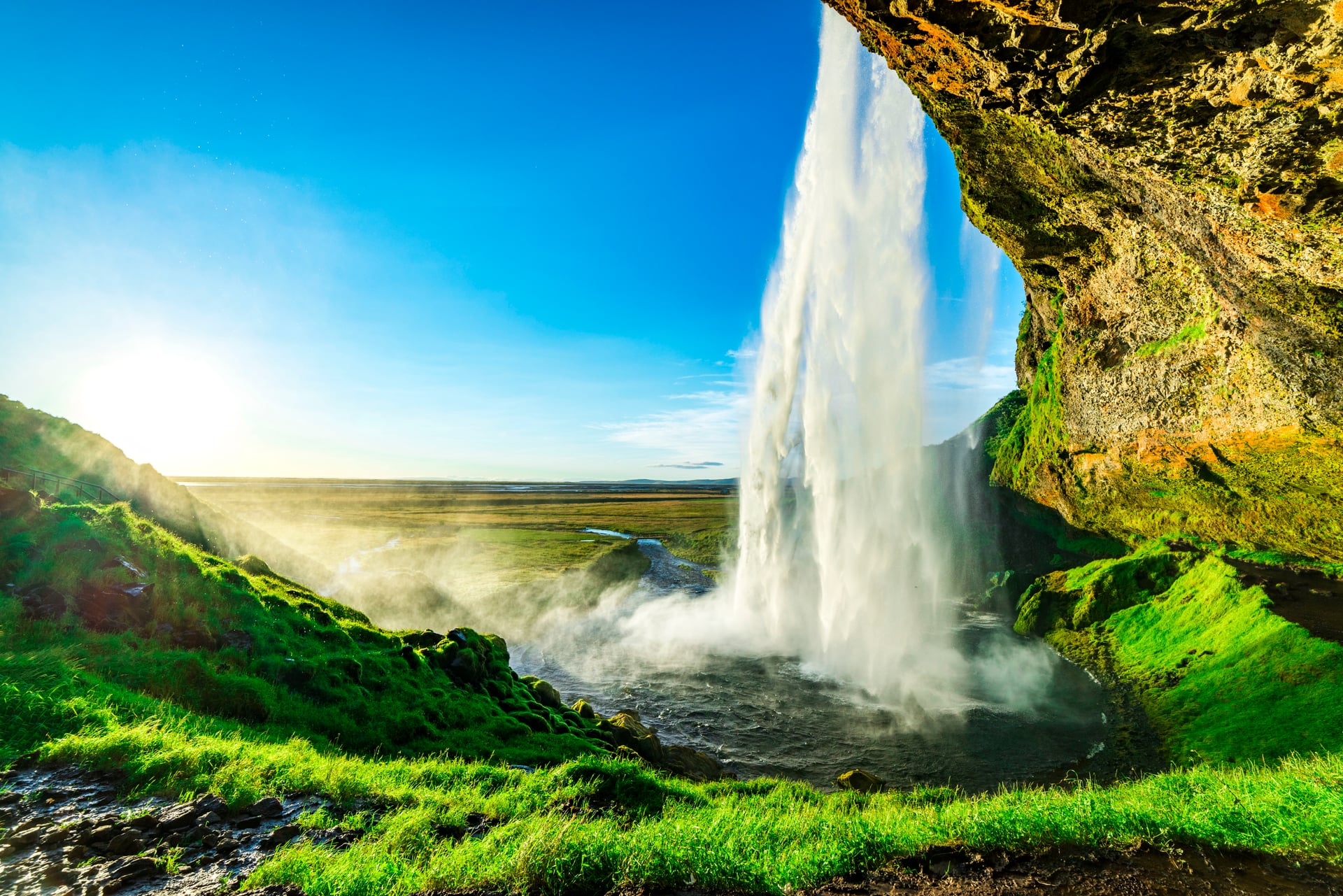
Visit South Iceland describes Seljalandsfoss as a unique waterfall in the river Seljalandsa, about 30 kilometers west of Skogar, roughly 60 meters high, with a footpath behind it at the bottom of the cliff. That factual description is accurate, but it only hints at why the site stays with people. The path behind the falls turns a scenic stop into an embodied experience. You feel the wind shift, the water strike the ground differently on each side, and the whole cliff begin to act less like background and more like architecture.
That cliff is part of the deeper story. The Katla UNESCO Global Geopark guide describes Seljalandsfoss as a waterfall that cascades over ancient sea cliffs. Visit South Iceland's broader geopark material explains that when the sea later retreated, it left behind sheer coastal escarpments now marked by waterfalls such as Seljalandsfoss and Skogafoss. In other words, the site preserves an old shoreline in plain sight. Travelers are not just looking at water dropping from a random edge. They are standing in front of a former coast, a geological memory of when ocean and land sat differently here.
That old shoreline helps explain why Seljalandsfoss feels so cleanly staged. The drop is not buried deep in a canyon or hidden in a forest. It stands forward on a cliff line that already reads like a boundary. The water falls from the old edge of the world, or at least that is how it can feel in the right weather. A lot of Iceland's beauty works through exposure, and Seljalandsfoss is a perfect example of that. Nothing about it is shy.
The setting at the base of Eyjafjallajokull gives the waterfall another layer. Visit South Iceland places Seljalandsfoss at the foot of the Eyjafjallajokull glacier, on the road leading toward Thorsmork. That means the stop belongs not only to a sightseeing route but to a wider South Coast geography shaped by glacier, volcano, floodplain, and mountain pass. Even visitors who never continue toward the interior are still standing in a threshold landscape. The waterfall sits where ordinary road travel begins to sense the wilder country behind it.
This is part of why Seljalandsfoss works so well for private travelers. It can be a brief stop on a classic South Coast day, but it can also be used as an opening chapter that teaches the eye how to read the whole region. Water from the high ice comes down over an old sea cliff. The cliff itself is a relic of changing coastlines. The neighboring roads point toward volcanic backcountry. All of South Iceland's major themes are quietly present before you have driven much farther.
People often talk about Seljalandsfoss as if the main point is to get the famous photo from behind the curtain. There is nothing wrong with that image; it has earned its reputation. But the more interesting truth is that walking behind the falls changes your pace. You cannot move there casually. The ground is wet, the rock can be slick, the wind can suddenly push mist into your face, and every few steps the view rearranges itself. The experience demands a little humility, which is part of its charm. Iceland is full of places that look manageable until the weather reminds you otherwise.
That is why the safety guidance matters and should be taken seriously, not treated as standard tourist boilerplate. Visit South Iceland states clearly that winter conditions can make the area dangerous, especially because the paths become slippery and large pieces of ice can fall from the cliffs and from the ceiling of the path behind the waterfall. This is one of those rare attractions where the dramatic experience and the safety warning are directly related. The very mist that makes the place beautiful can also freeze, thaw, and turn hazardous. A good private itinerary respects that reality rather than trying to force the same experience in every season.
Summer, shoulder season, and winter all change the personality of Seljalandsfoss. In a greener season, the waterfall can feel almost theatrical: bright slopes, wet grass, light behind the stream, and a sense of movement in every direction. In colder months, the mood becomes harsher and more sculptural. Ice builds, paths may close, and the waterfall can look less like an invitation and more like a warning. Neither version is better in the abstract. They are simply different readings of the same place.
A fuller understanding of Seljalandsfoss also means not stopping at Seljalandsfoss alone. Visit South Iceland points travelers westward toward the nearby waterfall Gljufrabui, and this short walk is one of the great little pairings on the South Coast. If Seljalandsfoss is open, frontal, and world-famous, Gljufrabui is intimate, hidden, and slightly secretive. The South Iceland description of Gljufrabui says it falls 40 meters into a deep chasm and is partly concealed by palagonite rock so that only the upper part is visible from outside. That alone gives the neighboring stop a completely different emotional register.
The folklore around Gljufrabui adds something especially worth carrying back into the Seljalandsfoss experience. South Iceland notes that people once believed the blocking boulder and surrounding cliffs were homes of huldafolk, the hidden people. The same source also mentions a small cave called Ompuhellir, named after a hermit woman said to have lived there. Whether a modern traveler takes these traditions literally is not really the point. What matters is that the surrounding landscape was historically read as inhabited, storied, and morally charged. Waterfalls here were not only scenery. They were places with presence.
That old way of seeing helps Seljalandsfoss feel less overexposed, even though it is one of Iceland's most photographed sites. The famous waterfall and the hidden canyon next door belong to the same cliff system, but one became a global image while the other kept more of its local mystique. Together they create a stronger narrative than either one alone. You move from spectacle to concealment, from wide exposure to chasm, from easy recognition to folklore.
There is also geology under that contrast. The Natural History Institute of Iceland describes Seljalandsfoss and Gljufrabui as waterfalls on the western slopes of Eyjafjoll where ancient sea cliffs, palagonite, glacial deposits, and lava all contribute to the visible layering. Their description notes that the lava above dates back about 3,500 years, while the palagonite belongs to the last glacial period. That kind of timescale can sound abstract on paper, but at the site it becomes tactile. You are looking at a cliff assembled over radically different phases of Icelandic history, then cut again by water into two very different kinds of waterfall experience.
For photographers, Seljalandsfoss asks for restraint and timing more than gimmicks. The obvious shot behind the falls works because it is genuinely good, but the place rewards slower observation too: a figure moving through mist, the silhouette of the cliff edge, the opening toward the lowlands, or the way evening light can turn the falling water almost translucent. In poor light or heavy crowds, the site can tempt people into rushing. The best images usually come when you accept the weather and let the place set the terms.
For private touring, Seljalandsfoss is strongest when treated as more than a checkbox between Reykjavik and Vik. Pair it with Gljufrabui and you already have a more layered stop. Pair it with Eyjafjallajokull context, a thoughtful guide, and perhaps a wider South Coast day toward Skogar or Thorsmork, and the waterfall starts to function as an introduction to how this region works. Sea cliffs, glacial water, volcanoes, stories of hidden beings, weather risk, and beauty intense enough to become iconic all meet here within a very short walk.
That is the real reason Seljalandsfoss survives its own fame. It is not just beautiful in a generic sense. It gives travelers a rare chance to move through a landscape instead of merely facing it. You go behind the water, feel the cliff, look back out across the open country, and understand that this celebrated stop is also an old coast, a volcanic district, and the doorway to a more mythic South Iceland. For a visitor willing to slow down, Seljalandsfoss is not the easy famous waterfall. It is the moment when the South Coast starts to feel fully alive.