Iceland Travel Guides
Seljavallalaug: The Old Pool That Still Belongs to the Valley
A fuller private guide to Seljavallalaug, with its 1922 to 1923 history, valley walk, swimming-school past, Eyjafjallajokull ash memory, and rough mountain-pool charm.
GlaciGo Iceland / May 2026 / 10 min read
Seljavallalaug is one of those Icelandic places that people often misunderstand before they reach it. The name gets grouped too quickly with hot springs, luxury lagoons, and dramatic bathing stops, as if it were simply another geothermal reward waiting at the end of a short walk. But Seljavallalaug is better, and stranger, when approached more honestly. It is an old outdoor pool set in a narrow green valley under Eyjafjoll, worn by weather, tied to local memory, and shaped by effort rather than polish. You do not go there for perfection. You go because it still feels like a human idea placed carefully inside a mountain landscape.
The basic facts already point in that direction. A widely cited local account from nearby Eyvindarholt explains that Seljavallalaug was built from 1922 to 1923 and was, at the time, the biggest swimming pool in Iceland. It also notes that half of the pool was built into the mountain, with warm geothermal water flowing from the hillside into the pool. Those details matter because they keep the place from being romanticized into something timeless and natural in the wrong sense. Seljavallalaug is old, but it is not ancient. It is man-made, but not modern. It sits in that very Icelandic middle ground where necessity, landscape, and modest ambition met each other well.
The same local source gives the social history that makes the site feel alive. In earlier decades, it says, Seljavallalaug was the only warm swimming pool in the area, and many young people came there in spring to learn how to swim. They stayed in tents with their teachers for days at a time. That image changes everything. Suddenly the pool is not just a photogenic basin in the hills. It becomes part of a local education story, a rural community resource, and a reminder of how serious swimming has long been in Icelandic life. In a country where swimming literacy matters, Seljavallalaug once served not as a novelty, but as infrastructure.
That educational and communal past is one of the reasons the pool still feels different from Iceland's better-known bathing destinations. Blue Lagoon is designed. Sky Lagoon is curated. Secret Lagoon is historic but still clearly run as a contemporary experience. Seljavallalaug is rougher and older in its mood. It holds on to the feeling of something that began as practical, became beloved, and then simply remained. The walls are there. The valley is there. The changing room is there. The mountain water is still doing its quiet work. The place was never really converted into spectacle, and that is part of its charm.
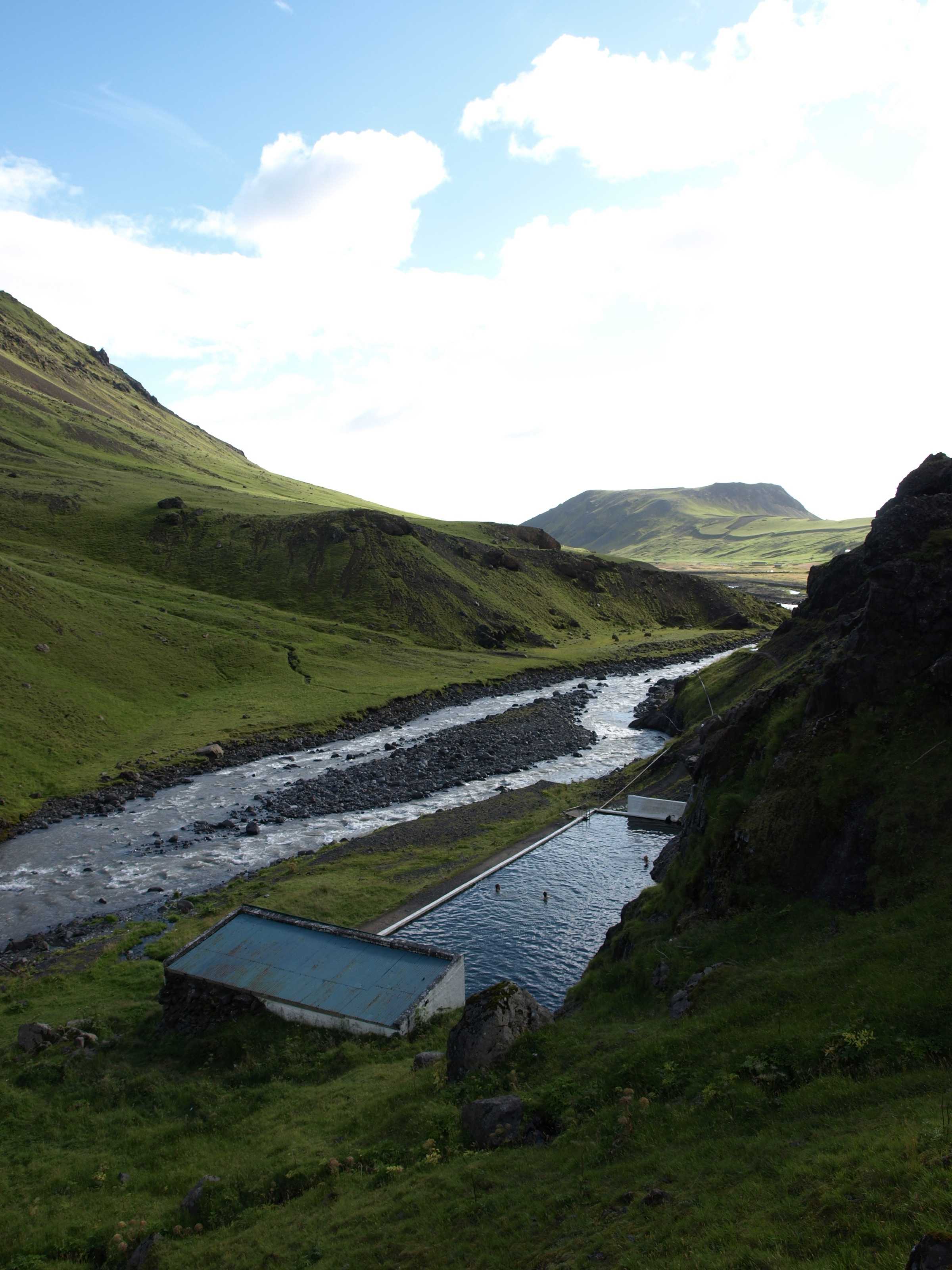
Its setting does at least half the work. Eyvindarholt's description places the pool beneath the famous glacier and volcano Eyjafjallajokull in a small valley by a beautiful river, surrounded by high mountains and striking rock formations. That is exactly the right scale for understanding it. Seljavallalaug does not sit out in a broad open field where it can be consumed as a simple roadside attraction. It is tucked in. The walk in matters. The enclosing mountains matter. The way the valley narrows your attention before you arrive matters. The pool feels discovered, even though many people know about it now.
This is why the approach should stay inside the article. Eyvindarholt gives the practical version clearly: you park near Seljavellir and walk about 1.2 kilometers one way, usually taking 30 to 40 minutes. The route is not epic, but it is long enough to shape expectation. By the time visitors reach the pool, they have already left the ordinary road system behind. That transition helps Seljavallalaug feel less like a service and more like an arrival. Even a modest walk can change the emotional quality of bathing, and here it absolutely does.
The weathered condition of the place is part of its truth and should not be written around too carefully. Seljavallalaug is loved partly because it still feels exposed to the same forces as the valley itself. It has no illusion of spa-level finish. It can feel cold at the edges, algae may be visible, the changing area is basic, and the pool's appeal depends heavily on your tolerance for roughness. But for many travelers, that roughness is exactly why it works. The pool has not been separated from the mountain world to make visitors comfortable. It still belongs to that world.
There is also an important layer of recent volcanic memory here. The Commons record for one of the best-known photographs of the pool identifies it as Seljavallalaug filled with ash from the 2010 eruption of Eyjafjallajokull. That is a useful, concrete reminder that even a place as intimate as this sits inside a larger volcanic region that still changes. Seljavallalaug is not just old and atmospheric. It is vulnerable. Ash reached it. Volunteers later cleaned it. The pool's present-day charm therefore includes resilience. It survived not because it was protected from the landscape, but because people cared enough to restore it after the landscape asserted itself again.
That connection to Eyjafjallajokull gives the pool more depth than most short summaries allow. It is easy to write about Seljavallalaug as if it were hidden and peaceful outside history. In reality, it lies under one of Iceland's most globally famous volcanoes and carries visible memory of that relationship. The valley feels quiet, yes, but not sealed off. Water, ash, and weather have all left marks here. The calm is real, but it is not sterile.
Photographically, Seljavallalaug is almost always stronger when treated as part of the valley rather than as an isolated architectural object. The obvious image is the rectangular pool with the mountain wall behind it, and that image deserves its fame. But the most persuasive photographs usually preserve surrounding slope, river valley, cloud, and texture. They let the pool feel small against the terrain that cradles it. That scale relationship is the whole point. If the frame becomes too tight, Seljavallalaug can look like a quirky concrete basin. If the valley stays in the image, it becomes what it really is: a human intervention that never quite stopped being humble.
It also matters that Seljavallalaug is not primarily a place of heat. Many travelers come expecting hot-spring intensity and are confused when the experience turns out gentler, cooler, and more dependent on season and conditions. The better framing is that this is a warm old mountain pool, not a thermal performance. Its value lies more in setting, history, and atmosphere than in sheer bathing comfort. Once understood that way, disappointment tends to disappear. You stop measuring the place against luxury lagoons and start reading it on its own terms.
That self-respecting simplicity is why Seljavallalaug works so well in a broader South Coast route. After waterfalls, black beaches, glaciers, and volcanic viewpoints, the pool changes the rhythm. It narrows the scale. It asks for a walk, a pause, and a quieter kind of attention. You do not stand there to absorb spectacle from a distance. You enter a valley, approach a structure, and decide whether to inhabit it for a while. That small shift in posture is one reason the stop stays in memory.
Seljavallalaug benefits from careful explanation because traveler questions around it is consistently confused and layered. People want to know whether it is natural or man-made, whether it is one of the oldest pools in Iceland, how far the walk is, whether it is really warm, what happened after the Eyjafjallajokull eruption, and whether it is still worth visiting despite its rough condition. The strongest way to understand it is yes, if you understand what you are visiting. Seljavallalaug is not a pristine spa. It is a mountain pool with history, character, and just enough stubborn imperfection to feel real.
What stays with many visitors after Seljavallalaug is not usually the swim alone. It is the whole composition: the walk in, the narrow valley, the old concrete against green slope, the sense of local youth once learning to swim here, the thought of ash filling the pool in 2010, and the strange dignity of a place that has never tried to become more polished than it should be. Seljavallalaug lingers because it feels like Iceland before packaging, and yet still fully present in the Iceland people travel to find.