Iceland Travel Guides
Seltún: Color, Steam, and the Unfinished Earth of Reykjanes
A fuller private guide to Seltún, with geothermal geology, mineral colors, Krýsuvík history, nearby Kleifarvatn, and the human scale of Reykjanes.
GlaciGo Iceland / May 2026 / 10 min read
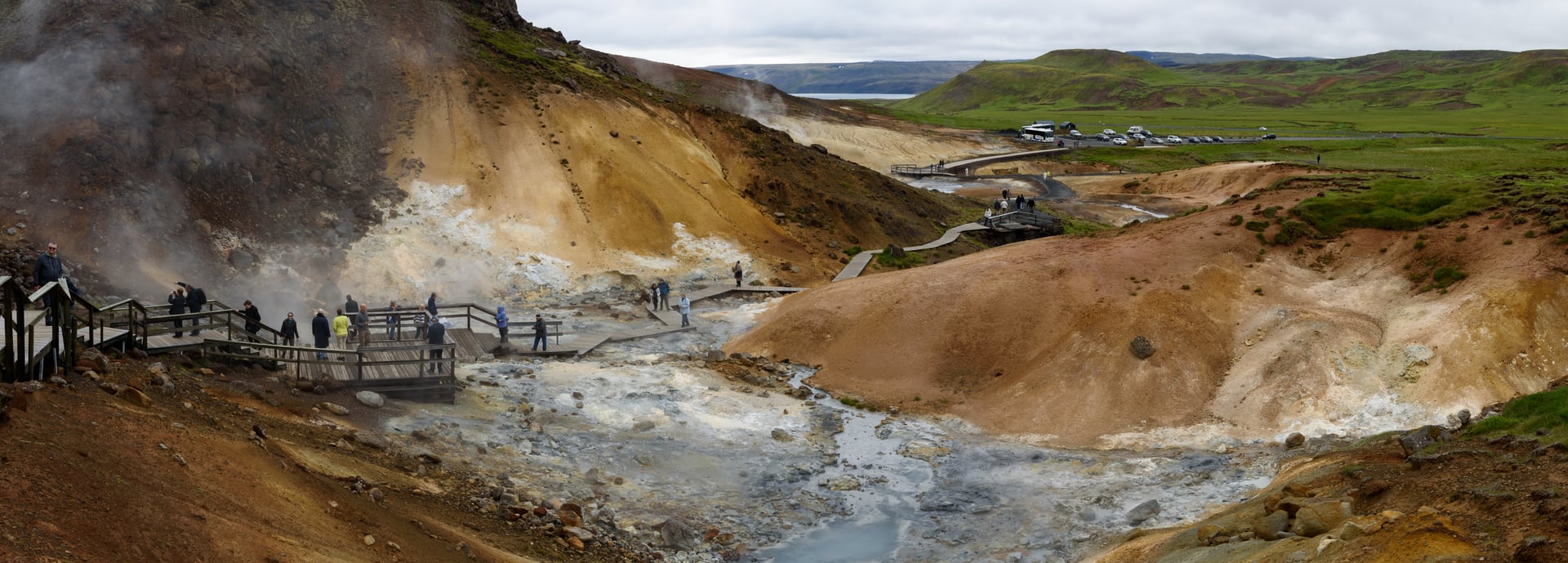
Seltun is one of those Icelandic places that rearranges your sense of what color can do in a landscape. Many travelers arrive expecting steam and sulphur and leave remembering ochre, rust, pale green, ash-grey, white crust, and mud that seems to breathe. The geothermal field sits in the Krysuvik area on the Reykjanes Peninsula, and the official Visit Reykjanes description is wonderfully direct: this is an important high-temperature geothermal area with mud pots, fumaroles, colorful sediments, and a boardwalk that lets visitors move through it safely. That plain description is accurate, but it does not quite capture the emotional effect. Seltun feels less like a scenic stop and more like a place where the earth is still mid-sentence.
The first thing worth understanding is that Seltun is not an isolated curiosity. It belongs to the wider Seltun-Krysuvik geothermal field and to the larger volcanic logic of Reykjanes UNESCO Global Geopark, where the Mid-Atlantic Ridge comes ashore above sea level. Visit Reykjanes presents the peninsula as one of the only places on earth where that ridge is visible on land, and Seltun is one of the most legible expressions of the idea. Here, geothermal heat is not buried in abstraction. It hisses, stains, vents, and reshapes the ground in front of you.
A good Seltun article should slow down at this point, because the place rewards attention more than speed. Official local material emphasizes the variety of features: mud pools, solfataras, fumaroles, mineral deposits, walking paths, parking, and the practical boardwalk through the hottest area. That list matters because Seltun is not a single spectacle with one correct angle. It is a compact field of ongoing processes. The mud does not simply bubble for effect. Steam does not drift upward as atmosphere alone. Minerals are not decorative. Everything visible here is evidence of underground heat moving water and gas through volcanic ground.
Visit Reykjanes' history piece on Seltun adds a helpful geological frame. It notes that the area includes basalt, post-glacial lava fields, pillow-lava ridges, and breccias, all of them signs of repeated volcanic activity. It also states that the most recent eruption in the Seltun area took place in the thirteenth century. That detail matters because it gives the landscape a time scale larger than the boardwalk beneath your feet. Seltun looks immediate, but it is also archival. The colors that feel almost painterly are records of long chemical and thermal interaction.
Those colors are one of the reasons Seltun stays in people's memory. Visit Reykjanes describes the ground as streaked with white, silvery-grey, brown, red, orange, yellow, and even blue, an unusually broad palette for one small stop. In person, the effect is less tidy than a brochure makes it sound. The hill slopes look bruised and bright at the same time. Mud pools plop in slow rhythms. Sulphur hangs in the air. In rain, the place becomes darker and more metallic. In sun, the colors sharpen and almost seem improbable. It is one of the rare Icelandic landscapes where the eye has to work as hard as the lungs.
Seltun also gains depth from what surrounds it. A few minutes away stands Krysuvik Church, a small nineteenth-century church that Visit Reykjanes dates to 1857. The same source notes that it ceased serving as a parish church in 1929, that the old estate was once large and prosperous, and that the building is now protected by the National Museum. The contrast between church and geothermal field is part of what makes this corner of Reykjanes so satisfying. You can stand among steaming mud and raw mineral deposits, then move south toward a modest wooden church and the traces of a former farm. The region does not separate geological drama from human scale. It holds them close together.
That closeness is one reason Seltun works so well for travelers who want more than checklist tourism. If you treat it only as a quick photo stop on the road between Reykjavik, Grindavik, and the Blue Lagoon orbit, you will get the obvious experience and miss the richer one. The richer one comes from reading the Krysuvik area as a cluster: the geothermal field, the old church, the former estate landscape, nearby crater lakes, and Lake Kleifarvatn stretched darkly between ridges. Visit Reykjanes describes Kleifarvatn as the largest lake on the peninsula, about 10 square kilometers, around 97 meters deep, and one of the deepest lakes in Iceland. It also notes that after the earthquakes around the year 2000, fissures likely opened in the lake bottom and the water level dropped. Suddenly the whole neighborhood starts to feel interconnected. Seltun is not just hot ground. It is part of a peninsula where earth movement still changes visible reality.
Kleifarvatn contributes something else as well: atmosphere and folklore. The official lake page mentions a local story that a monster shaped like a worm or serpent, as large as a medium-sized whale, lives in the water. That kind of tale belongs naturally in an Icelandic travel article when it is handled with a light touch. No serious visitor has to believe in the creature to appreciate what the story says about the place. It suggests that the landscape around Seltun has long felt slightly too alive to be reduced to explanation alone. Steam fields, deep lake water, earthquake fissures, dark ridges, and isolated farm history create exactly the kind of environment where stories cling.
There is also a useful tourism history layer here. Visit Reykjanes calls Seltun a must-see on the peninsula, but its 29 April 2024 history article also points out that it still receives less footfall than places such as Geysir. That is a meaningful distinction. Seltun is not undiscovered, especially after the recent volcanic attention focused on Reykjanes as a whole, but it can still feel more intimate and less scripted than many headline attractions in South Iceland. For private touring, that matters enormously. A place like this is strongest when you can pause at one fumarole longer than expected, walk the boardwalk without being hurried, and give the landscape time to become legible.
Safety, though, is part of respecting that intimacy. The same Visit Reykjanes history article warns that steam can erupt from the ground violently and with little or no warning, and that visitors should never stray into closed or restricted areas. This should not be treated as generic boilerplate. At Seltun, safety advice is part of the geology lesson. The boardwalk exists because the ground is active, unstable, and in places dangerously hot. The best way to experience the area is not to seek proximity beyond the marked path, but to understand that the designated route already brings you as close as you need to be.
Photographically, Seltun asks for a different approach from waterfalls or black-sand beaches. The strongest images often come from texture, contrast, and scale rather than heroic grandeur. A single vent framed against mineral-streaked ground can say more than a wide shot. So can the line of the boardwalk disappearing into steam, or a composition that holds the sulfur-bright foreground against darker mountains behind. On overcast days, the palette becomes subtler and sometimes better. On sunny days, the place can verge on the surreal. Either way, Seltun rewards patience and restraint more than frantic coverage.
There is a deeper human reason many travelers remember Seltun. Iceland often gets described through purity: pure water, pure light, pure ice, pure remoteness. Seltun interrupts that language in a helpful way. It is messy, chemical, pungent, stained, noisy in small volcanic sounds, and visually unstable. It reminds visitors that Iceland is not beautiful only when it is clean and serene. It is also beautiful when it is active, sulfurous, and unresolved. That makes Seltun one of the most educational geothermal stops in the country, especially for travelers who want to feel the peninsula as a working volcanic system rather than a postcard backdrop.
From an itinerary perspective, Seltun works especially well as part of a Reykjanes day that values contrast. It can pair with Krysuvik Church for history, Kleifarvatn for mood and open space, or coastal sites farther west for a more ocean-facing volcanic narrative. Because it sits relatively close to Reykjavik, it also offers something many South Iceland icons cannot: a serious geological encounter without a punishing drive. That makes it useful on arrival or departure days, on private Reykjanes loops, and on custom routes where guests want something more elemental than urban sightseeing but less crowded than the most famous national stops.
What stays with most people after Seltun is not one singular image but a collection of sensations. Warm earth beneath a cold sky. Mud moving in thick breaths. Sulphur in the air. Yellow and red mineral stains where you expected black lava. A small church not far away. A deep lake holding monster stories and earthquake memory. In other words, Seltun does exactly what a strong Iceland destination should do: it turns geology into experience, and experience into something you keep thinking about later.