Iceland Travel Guides
Seyðisfjörður: Arrival by Fjord, Art by Necessity, and a Town of Weather
A fuller private guide to Seyðisfjörður, with its blue church, rainbow street, ferry-port identity, art scene, wooden houses, 2020 landslide memory, and the reason this Eastfjords town feels far deeper than its most photographed view.
GlaciGo Iceland / May 2026 / 10 min read
Seyðisfjörður is one of the Icelandic towns that people often think they already know before arriving. They have seen the rainbow-painted street, the blue church, the steep mountains closing around the fjord, and perhaps a foggy photograph that made the whole place look like a Nordic film set. But the town becomes more interesting the moment you stop treating it as an image and start treating it as a port, a lived community, and a place with repeated contact across the sea. Seyðisfjörður is beautiful, certainly, but its deeper character comes from the way art, weather, wooden houses, maritime arrival, and vulnerability to the surrounding landscape all remain visible at once.
The town's own community material describes Seyðisfjörður as a place of singing waterfalls and peculiar characters, rich in history and booming with creativity. That phrasing is unusually apt. Seyðisfjörður does not feel grand in the civic way Akureyri does, nor quiet in the farm-and-fjord way some East Iceland settlements do. It feels a little more exposed, a little more artistic, and a little more self-conscious in the best sense. The town sits at the innermost point of a long fjord, and the mountains around it make arrival feel like entering a narrow chamber where weather, culture, and local memory intensify rather than disperse.
One useful historical anchor is that Seyðisfjörður was established as a town in 1906, but its atmosphere depends on more than a civic founding date. The harbor has long mattered, and it still does. Visit Austurland notes that the international ferry Norræna docks in Seyðisfjörður, and that fact gives the town a special position in Icelandic imagination. Seyðisfjörður is one of the rare places in Iceland where Europe can feel physically close, not abstractly connected. People do not only fly in and drive through. Some arrive by sea, carrying with them the older feeling that this fjord is a threshold between island life and the wider North Atlantic world.
That maritime openness helps explain why the town's artistic culture feels so natural rather than imported as branding. Seyðisfjörður has long been known across Iceland for music, visual art, festivals, and creative communities. Even the basic official guidance for visitors emphasizes the thriving art scene alongside the old wooden houses and the surrounding nature. A traveler walking through town feels that mixture immediately. The buildings are intimate in scale, often colorful, and the streets invite wandering rather than rushing. It is not hard to understand why artists, musicians, and small cultural institutions would find the place attractive. The landscape isolates the town, but the harbor has always complicated that isolation.
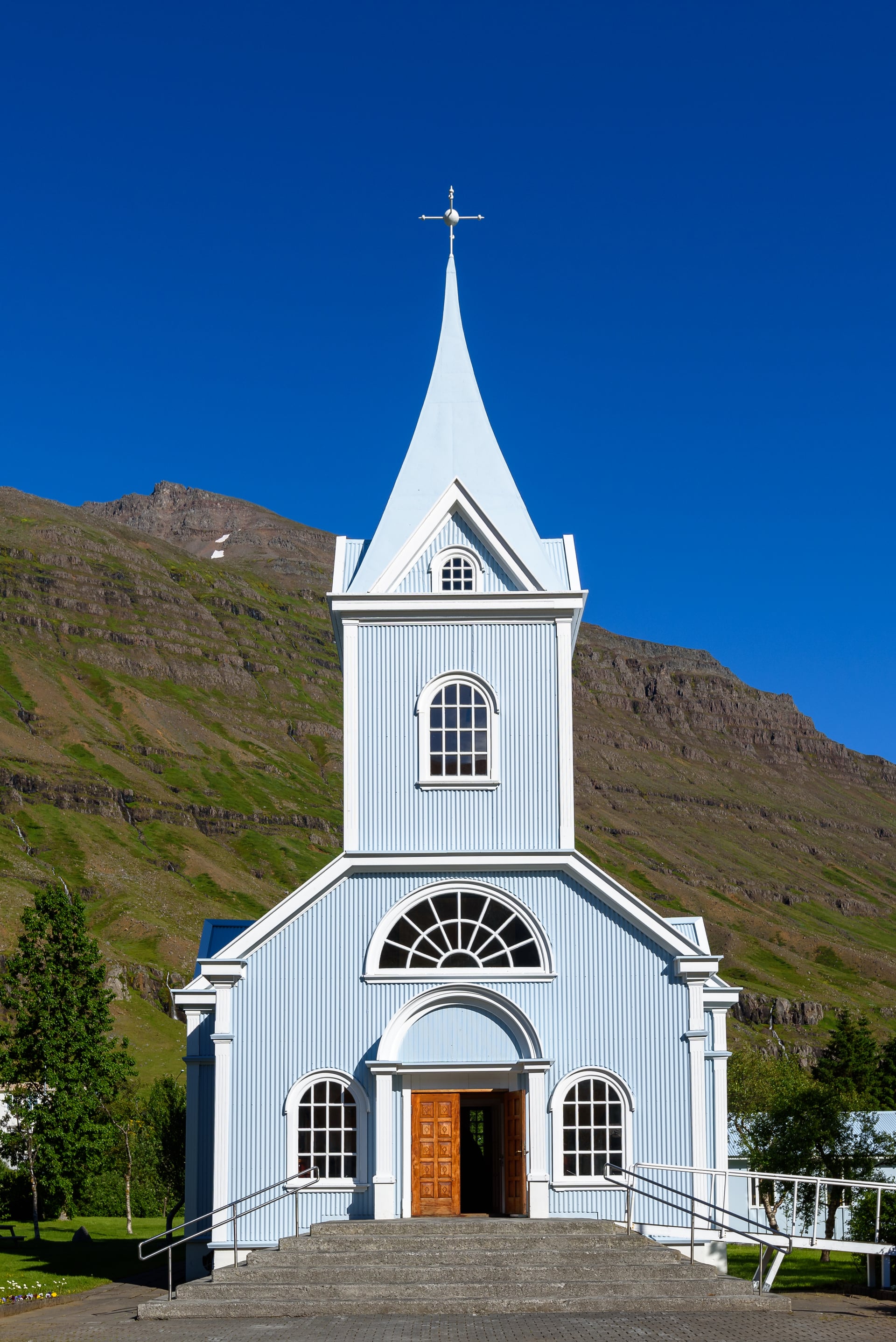
The Blue Church, Seyðisfjarðarkirkja, is the most recognizable architectural symbol of the town, but it becomes more interesting once its own history is allowed into the article. Visit Austurland explains that the church originally stood at Dvergasteinn farm, was moved in 1882 to Vestdalseyri, then stood on a hill until a huge storm blew it over in 1894. It was rebuilt, stood down on the peninsula, and was finally moved again in 1920 to its present location in the heart of Seyðisfjörður. In 1989 it suffered fire damage during renovation work, and the organ installed just two years earlier was lost. What many tourists now meet as a neat, photogenic landmark is therefore a building with a history of movement, damage, rebuilding, and persistence. That feels very Seyðisfjörður somehow: lovely, yes, but never untouched by weather and circumstance.
The rainbow street leading to the church is now one of the town's most widely circulated images, and it deserves mention without being allowed to trivialize the place. The community guidelines explicitly call Rainbow Street iconic, and it is. But it works best when understood as a contemporary gesture of public feeling rather than as the whole meaning of the town. The painted street creates a playful and welcoming approach to the church, yet around it stand houses where people actually live. The same community material reminds visitors to respect private homes and gardens and not turn daily life into a backdrop. That reminder matters. Seyðisfjörður is one of those towns where charm and privacy live very close together.
The Technical Museum of East Iceland adds another necessary layer. Visit Austurland describes its exhibition Búðareyri – stories of transformation as telling the history of the part of Seyðisfjörður that was hit by the major landslide of December 2020. The museum also features an outdoor exhibition on working women around 1900 and their economic contributions during a period of social change. This is exactly the kind of institution that prevents a town article from becoming shallow. It ties Seyðisfjörður not only to aesthetics but to labor, technology, gendered work, and local resilience. It also ensures that the story of the 2020 disaster is remembered as part of the town's continuing life, not merely as a passing news event.
That landslide belongs in the article with care. The official community guidance states that on December 18, 2020, the largest landslide ever to hit a town in Iceland destroyed 13 buildings after days of heavy rain, though miraculously there were no casualties. This is not a detail to sensationalize. It matters because Seyðisfjörður is one of the clearest places in Iceland where scenic beauty and physical vulnerability stand side by side. Waterfalls spill down the mountains. Fog enters easily. The fjord is beautiful. But the slopes above are not just scenery. They are active participants in the town's history. Understanding that makes the place feel more real and, in a deeper sense, more admirable.
Nature around Seyðisfjörður is unusually close even by Icelandic standards. The community guidance points to waterfalls with walking trails, to Vestdalur and Vestdalseyri as protected areas with cultural heritage and distinctive vegetation, and to Tvísöngur sound sculpture on the mountainside above town. Visit Austurland also highlights Bjólfur and the avalanche-barrier hike for broad views over the fjord. These are not side attractions tacked onto a town visit. They are part of the town's internal logic. In Seyðisfjörður, mountains are never background for long. They shape movement, sightlines, weather, and even public memory.
For tourists, this means the best experience of Seyðisfjörður is rarely purely urban or purely natural. You walk the small central streets, notice the harbor, pass houses painted in strong colors, perhaps stop at an art center or café, then look up and remember that waterfalls and steep slopes are only minutes away. Very few Icelandic towns have this kind of immediate vertical drama combined with such a self-aware cultural scene. That is why Seyðisfjörður often becomes a favorite even for travelers who arrived expecting only a short scenic detour from Egilsstaðir.
It also matters that the road over Fjarðarheiði has historically made arrival feel earned. Even when conditions are good, the drive over the pass creates a transition. You leave the inland hub of Egilsstaðir, climb into a higher, often mistier zone, and then descend into this narrow fjord town that feels improbably sheltered and cosmopolitan at the same time. The geography stages the town well. Seyðisfjörður does not merely appear. It announces itself through approach.
Sey?isfj?r?ur can be approached through several doors: the rainbow street, the Blue Church, the ferry, the art scene, or the search for an atmospheric Eastfjords town to stay in. None of those angles is wrong, but each is incomplete on its own. The fuller answer is that Sey?isfj?r?ur combines maritime openness, wooden-house intimacy, creative life, and a very visible relationship to the surrounding mountains.
What stays with many visitors after Seyðisfjörður is often not one single landmark but a complicated mood: the church at the end of the painted street, the harbor sense of arrival and departure, the small-town scale, the waterfalls and fog, the knowledge of the 2020 landslide, and the feeling that art here is not decorative but adaptive. Seyðisfjörður lingers because it feels at once fragile and self-possessed, remote and connected, theatrical and completely lived-in. That tension is what makes it more than just one of Iceland's prettiest towns.