Iceland Travel Guides
Sigöldugljúfur: Soft Water, Hard Edges, and the Fragility of the Highlands
A fuller private guide to Sigöldugljúfur, with its many waterfalls, Highland setting, rising popularity, official safety concerns, and the fragile beauty behind the canyon's dreamlike appeal.
GlaciGo Iceland / May 2026 / 10 min read
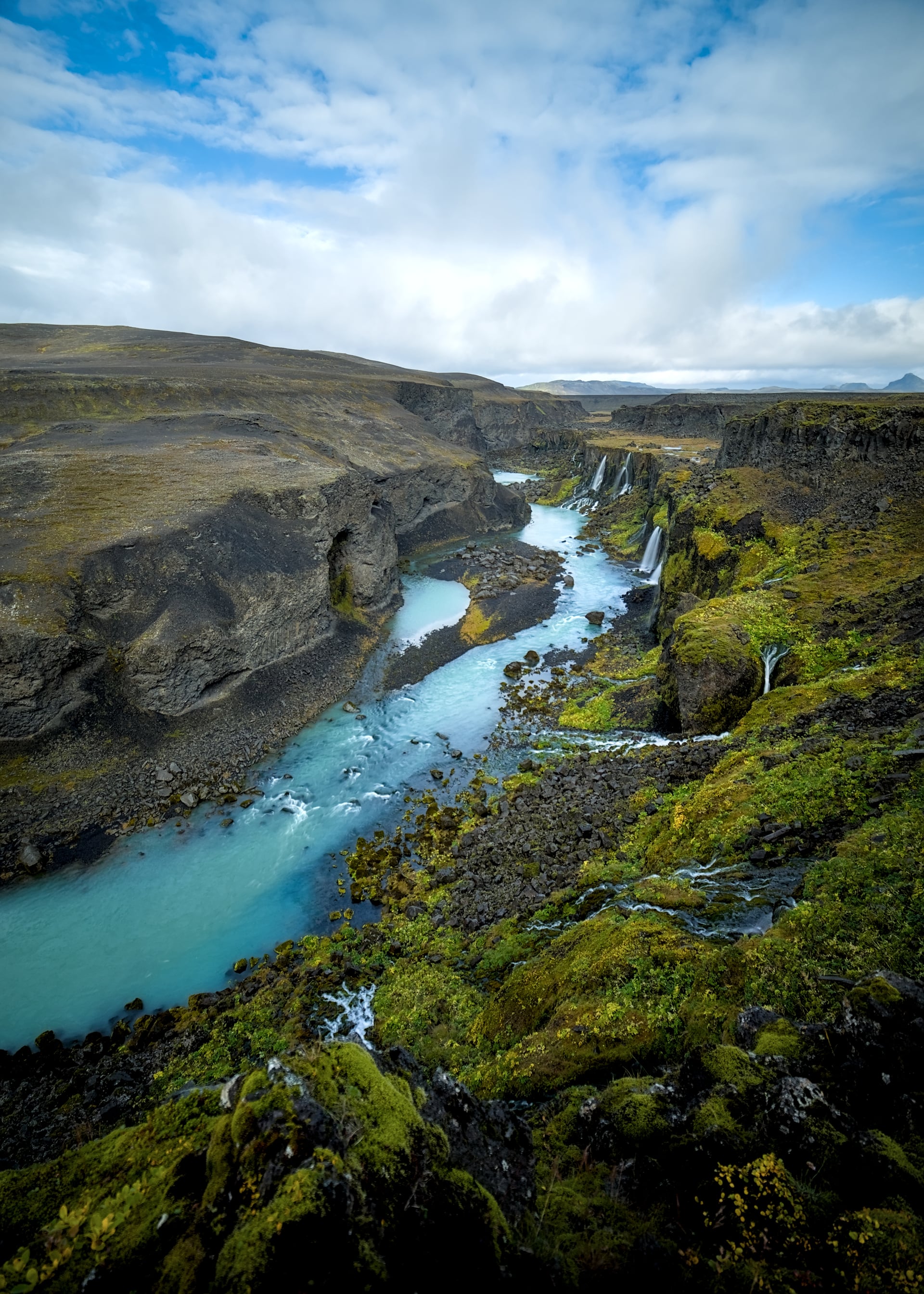
Sigöldugljúfur is one of those Icelandic places that can look almost suspiciously beautiful at first, as if someone had designed a canyon to satisfy every landscape instinct at once. Moss-covered walls, a blue-green river, dozens of narrow waterfalls dropping from the cliffs, and a Highland setting that already feels slightly improbable by normal travel standards. It is easy to see why people gave it a nickname dramatic enough to spread quickly. But Sigöldugljúfur becomes more interesting when you stop treating it as a viral image and start reading it as a real Highland place shaped by water, infrastructure, fragility, and sudden popularity.
The official South Iceland destination planning material is unusually valuable here, because it says out loud what many softer travel summaries leave unsaid: safety at Sigöldugljúfur has been seriously lacking even as the canyon has grown much more popular in recent years. The 2024 to 2025 appendix to the regional destination plan identifies the site specifically, gives its location, and lists the core management goals as improved safety, nature protection, and education. That is a strong clue for how the article should be written. Sigöldugljúfur is not just beautiful. It is a place where beauty arrived faster than infrastructure.
That management perspective matters because the canyon's attraction is inseparable from its vulnerability. The very features that make Sigöldugljúfur feel magical also make it delicate: steep edges, wet ground, multiple small falls, unstable viewpoints, and a Highland environment where visitor pressure concentrates quickly once a place becomes famous online. The destination plan's concern with basic protection and safer access is not bureaucratic background. It is part of the present-day truth of the site.
The visual identity of Sigöldugljúfur is distinctive enough that it would stand out almost anywhere in Iceland. Unlike basalt-heavy canyons where rock geometry dominates, this place is remembered first for the sheer number of thin waterfalls spilling into one narrow green corridor. The effect can feel almost excessive in the best way, as though the canyon were not holding one main spectacle but many small griefs of water at once. That multiplicity is exactly why the nickname Valley of Tears spread so easily. Yet even if one avoids that phrase, the core experience remains the same: this is a canyon defined by repeated descent rather than one single dramatic drop.
The Highlands setting sharpens the effect. Sigöldugljúfur does not sit in an easy lowland picnic zone where waterfalls happen to be nearby. It belongs to the interior travel logic that already asks for intention, weather-awareness, and a tolerance for gravel, distance, and changing conditions. The canyon therefore feels more surprising when it appears. In a rougher upland world of open roads and exposed ground, this sudden concentration of green walls and falling water can feel almost secretive.
That contrast is one reason Sigöldugljúfur works so powerfully in memory. The route toward it teaches austerity first. Then the canyon arrives with softness, color, and sound. Good Icelandic travel often turns on these changes in register, and Sigöldugljúfur does so unusually well. You do not merely find another beautiful place. You experience a reversal inside the Highlands themselves: from broad and stark to enclosed and lush.
There is also an important modern layer behind the landscape. Widely repeated local travel writing notes that the geography of the area changed significantly after hydropower development in the wider region, and official planning sources confirm that the canyon now sits within an actively managed visitor landscape rather than untouched oblivion. This should not be simplified into a morality tale too quickly. What matters for the visitor is that Sigöldugljúfur today is both natural and managed, both remote and recently popular, both fragile and very much present inside current debates about access and protection in Iceland.
That makes the canyon a useful symbol for a newer phase of Iceland travel. Earlier generations often discovered places through local knowledge, maps, and gradual circulation. Sigöldugljúfur became famous in an era when beauty can spread globally almost overnight. The site now has to carry the consequences of that fame. In practical terms, that means visitors should understand that the place needs more than admiration. It needs restraint. Standing too close to edges, trampling soft ground, or treating the area like a content set instead of a vulnerable Highland canyon is exactly the kind of behavior the official management response is trying to correct.
Photographically, the place is almost impossibly generous. Wide frames work because the repetition of the waterfalls creates rhythm. Vertical compositions work because the cliffs themselves are part of the story. Closer studies of water threading through moss can also succeed if the larger structure has already been understood. But the best photographs usually preserve a little distance and humility. Sigöldugljúfur becomes weaker when it is forced into a single heroic frame. It is stronger when the eye is allowed to wander from one falling ribbon to the next.
Weather matters here in its own particular way. In bright sun, the canyon can look almost unreal in color, as if the greens and blues have been oversaturated by design. In softer light, it becomes more melancholy and coherent, with the repeated waterfalls emerging gently from the walls. Mist and drizzle may actually improve the mood for some visitors, because they make the canyon feel more internal and less performative. Sigöldugljúfur is not only picturesque. It is atmospheric, and the difference matters.
Compared with Fjaðrárgljúfur, Sigöldugljúfur feels less geological in the overtly educational sense and more immediately sensory. Fjaðrárgljúfur teaches erosion and time through form. Sigöldugljúfur teaches mood through repetition and contrast. Compared with Eldgjá, it is smaller in scale but more concentrated in visual softness. Compared with the open Highland expanses around Landmannalaugar routes, it feels almost improbably intimate. Those differences help explain why the canyon occupies such a strong niche in memory despite not being the largest or most historically famous place in the interior.
The stronger way to experience Sigöldugljúfur is therefore not as a trophy stop but as a pause in perception. Let the road and the Highlands do their preliminary work. Then let the canyon narrow the day back down. Listen to the many separate falls. Notice how the river holds color differently from surrounding streams. Watch how the cliffs gather moisture. Look at the edge before you look at the phone screen. The place gives back more when it is treated less like a surprise reveal and more like a fragile conversation.
Sigoldugljufur benefits from careful explanation because traveler questions around it is confused in exactly the ways that matter. People want to know whether it is really worth the detour, how difficult access is, why it became so famous, whether it is safe, and what makes it different from Iceland's other canyons. The strongest way to understand it is that Sigoldugljufur is a Highland canyon of unusual visual tenderness, but one that now has to be approached with more care than its dreamy appearance suggests.
What stays with many visitors after Sigöldugljúfur is not only the number of waterfalls. It is the feeling that the Highlands briefly opened a softer face without becoming less wild. The canyon lingers because it holds beauty and unease together: lovely enough to feel unreal, vulnerable enough to need protection, and remote enough that reaching it still changes the day around it. That combination is exactly what makes Sigöldugljúfur memorable, and exactly why it deserves to be written about carefully.