Iceland Travel Guides
Skaftafell: Shelter, Ice, and Human Scale in Vatnajokull
A fuller private guide to Skaftafell, with farm history, sheltered climate, glacier rivers, hiking culture, and the human side of Vatnajokull National Park.
GlaciGo Iceland / May 2026 / 10 min read
Skaftafell is one of those places in Iceland that can be described lazily and still sound impressive: a beautiful area in Vatnajokull National Park, full of trails, glaciers, waterfalls, and big views. None of that is wrong. It is just smaller than the truth. Skaftafell matters because it feels like a rare human-scale opening inside an overwhelmingly glacial world. It is where forest, farm history, river violence, mountain routes, and visitor life all meet at the foot of immense ice. If many South Coast stops feel like dramatic episodes, Skaftafell feels more like a whole landscape you can actually live inside for a while.
The official page from Vatnajokull National Park starts in exactly the right register. Part of the area around Skaftafell was declared a national park in 1967, and since 2008 it has been part of the larger Vatnajokull National Park. The park describes natural beauty, favorable weather conditions, and a selection of hiking trails as key reasons people come here. That phrase about weather is more important than it first sounds. Skaftafell is not only scenic. It is also comparatively hospitable, and that hospitality is one reason it has carried human meaning for so long.
The national park explains that the climate in Skaftafell is extremely hospitable and often much better there, in the shelter of the Oraefajokull glacier, than in neighboring areas. That creates one of the strangest and most beautiful tensions in southeast Iceland. You are standing in the shadow of one of the most powerful glacial-volcanic systems in the country, and yet the local ground can feel protected, even gentle. Birch woodland survives here. Rowan grows among the birch. Ground cover is rich. Baejarstadarskogur holds taller birch than most places in Iceland. The result is a landscape that feels less like pure exposure and more like a high-latitude refuge carved out at the edge of ice.
That sheltered quality helps explain why Skaftafell should not be reduced to a launch point for Svartifoss or glacier walks. It has its own internal character. Visit South Iceland highlights the easy trails to Svartifoss and Skaftafellsjokull, then points to longer outings toward Morsardalur and Kristinartindar, and to the route beginning at Haalda for those heading toward Hvannadalshnukur, Iceland's highest peak. What matters is not only that there are many hikes, but that the trail system reveals several versions of Iceland in one relatively compact area: forest, moraines, outwash, ridges, ice tongues, waterfalls, and high mountain perspectives.
The human history underneath that recreational surface is unusually moving. Vatnajokull National Park notes that Skaftafell was a manor farm and a local assembly site in the Middle Ages. The estate once stretched from the sea up to the middle of Vatnajokull. Over time, however, the increasing encroachment of the Skeidara river destroyed arable land on the plain, and in the middle of the nineteenth century the farmers of Skaftafell moved their houses and farmland up to the slopes. This is the kind of fact that changes how you walk through the place. The beautiful lower ground was not simply admired; it was lost, or at least made unreliable, by water.
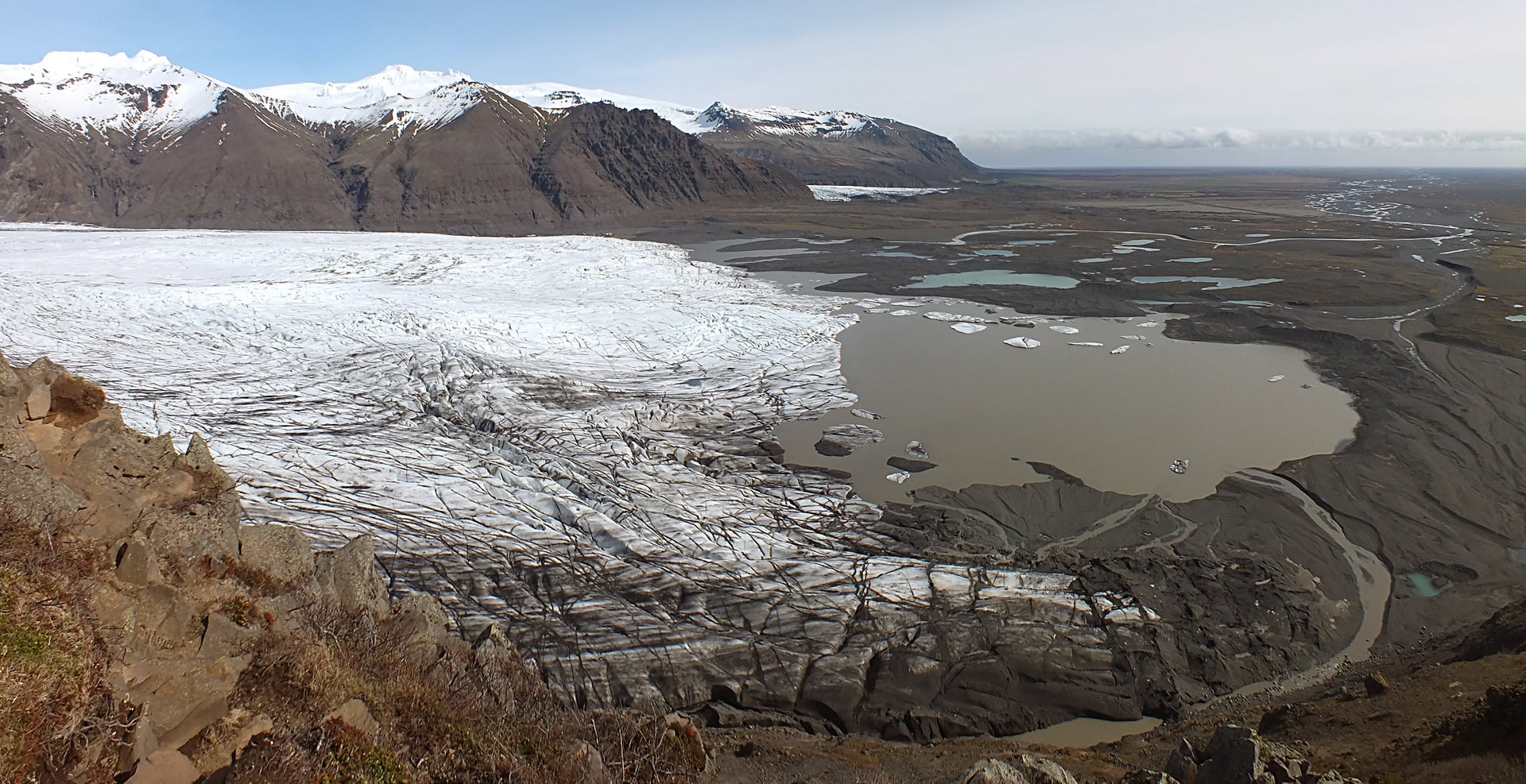
That story becomes even more resonant when the park describes the larger glacial-hydrological system. The landscape at Skaftafell has been shaped by the erosive power of glaciers and water. Outlet glaciers define the area, and the rivers Skeidara, Morsa, and Skaftafellsa emerge from glaciers of the same names. Skeidara was once a major obstacle to travel until a bridge was built in 1974, and it is especially associated with Skeidararhlaup outburst floods triggered by volcanic activity or geothermal heat in the Grimsvotn area. In other words, this is not a calm alpine playground with ice as a decorative backdrop. The place is legible only if you remember that rivers here can reorganize land and movement on a civilizational scale.
The wider regional history adds another layer. Visit South Iceland's Oraefi material explains that two eruptions, in 1362 and 1727, left a deep mark on the area. Before the great eruption, the district was known as Litla Herad, but afterward it came to be called Oraefi, a name associated with wasteland or wilderness. The 1362 event was the largest pumice eruption in Iceland after settlement. That history sits behind even the loveliest day in Skaftafell. The green slopes and hospitable weather are real, but so is the memory of destruction. The place feels kind, yet it belongs to a region with catastrophic precedent.
This is one reason Skaftafell has such unusual emotional range. On one level, it is accessible. There is a visitor centre open year-round. Rangers provide information and educational service. The campsite is open all year, with long infrastructure history going back to the early park years. There are interpretive paths that explain both nature and culture. On another level, everything around that orderly visitor experience points outward toward scale and instability: glacier tongues, floodplains, ash history, and the highest volcano in Iceland under ice.
For private travelers, Skaftafell often works best when treated less as a checklist and more as a base of perception. You might walk to Svartifoss, where the basalt columns create one of Iceland's clearest conversations between geology and form. You might continue toward Skaftafellsjokull and feel the colder, more severe edge of the area take over. Or you might simply spend enough time in the lower trails to notice how many transitions the land holds. Good itineraries do not always require the longest route. Sometimes the richer experience comes from moving between woodland, river plain, and glacier view without rushing to collect every landmark.
The phrase 'from home to world heritage' on the national park page is quietly excellent, because it captures what happened here. Skaftafell was once home, farm, assembly landscape, and working ground. Then it became a national park in 1967. When Vatnajokull National Park was founded on June 7, 2008, Skaftafell was absorbed into a larger protected whole, and in 2019 the region was registered as a UNESCO World Heritage Site. Those milestones matter, but not because international status automatically makes a place more meaningful. They matter because they formalize something locals had already lived with: this landscape is not ordinary, and it cannot be understood through scenery alone.
There is also a beautiful paradox in Skaftafell's abundance. In much of Iceland, visitors instinctively expect openness and scarcity: treeless plains, weather exposure, long distances between shelter. Skaftafell interrupts that expectation. The national park explicitly points to diverse vegetation, and the Oraefi material speaks of pleasant local climate and varied plant life. That abundance changes how the eye moves. In Skaftafell, green is not just accent color around a glacier. It is part of the identity of the place. The result is an Icelandic landscape that feels both recognizably wild and unexpectedly nourished.
Photographically, Skaftafell can easily split into two bad habits. One is to reduce it to the most famous compositions: Svartifoss framed by columns, glacier tongue under cloud, campsite light against mountain. The other is to go so wide that the place becomes anonymous grandeur. The better approach is usually relational. Forest against moraine. Human path against glacial scale. A river corridor leading the eye toward ice. The old farm logic of shelter beneath larger forces. Skaftafell photographs best when it still feels inhabited, even if only temporarily by walkers and campers.
Skaftafell is also unusually useful for travelers who want a stop that can scale with their time and energy. A short visit can still include the visitor centre, sheltered paths, and a sense of the glacier landscape. A longer private day can move toward Svartifoss, Skaftafellsjokull, Sjonarnipa, or deeper routes into the valleys and mountains. That range is the point: Skaftafell lets people meet Vatnajokull National Park without pretending every visitor needs the same level of expedition.
What makes Skaftafell memorable in the end is not only that it is beautiful, though it is. It is that the beauty has structure. The slopes are green because of shelter. The farm moved because of the river. The trails matter because they carry you between versions of the landscape. The park exists because the area was recognized as exceptional long before tourism reached its current scale. Glaciers, floods, woodland, farming, education, world heritage, all layered together. Skaftafell is one of the clearest places in Iceland for understanding that nature and human history are not separate stories laid side by side. They are the same terrain, read at different speeds.