Iceland Travel Guides
Skogafoss: Waterfall Force, Treasure Legend, and South Coast Depth
A fuller private guide to Skogafoss in South Iceland, with waterfall folklore, rainbow mist, Skogar Museum context, upstream hiking, and South Coast planning.
GlaciGo Iceland / May 2026 / 10 min read
Skogafoss does not charm people by being subtle. It wins through force. Long before you reach the base, you hear it. Then the white wall of water comes into view, dropping in one broad vertical sheet, and the whole scene feels less like a picturesque stop than a confrontation with scale. On the South Coast, Seljalandsfoss invites you inward and sideways, behind the curtain. Skogafoss does something else entirely. It stands in front of you like a declaration.
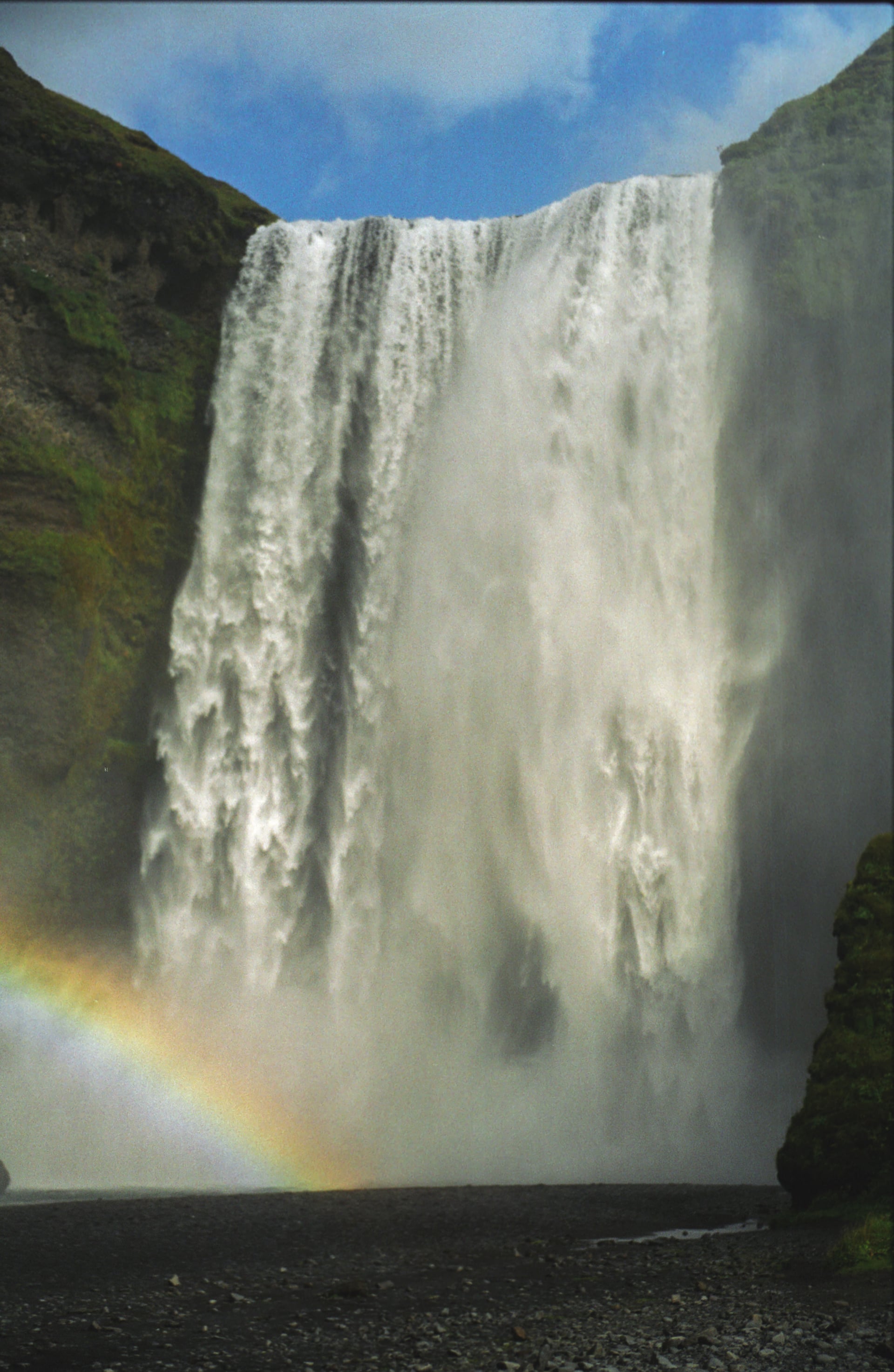
Visit South Iceland describes Skogafoss as the great attraction of Skogar: a 60 meter high waterfall in the river Skoga, framed by beautiful surroundings and by the snow-covered heights of two glaciers. That is the official introduction, but in person the most striking thing is the width and density of the fall. The water does not lace down the cliff in a thin line. It lands heavily and continuously, making a permanent cloud of spray and sound. The effect is physical. Even visitors who have seen many Icelandic waterfalls often stop speaking for a moment here.
Part of Skogafoss's power comes from how exposed it is. Like Seljalandsfoss farther west, it belongs to the old coastal cliff line of South Iceland, a reminder of the time when the sea lay farther inland. But where Seljalandsfoss feels sculpted for passage behind the water, Skogafoss feels built for frontal impact. It is the waterfall as a face. You do not pass around it so much as stand before it and accept the volume.
The mist matters almost as much as the falling water. Visit South Iceland notes that when sunlight conditions are favorable, vivid rainbows appear in front of the falls. That detail sounds almost too postcard-perfect until you see how often it happens. The combination of heavy spray and open light makes rainbow arcs feel natural to the place rather than occasional decoration. For many travelers, that becomes part of the emotional memory of Skogafoss: not only the weight of the water, but the strange softness of color suspended in front of all that force.
Then there is the legend, and Skogafoss would lose something if it were stripped away. Visit South Iceland preserves the local story of the settler Thrasi, who is believed to have buried a chest of gold beneath the waterfall. According to the familiar telling, later men tried to pull the chest free and managed only to catch the ring on its side before it vanished again. The ring, tradition says, ended up in the Skogar museum. Whether one treats the tale as folklore, memory, or landscape-poetry, it is exactly the kind of story that fits Skogafoss. A waterfall this commanding almost asks to be imagined as a guardian.
What is appealing about that legend is not merely treasure. It is the suggestion that the place holds back more than it reveals. Skogafoss looks open, visible, legible from a distance. Yet local tradition insists there is depth beneath the obvious image, something hidden under the thunder and mist. For tourists, that can be a useful correction. The waterfall may be easy to reach, but it does not have to be consumed superficially.
Skogar itself adds cultural weight to the stop. Visit South Iceland describes the village as an old farm settlement between the Skoga and Kverna rivers, and notes the church from 1890. More importantly for many visitors, it points to the Skogar Museum, while the museum's own official site shows how broad that institution really is. This is not a random side attraction beside a waterfall car park. It is a serious cultural archive of the region, with folk material, fisheries history, agriculture, furnishings, handcrafts, natural history collections, and preserved records from the surrounding counties.
That museum context matters because Skogafoss sits in a district where nature and livelihood were never separate. The official Skogar Museum material explains that fisheries along Iceland's south shore were unusually difficult because the sandy coast offered no proper harbors and boats had to launch directly into North Atlantic surf. The agriculture section, meanwhile, preserves the self-sustaining tools of farm life. Once you absorb even a little of that background, the waterfall begins to feel less like a detached scenic icon and more like part of a hard-working historical landscape where rivers, cliffs, weather, sea, and survival were tightly bound together.
For private travelers, this is one of the biggest advantages of Skogafoss over a faster bus-stop visit. You can treat the site as more than a single photograph. Spend time at the base, then climb the long staircase to the viewpoint above, then continue a little way along the river, or pair the waterfall with the museum and let the district deepen around it. The experience gains texture when Skogafoss stops being an isolated 'must-see' and becomes the center of a larger Skogar chapter.
The staircase above the waterfall changes the mood completely. Visit South Iceland notes that the path at the top continues upstream, where numerous more dramatic waterfalls of great beauty can be found. This is the beginning of a different relationship with the landscape. From below, Skogafoss feels monumental and immediate. From above, the river becomes a guide into the interior. The eye turns away from the single drop and toward a chain of smaller dramas, all of them feeding into the famous one below.
That continuation matters because Skogafoss is also tied to movement through the highlands. Visit South Iceland describes the route from Skogar along the Skoga River and onward over Fimmvorduhals between Eyjafjallajokull and Myrdalsjokull toward Thorsmork. Even travelers who do not attempt the full hike still feel the pull of it. Skogafoss is one of those South Coast places where the ordinary roadside itinerary brushes right up against a much bigger Iceland: glacier passes, long weather-exposed trails, and the older logic of crossing from one world into another.
This gives the waterfall a slightly different personality than many famous roadside falls. Some attractions feel complete in themselves. Skogafoss feels like an entrance. You can enjoy it in ten minutes, but the place keeps pointing onward: up the stairs, up the river, into the pass, toward the glaciers. That open-endedness is part of its appeal. It satisfies the quick visitor and still whispers to the more ambitious one.
Photographically, Skogafoss asks for a different discipline than Seljalandsfoss. Here the temptation is to show everything at once: the whole wall of water, the rainbow, the tiny people near the base, the black cliff, the green grass, the sky. Sometimes that works. But often the strongest image comes from choosing the dominant truth of the moment, whether that is scale, mist, color, or the human figure dwarfed by the falling water. The waterfall is already dramatic enough; the photograph does not need theatrics layered on top.
Season also changes the reading of Skogafoss. In greener months, the setting can feel almost improbably lush for Iceland, with the cliff and surrounding slopes softening the severity of the drop. In colder weather, the same site turns darker and more elemental, with ice, wind, and a harder edge to the spray. Either way, the waterfall remains legible from a distance in a way many sites do not. It keeps its identity in all conditions because its form is so bold.
A fuller article about Skogafoss should also admit something simple: popularity here is understandable. Sometimes people speak as if the most famous places are necessarily overrated. Skogafoss is a good corrective to that reflex. It is famous because the experience is genuinely strong, because the geology is cleanly visible, because the folklore is memorable, because the access is easy, and because the surrounding district gives it cultural and historical depth. That is not overexposure. That is substance.
On a private South Coast itinerary, Skogafoss works best when it is allowed to be what it is: not an intimate hidden stop, not a delicate geological puzzle, but a commanding landmark with a long local memory behind it. Stand at the base and feel the water in the air. Remember Thrasi's buried chest. Climb above it and watch the river pull inland. Then, if time allows, cross into the museum and let the human story of Skogar answer the natural one. Done that way, Skogafoss becomes more than a famous waterfall. It becomes one of the clearest places in Iceland to feel force, folklore, labor, and landscape meeting in one frame.