Iceland Travel Guides
Sky Lagoon: Ocean Ritual, Modern Design, and Warmth at Reykjavík's Edge
A fuller private guide to Sky Lagoon, with its oceanfront setting, seven-step Skjól ritual, contemporary Icelandic design language, and the deeper bathing culture behind the experience.
GlaciGo Iceland / May 2026 / 10 min read
Sky Lagoon is one of the clearest examples of how contemporary Icelandic travel tries to translate an old habit into a new setting. The old habit is simple: hot water, weather, contrast, conversation, and the bodily relief of stepping out of wind into warmth. The new setting is highly designed, oceanfront, carefully sequenced, and only minutes from Reykjavík. That combination is exactly why Sky Lagoon has become so popular so quickly. But it is also why it deserves a better article than a simple 'worth it or not' summary. The place is not interesting only because it is photogenic. It is interesting because it turns Icelandic bathing culture into a choreographed experience without fully losing the feeling of being beside raw sea and sky.
Visit Reykjavík presents Sky Lagoon in the most useful way to begin: an oceanside lagoon just minutes from the city centre, with views of the North Atlantic, distant mountains, and even glaciers on clear days. That urban closeness matters. Sky Lagoon is not a remote geothermal discovery. It is a deliberately placed threshold between city life and something that feels older, slower, and more elemental. You can be in central Reykjavík and then, a short while later, standing in warm water with the horizon stretched wide in front of you. That contrast is part of the experience, not just a logistical detail.
The official Sky Lagoon material frames the place as a contemporary expression of Iceland's bathing culture, shaped by hot springs, winter seas, and community. That wording is important because it keeps the lagoon from being misunderstood as purely luxury branding. Icelandic bathing is not a niche wellness trend imported from elsewhere. It is woven into ordinary life through pools, hot pots, geothermal water, and the routine social habit of soaking. Sky Lagoon takes that cultural inheritance and gives it a modern oceanfront form. Whether one prefers more rustic or more curated bathing, the underlying tradition is real.
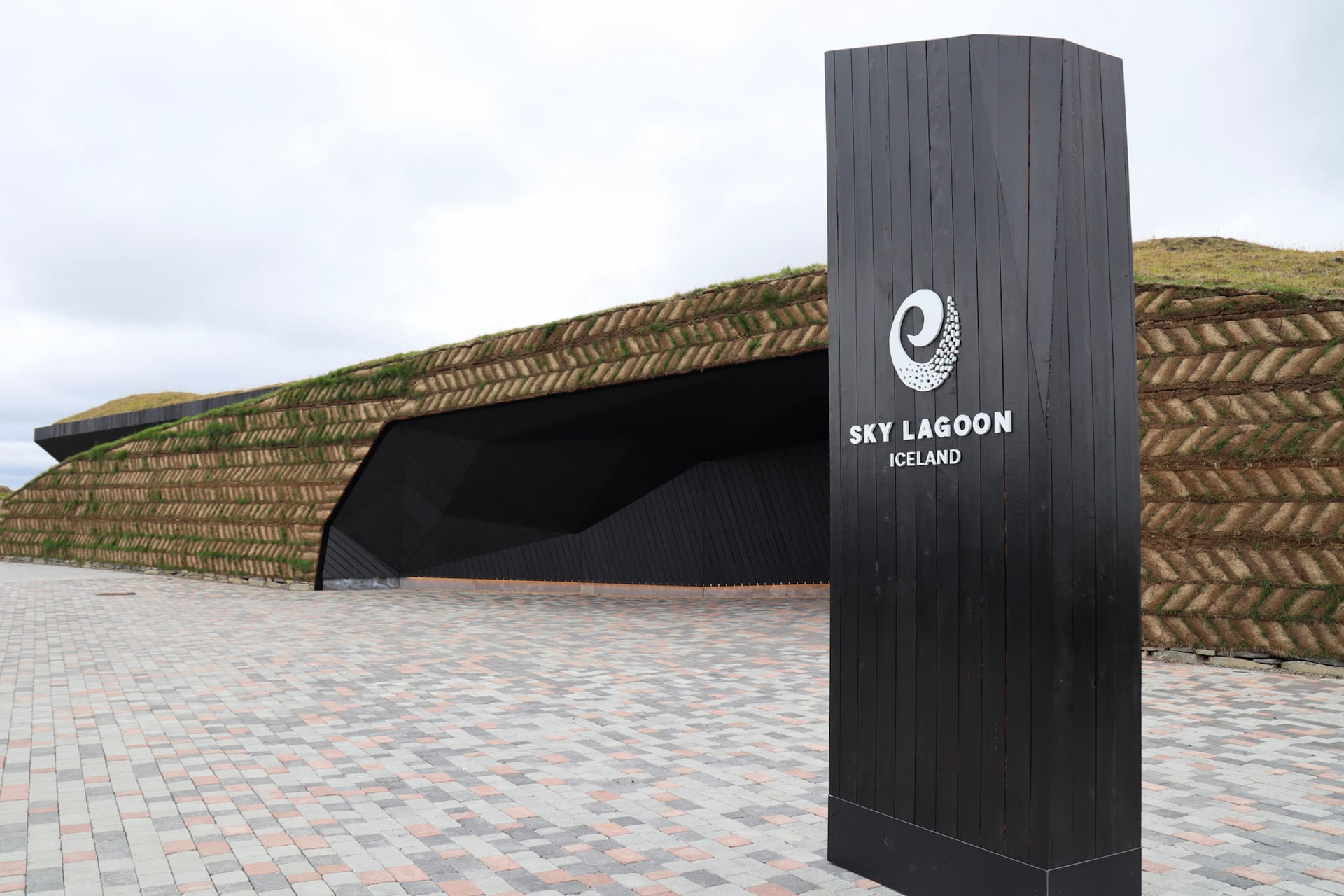
Design is a major part of why the place works. The official history and design material describes low, turf-inspired forms, basalt-toned surfaces, and a horizon line where sea and sky seem to merge. This is one of the cleverest things about Sky Lagoon. It does not try to impress through scale alone. It tries to disappear into the idea of an Icelandic shoreline while remaining unmistakably built. The result is less wild than a natural hot spring and less industrial than some larger geothermal destinations. It sits in a carefully chosen middle ground: curated, but still emotionally tied to weather and coast.
That coastal setting changes the whole psychological tone of the bath. Many geothermal places in Iceland are enclosed by lava, steam, or inland topography. Sky Lagoon looks outward. The official site keeps returning to that outwardness, and rightly so. The lagoon's infinity edge is not just an attractive design feature. It is the core dramatic move. It sends the eye across the North Atlantic and asks the body to relax into open distance. This is one reason Sky Lagoon often feels especially strong at the edges of the day, when wind, cloud, dim light, or sunset give the horizon real emotional presence.
One of the most important parts of the experience is the Skjól ritual. Official Sky Lagoon materials describe it as a seven-step progression built around heat, cold, steam, mist, scrub, and rinse. This matters because Sky Lagoon is not simply selling warm water. It is selling rhythm. The ritual gives the visit a beginning, middle, and end. In older Icelandic bathing habits, people often create their own rhythm informally: soak, cool off, chat, steam, soak again. Sky Lagoon formalizes that instinct into a sequence that many travelers find grounding precisely because it slows them down and gives attention a structure.
That structure also explains why Sky Lagoon tends to feel different from a normal spa. A conventional spa often aims for insulated calm, shutting the outer world away. Sky Lagoon does almost the opposite. The official ritual material emphasizes the ocean-view sauna, the cold plunge, the mist, and the steam, but the deeper logic is contrast rather than escape. Warmth means more because cold is present. Shelter means more because weather is visible. Calm means more because the Atlantic is right there beyond the edge. The body is not detached from the landscape; it is guided into noticing it more deeply.
Accessibility and inclusiveness are part of the story as well. Sky Lagoon's official accessibility document explains that accessible design was considered during planning and construction, including consultation with Sjálfsbjörg, the National Confederation of Physically Disabled People in Iceland. That matters because highly stylized wellness spaces can easily become exclusionary if accessibility is treated as an afterthought. Here, the effort to make the lagoon more widely usable belongs in the article because it says something good about the seriousness of the project, not just about compliance.
For visitors, one of the most useful truths is that Sky Lagoon works especially well when you do not rush it or fold it into an overfilled city day. Because it is so close to Reykjavík, people sometimes treat it like a slot to squeeze in. But the place gains a lot from unhurried pacing. Let the transition from street to water happen. Move through the ritual without racing it. Stay long enough to notice how the light changes on the ocean. In that sense, Sky Lagoon is less about ticking off an attraction than about temporarily changing your internal tempo.
It also has a distinct place in the wider Reykjavík-area bathing landscape. The city region offers public pools, older bathing habits, and several different geothermal experiences nearby. Sky Lagoon's own identity is not that it is the most historical, the most remote, or the most geologically raw. Its identity is that it is a refined, ocean-edge interpretation of bathing culture that stays emotionally legible to first-time visitors. That makes it especially strong for travelers who want a memorable introduction to Icelandic water culture without leaving the capital area for half a day.
Food and aftercare are part of the experience too. Visit Reykjavík highlights Smakk Bar and the tasting platters, while Sky Lagoon's own material points to food and drink options on site. That may sound secondary, but it actually fits the cultural logic of the place. Bathing in Iceland often spills naturally into eating, resting, and lingering. A successful visit does not end the instant you towel off. It softens into the next hour. Sky Lagoon understands this and builds the experience accordingly.
Photographically, Sky Lagoon is powerful, but the best encounters often happen when photography stops being the main point. The architecture, dark materials, sea line, and steam all produce excellent images. Still, the place has more depth than that. It is strongest when the eye relaxes and the body takes over: the shock of the cold plunge, the softness after steam, the quiet floating along the edge, the feeling of salt air against warm skin. These are difficult to photograph well and impossible to reduce to one angle, which is part of why the memory lasts.
Sky Lagoon deserves a careful reading because travelers usually arrive with mixed questions: whether it is worth the cost, how it differs from other lagoons, whether it is easy from Reykjavik, what the ritual actually involves, and whether the style has substance. The honest answer is that it is undeniably styled, but not empty. Its strength lies in the way it stages old Icelandic pleasures: hot water, weather, contrast, stillness, and warmth beside a cold horizon.
What stays with many visitors after Sky Lagoon is not only relaxation, but a clearer sense of what Icelandic bathing can mean when it is done well. It is not merely indulgence. It is an organized pause between body and weather, city and ocean, motion and stillness. Sky Lagoon lingers because it takes something deeply ordinary in Icelandic life and frames it with enough care that even a first-time visitor can feel its depth.