Iceland Travel Guides
Snæfellsjökull: Ice Over Fire and the Mythic Crown of Snæfellsnes
A fuller private guide to Snæfellsjökull, with glacier-volcano geology, the 2001 national park, Jules Verne, Bárður saga, and the mountain's unusual hold on the Icelandic imagination.
GlaciGo Iceland / May 2026 / 11 min read
Snæfellsjökull is one of the few Icelandic mountains that seems to arrive in the mind already carrying several identities at once. It is a glacier, a volcano, a national-park crown, a literary portal, a visual anchor for the whole Snæfellsnes Peninsula, and for many people something harder to classify than any of those terms alone. Some travelers know it first through Jules Verne. Others know it as the glacier-volcano visible from much of western Iceland. Others know it through the stronger local feeling that Snæfellsjökull is not just a summit but a presence. All of those versions contain some truth. The challenge of a good article is not to choose only one, but to hold them together without letting the mountain dissolve into cliché.
The official national-park material gives the geological frame clearly. Umhverfisstofnun, Iceland's Environment Agency, describes Snæfellsjökull as a 1,446-meter glacier-capped volcano and states that the mountain has been built up through numerous eruptions during the last 800,000 years. It also notes that the summit crater is about 200 meters deep and filled with ice. These are clean facts, but what makes them powerful is the combination they imply. Snæfellsjökull is not simply a volcano wearing a decorative white cap. It is a mountain whose defining image comes from fire and ice occupying the same form at once.
That duality explains much of the mountain's magnetism. In Iceland, people often speak easily about glaciers and volcanoes as separate categories of wonder. Snæfellsjökull refuses that separation. The glacier is the volcano's visible crown, and the volcano is the glacier's hidden structure. This is one reason the mountain can feel almost too archetypal, as if it were designed to summarize Iceland for outsiders. Yet the effect is not merely symbolic. The official geology page for Snæfellsjökull National Park points to lava trails down the flanks, smaller craters in the surrounding lowlands, and volcanic formations across the park that make the mountain's role readable in the wider landscape.
The park itself deepens that reading. Umhverfisstofnun notes that Snæfellsjökull National Park was established on 28 June 2001 and was the first national park in Iceland to extend to the seashore. That is a beautiful and important detail. The park does not isolate the glacier at altitude and leave the coast to some lesser narrative. Instead, it recognizes a whole system: glacier, lava, caves, craters, bird cliffs, black beaches, and fishing history all arranged around one dominating mountain. Snæfellsjökull therefore works best when understood not as a solitary summit but as the organizing force of a whole western peninsula landscape.
The official glacier page adds another significant point: the latest eruption of Snæfellsjökull was very large and took place around 1,800 years ago. Light-colored ash spread widely over northern Snæfellsnes and even into the Westfjords, while lava flowed down the southern slopes and formed the Háahraun lava field. This matters because it rescues the mountain from the false category of picturesque dormancy. Snæfellsjökull may be quiet in human historical memory, but it is not dead scenery. It is an active stratovolcano whose calm appearance belongs to a long volcanic timescale, not to harmlessness.
And yet it would be wrong to write about Snæfellsjökull only as a hazard or a geological summary. The mountain's cultural reach is too wide for that. The official Snæfellsnes regional site states plainly that in Jules Verne's Journey to the Center of the Earth, an entrance to the earth's interior is found on Snæfellsjökull. That literary association has shaped the mountain's global afterlife for generations. It would be easy to dismiss this as a tourist embellishment, but that would miss the deeper point. Verne chose the glacier because Snæfellsjökull already looked like an entrance: isolated, symmetrical, glaciated, and somehow self-contained enough to suggest hidden structure beneath what the eye could see.
The same Snæfellsnes source also notes that Halldór Laxness's Under the Glacier takes place near the glacier. That is a different kind of literary aura from Verne's. If Journey to the Center of the Earth turns Snæfellsjökull into a gateway downward, Laxness turns the district into a place where belief, absurdity, Icelandic character, and metaphysical strangeness gather around the glacier's presence. Together, these literary echoes tell us something important. Snæfellsjökull has not inspired writers because it is merely pretty. It has inspired them because it feels like a mountain that thinks back.
Local saga tradition adds yet another layer. Umhverfisstofnun's history page points to Bárðar saga Snæfellsáss as the best-known saga associated with the area. Bárður, half-man and half-troll in later retellings, belongs to the imaginative geography of Snæfellsnes in a way that makes perfect sense once you stand under the glacier. This is not folklore pasted onto a random mountain. Snæfellsjökull and the surrounding district already feel like a threshold landscape, where coast, lava, caves, snow, and old settlements produce exactly the kind of atmosphere in which saga memory can survive naturally.
That threshold quality is why so many people describe the glacier in almost spiritual language. The official glacier page itself acknowledges that many visitors feel a powerful influence from Snæfellsjökull and that some even consider it one of the world's major energy centers. Whether a traveler embraces that language, smiles at it, or keeps it at arm's length, the fact that the national-park material mentions it at all is revealing. Snæfellsjökull is not experienced only as topography. It is experienced as force, or at least as a place where many people sense more than ordinary scenery.
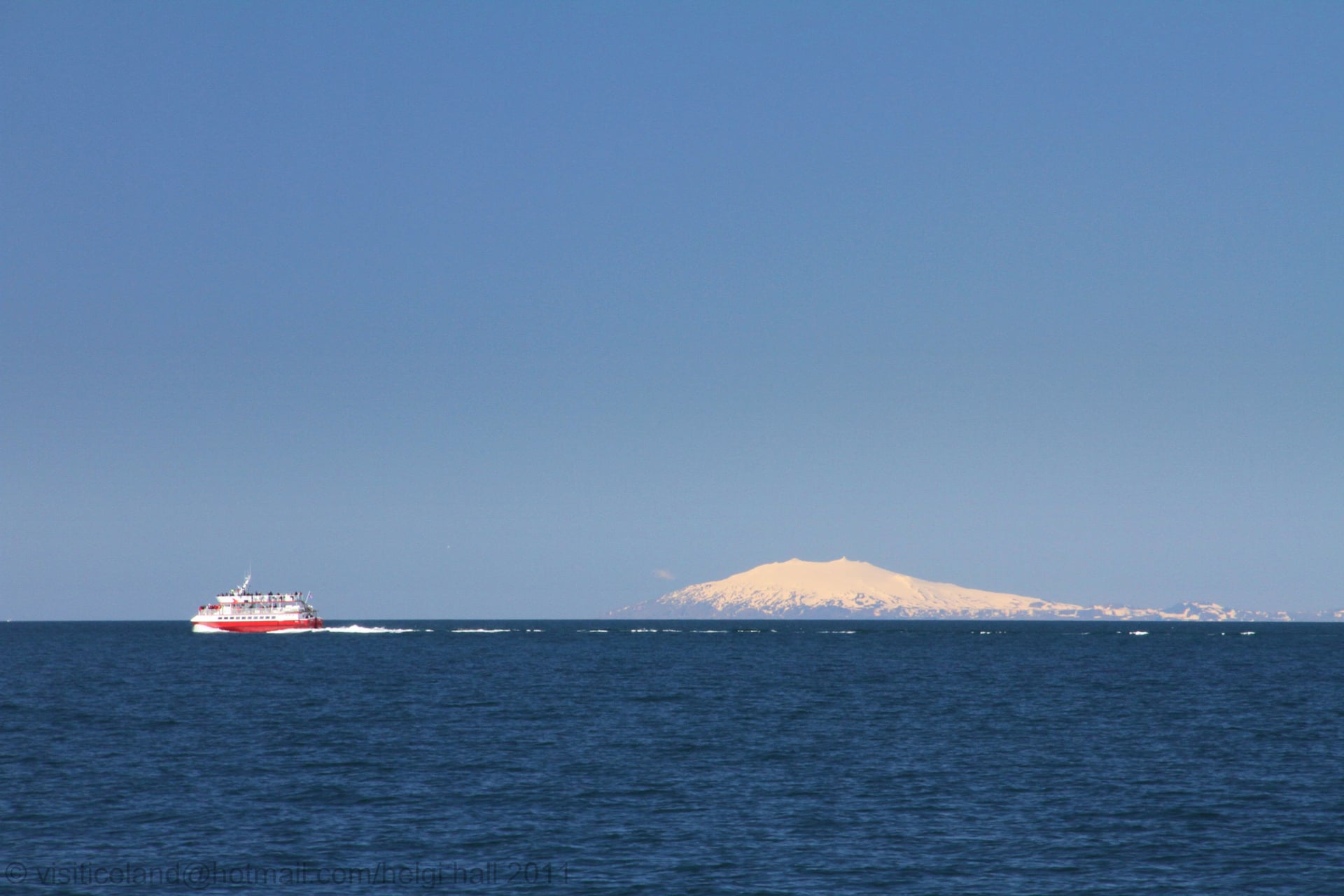
The mountain's visual power also comes from its relation to the sea. Because the park reaches the shore and because Snæfellsjökull rises so close to the ocean compared with many other Icelandic glaciers, the contrast is unusually strong. Coastal lava, bird cliffs, black beaches, and fishing remains sit under a glacier that appears both near and aloof. Umhverfisstofnun's geology page makes this legible through examples like Lóndrangar, volcanic plugs, moss-covered lava, sheltered hollows, and a cave-rich landscape. The mountain does not hover abstractly above the park. It sends its logic down into everything around it.
This is also why Snæfellsjökull is so satisfying on a private itinerary. Some iconic mountains are best admired from a single viewpoint and then left alone. Snæfellsjökull improves the more you circle it, read its coast, and notice how different places in the park belong to its story. A private route can let the glacier emerge gradually through Arnarstapi light, Malarrif openness, lava fields, cave country, or the black-pebble coast near Djúpalónssandur. That pacing matters, because Snæfellsjökull is less a one-stop attraction than a governing presence over a whole district.
Photographically, the mountain can be oddly challenging precisely because it is so complete. A glacier-capped cone above the peninsula can look almost too emblematic, too easy to reduce to an Iceland postcard. The stronger photographs usually include some secondary language: sea birds in front of the snow, lava foreground, fishing-country traces, or weather that partially veils the glacier. Snæfellsjökull is most interesting when the image shows not only the summit but the world it rules.
There is a human-history layer below all this grandeur as well. Umhverfisstofnun's history page points to settlement remains around 1,100 years old, to old fishing stations such as Dritvík, and to the large medieval church at Ingjaldshóll bearing witness to a once substantial local population. That history matters because it keeps Snæfellsjökull from floating free as myth alone. People fished, prayed, settled, and built under this glacier-volcano for centuries. The mountain is powerful partly because it watched ordinary labor for a very long time.
Snaefellsjokull rewards a fuller explanation because travelers come to it through several doors at once: glacier facts, volcano facts, literary memory, the mountain's energy reputation, and the practical question of whether it is a summit, a viewpoint, or a regional symbol. In a sense, it is all of those. The mountain becomes clearer when geology and mystique are allowed to sit together without either one swallowing the other.
What stays with most travelers after Snæfellsjökull is not just the image of ice over fire. It is the feeling that this mountain gathers Icelandic themes unusually well: lava and snow, coast and summit, saga and literature, settlement and solitude, realism and myth. Snæfellsjökull is one of those rare places where explanation helps, but never quite exhausts the experience. That is probably why it continues to attract not only hikers and drivers, but people who want a mountain to mean more than one thing at once.