Iceland Travel Guides
S?lheimaj?kull: Retreating Ice and South Coast Perspective
A fuller private guide to Solheimajokull in South Iceland, with glacier retreat, volcanic context, laguna formation, guided access, and climate-literacy depth.
GlaciGo Iceland / May 2026 / 10 min read
Solheimajokull is one of the most useful glaciers in Iceland for helping travelers understand that ice is not scenery in the passive sense. It is movement, loss, ash, water, danger, access, and time made visible. People often arrive expecting a dramatic white tongue and maybe an adventurous photo. What they leave with, if the place has been explained honestly, is something deeper: the feeling of having stood in front of a landscape that is changing fast enough for human memory to register it.
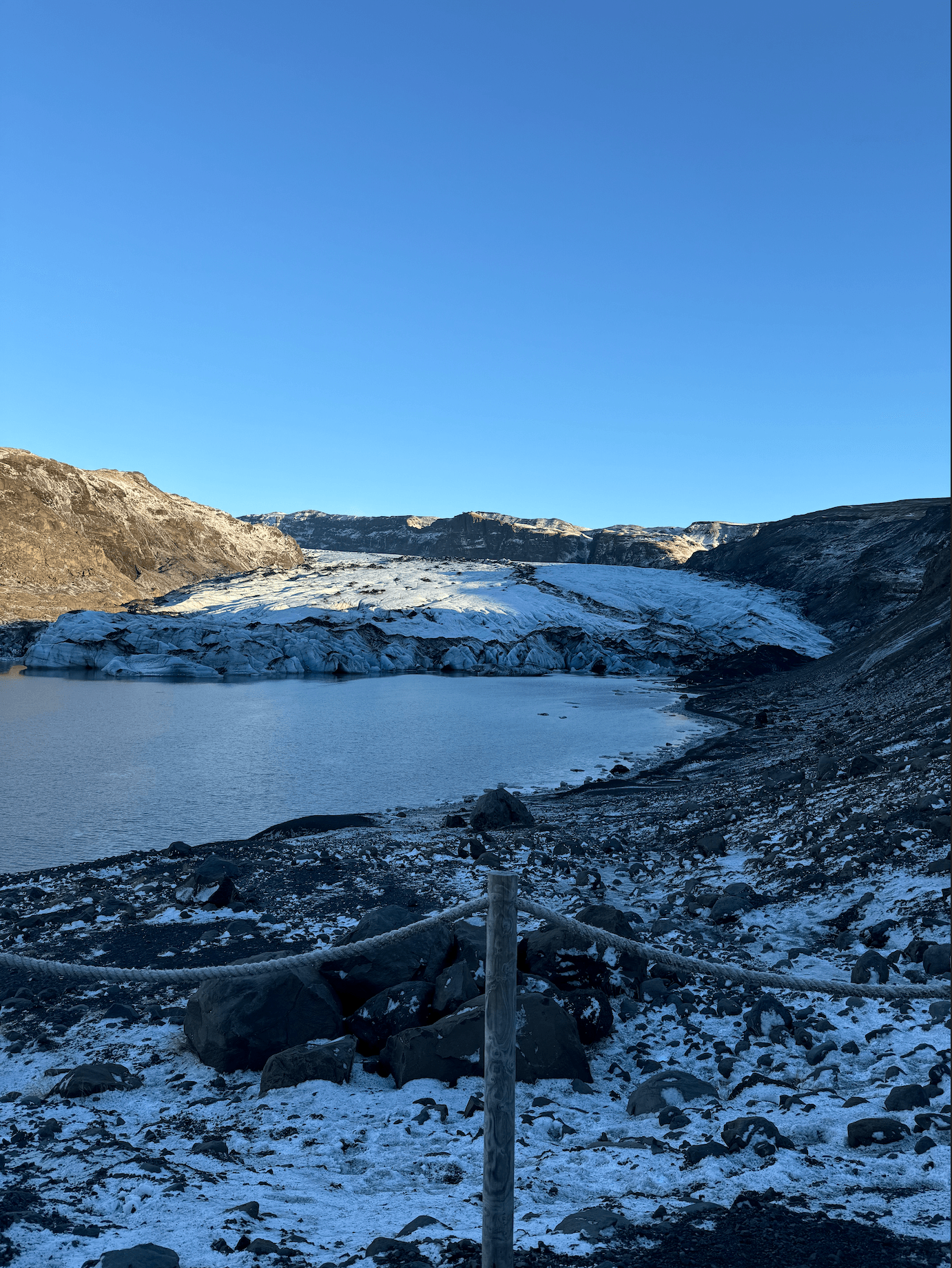
Visit South Iceland describes Solheimajokull as an outlet glacier descending from the southwest corner of Myrdalsjokull and calls it a 'climate glacier' that responds quickly to climate change. That phrase matters. Not every glacier makes the climate story as legible to ordinary visitors as Solheimajokull does. Here, retreat is not an abstract graph somewhere else. It shows up in the growing walk from the parking area, the changed shape of the tongue, and the lagoon that has formed at the glacier's head.
The same source points out that over a hundred years ago the glacier's footprint lay considerably in front of the current car park. That is an extraordinary sentence once you stop to picture it. It means that the space where visitors now organize gear, eat a quick snack, or take a few first photos used to belong to the glacier itself. Solheimajokull does not merely illustrate climate change through statistics. It does so through displaced everyday geography.
Visit South Iceland's glacier overview adds another important detail: in recent years a large lagoon has formed at the head of Solheimajokull as the glacier has melted and retreated. This is one of the clearest visual markers of change in southern Iceland. Lagoons of this kind form when a retreating glacier leaves behind a depression that water then occupies. The result can look beautiful, even serene, but it is also a sign that the glacier front is pulling back and the terrain in front of it is being reorganized.
That tension between beauty and warning is central to the place. Solheimajokull is visually magnetic. The ash-streaked surface, blue cracks, rough ice geometry, black volcanic sediment, and meltwater lake create exactly the kind of contrast that photographers and first-time visitors find hard to forget. But the Icelandic story under that beauty is more serious. The glacier is not only beautiful because it is icy. It is beautiful because fire and ice have been working on the same body for a very long time.
The volcanic setting explains a great deal. Solheimajokull flows out of Myrdalsjokull, one of Iceland's major ice caps, and Myrdalsjokull in turn covers Katla, one of the country's most powerful and historically consequential volcanoes. Visit South Iceland's glacier pages explain that Icelandic glaciers often cover active volcanoes, and that eruptions and geothermal heat can melt ice and trigger jokulhlaup, the glacial outburst floods that have shaped many South Coast lowlands. Once you know that, Solheimajokull stops looking like a frozen object and starts reading as part of a volatile system.
That system is one reason the glacier is so educational for private travelers. You can talk here about outlet glaciers, about why some valley glaciers retreat quickly, about ash layers darkening the ice, about crevasses, about meltwater, and about the way volcanoes under ice can transform landscapes far beyond the glacier itself. There are few places on a standard South Coast route where so many essential Icelandic processes come together so clearly within one accessible stop.
The access is part of what makes Solheimajokull special. Visit South Iceland notes that it reaches down to the lowlands, making approach to the glacier tongue relatively straightforward compared with more remote ice bodies. That does not make the glacier safe in any casual sense, but it does make it legible. You do not need to cross a huge wilderness first in order to encounter the glacier. This makes it one of the best places in Iceland for people who want a real sense of glacial presence without committing to a multi-day expedition.
At the same time, the ease of access can create the wrong kind of confidence if the place is badly interpreted. Glaciers are not stable promenades. Visit South Iceland is very clear in its broader glacier guidance that ice caves should not be visited without experienced local guidance and proper equipment, and the same principle of humility belongs at Solheimajokull more generally. Crevasses, unstable ice, falling debris, rapidly changing edges, and weather shifts mean the glacier should be approached with respect. A good private experience does not flatten risk into entertainment.
This is why guided glacier walking has real value here when done well. The point is not only adventure. It is literacy. On the ice, people begin to understand what surface melt looks like, why crampons matter, how ash bands record volcanic life around the glacier, why rope systems exist in more technical settings, and how quickly glacier margins can become unstable. Even travelers who do not step onto the ice benefit from standing near Solheimajokull with someone who can translate what they are seeing into process rather than just spectacle.
The Icelandic Meteorological Office gives the wider climate frame. Its glacier measurement pages note that Iceland's glaciers have changed immensely in historical time and that, in recent decades, the overall decrease has been on the order of roughly 0.3 to 0.5 percent per year. An older IMO report on Solheimajokull called it a type-site for glacial retreat in Iceland and even globally, describing exceptionally rapid retreat. That is strong language from glaciologists, and it explains why this glacier has been such a long-running research focus.
There is something emotionally particular about that kind of knowledge. Solheimajokull does not inspire only wonder or only grief. It often produces both at once. Travelers can be thrilled by the textures and scale of the ice and unsettled by the speed at which the landscape is changing. In many places around the world, climate change is understood through headlines, politics, or distant projections. At Solheimajokull, it is encountered spatially. The walk itself becomes part of the evidence.
Photographically, the glacier rewards honesty more than prettification. Blue ice is there, yes, but so are gray ash, dirty melt channels, fractured surfaces, and pools that make the glacier look more vulnerable than romantic. That is part of what makes the images strong. Solheimajokull is not pristine in the simplistic postcard sense. It is textured by geology and by retreat. If the photographs preserve that complexity, they say something more truthful about Iceland than a cleaner fantasy image would.
For route planning, Solheimajokull works best when paired with other South Coast stops that help complete the story rather than compete with it. Skogafoss and Seljalandsfoss show the old sea-cliff line and water dropping from glacier-fed systems. Reynisfjara and the wider coastline show erosion, sediment, and volcanic shore processes. Solheimajokull introduces the body of ice itself, closer and more directly. Together those places make the South Coast feel like one connected landscape rather than a playlist of disconnected highlights.
There is also a pacing advantage here. Waterfall stops can become repetitive if a day is built carelessly. Solheimajokull changes the texture of travel. The colors shift. The soundscape changes. Instead of spray and vertical drop, you get creak, silence, broken surfaces, and a more open-ended kind of attention. For private travelers especially, that variation is often the difference between a good day and a memorable one.
Solheimajokull is therefore best approached not as a bonus glacier near the road, but as one of the clearest places in Iceland to witness how climate, volcanism, and accessible travel meet. The glacier is beautiful, but beauty is not the whole point. It is also a classroom, a warning, an adventure edge, and a rapidly rewriting map. On the right South Coast itinerary, Solheimajokull becomes the place where travelers stop thinking of Icelandic ice as a backdrop and start understanding it as a living, changing force.