Iceland Travel Guides
Sólheimasandur Plane Wreck: Black Sand, Survival, and South Coast Atmosphere
A fuller private guide to Sólheimasandur Plane Wreck, with the 1973 emergency landing, the black sandur landscape, access restrictions, walk versus shuttle reality, and the reason the site feels bigger and stranger in person than online.
GlaciGo Iceland / May 2026 / 10 min read
Sólheimasandur Plane Wreck is one of the South Coast places that most clearly shows the gap between an image and an experience. The image is famous: the stripped fuselage of a military aircraft resting on black sand under a wide Icelandic sky. It has appeared in travel feeds, fashion shoots, music videos, and countless itineraries. The experience, however, is slower, emptier, and more complicated. You do not simply pull up, step out, and collect the scene. You cross a vast glacial outwash plain on foot or by shuttle, feel the wind, and gradually understand that the wreck matters not only because of the plane itself, but because of where it ended up: on a landscape already shaped by flood, ash, ice, and distance.
Visit South Iceland describes Sólheimasandur first as a sand desert formed by jökulhlaup, or glacial outburst floods, from the Katla volcanic system beneath Mýrdalsjökull. That is the right place to begin, because the plane wreck makes the strongest sense when it is set inside the sandur rather than treated as an isolated object. Sólheimasandur is not an empty black backdrop placed there for photography. It is a dynamic outwash plain built by repeated flood events from an active glacial-volcanic environment. The wreck is dramatic, but the land is the older and deeper force.
The official South Iceland page then gives the core event: in 1973 a US Navy DC-3 made an emergency landing on the beach at Sólheimasandur, everyone survived, and the remains still stand there today. More specialized historical sources refine the aircraft type to a Douglas C-117D, a military Super DC-3 variant, and place the event on 21 November 1973. A useful local-historical source, Stríðsminjar á Íslandi, notes that the aircraft was on route from Höfn and was forced down at Sólheimasandur in bad weather conditions, after which it was stripped of valuable components and left behind. That layered phrasing is important because accounts about the exact cause vary: some later retellings mention fuel problems, others stress severe icing or bad weather, and local oral accounts sometimes preserve different emphases. The most responsible thing to say is that it was an emergency landing in difficult conditions, and that all aboard survived.
That survival is one of the most important truths to keep in the article, because many first-time visitors assume they are approaching the site of a fatal crash. In fact, the emotional atmosphere of the place is not tragic in the usual disaster-tourism sense. It is stranger than that. The plane did come down in a dangerous situation, but without loss of life. What remains on the sand is therefore not a mass-grief memorial. It is a relic of incident, survival, abandonment, and weathering. That distinction matters both ethically and atmospherically.
The walk is part of what gives the site its real character. Visit South Iceland states that driving to the wreck is forbidden and that from the parking area on Route 1 the walk takes a little less than an hour each way. This is one of the most important practical facts about Sólheimasandur, because it changes the rhythm of the visit completely. The wreck is famous, but it is not effortless. The approach across the plain strips away some of the instant-consumption logic that dominates many popular Iceland stops. By the time you reach the fuselage, you have already had to reckon with exposure, distance, and monotony. That makes the arrival more cinematic in the best possible way.
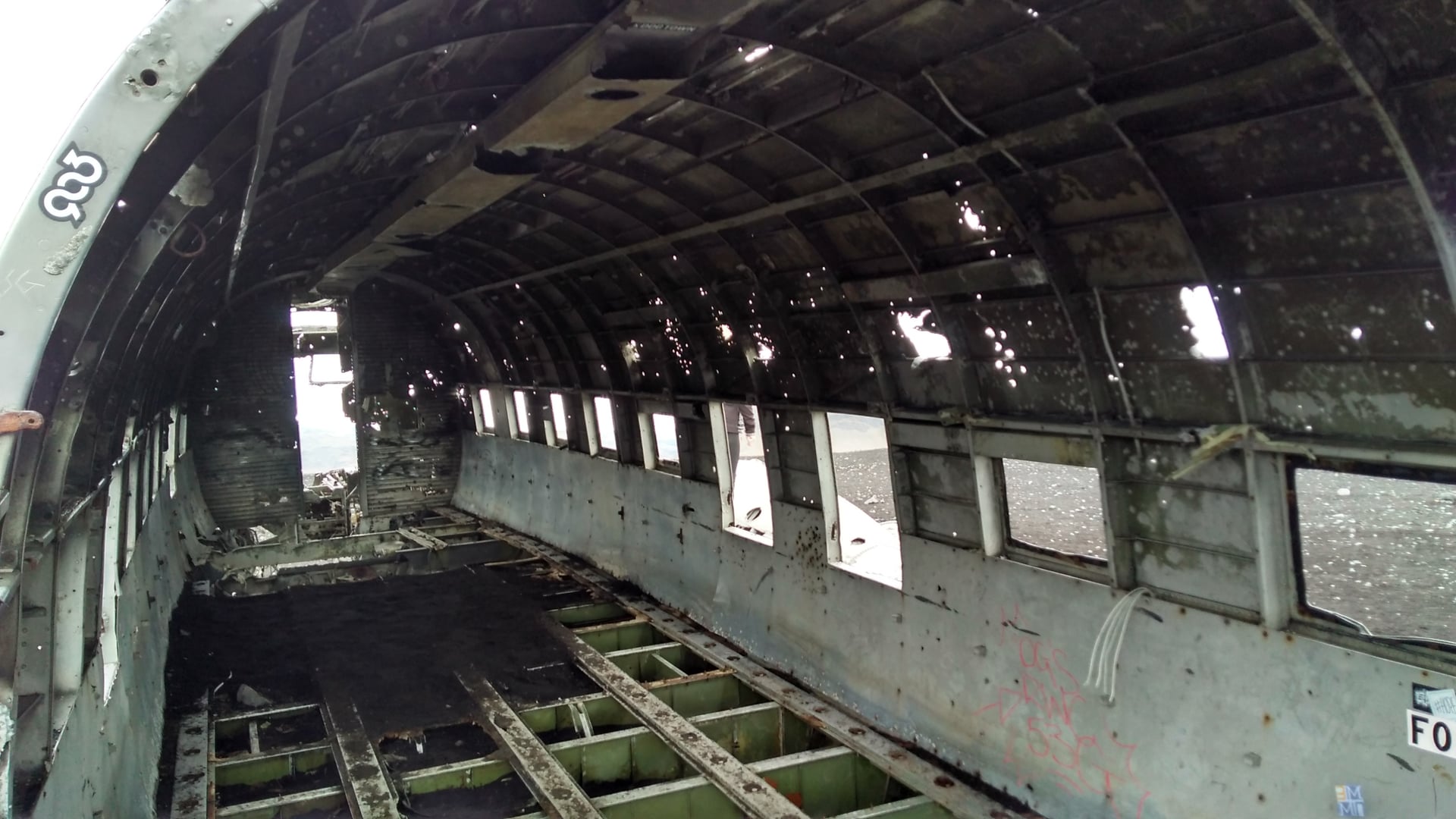
The landscape on the way out matters almost as much as the wreck itself. Sólheimasandur is broad, level, and visually spare, which means the plane appears less like a major crash site and more like an object that the earth has gradually absorbed into its own scale. The fuselage often looks surprisingly small at first. That is one reason many people find the site more powerful in person than in photographs. Online, the plane is the whole subject. On the sandur, it becomes one sharp white interruption inside a far larger field of wind, gravel, sky, and glacial memory.
This is also why the wreck works so well for travelers who respond to mood more than checklist tourism. It is not South Iceland's most beautiful stop in a conventional sense. It offers no waterfall thunder, no basalt cave, no steaming geothermal display, and no village warmth. What it offers instead is atmosphere: an almost post-industrial loneliness placed inside a natural system that cares nothing for machinery. The plane looks man-made and fragile. The sandur looks ancient and unfinished. That contrast does most of the emotional work.
Photographically, Sólheimasandur can easily go wrong if approached too greedily. Because the image is so familiar, many visitors arrive trying to reproduce a known frame rather than noticing what the day is actually offering. The strongest photographs often come when the wreck is allowed to sit in relation to weather and emptiness: low cloud, windblown clothing, a long line of walking figures, gray sea light, or the simple geometry of the fuselage against ash-dark ground. The place resists over-direction. It rewards stillness and scale.
Practical access is also part of the modern story of the site. Guide to Iceland and other current travel sources note the shuttle option that now operates from the parking area, while Visit South Iceland keeps emphasizing that private driving out to the wreck is forbidden. This matters because the plane has become so famous that unmanaged access would quickly damage both the site and the surrounding plain. The walk or shuttle is not only a logistical inconvenience. It is part of the way the place is now protected and mediated.
Weather deserves real respect here. Visit South Iceland explicitly warns that in winter there is a lack of daylight, weather can change quickly, and it is easy to get lost on the plain. This is not dramatic overstatement. Sólheimasandur is visually open but directionally deceptive, especially in low visibility. A walk that feels simple in fair conditions can feel much less casual in fog, wind, sleet, or fading light. That is one reason the site works best when it is treated as a real outing rather than a tiny add-on stop between South Coast highlights.
The wreck's modern fame has also changed its meaning. It is now one of those places where cultural afterlife matters almost as much as the original event. The fuselage survived because it was left behind. It became famous because photographers, filmmakers, and travelers found a kind of stark poetry in it. That does not make the site superficial, but it does mean a good article should be honest: people are not drawn there only for history. They are drawn there because the object and the landscape together create one of Iceland's most recognizable moods.
Solheimasandur Plane Wreck benefits from careful explanation because traveler questions around it is unusually mixed. Some people are looking for the true story of the plane. Some want to know whether people died. Some are trying to understand the walk, the shuttle, or whether driving there is allowed. Others are really searching for a photography stop on the South Coast. Thin listicles usually mash all these questions together into one short paragraph. What matters on the ground is a fuller answer: this is a site where story, access, and landscape all matter equally.
What stays with many visitors after Sólheimasandur is not simply the wreck itself, but the feeling of leaving it behind and walking back across the black plain. The plane does not dominate the sandur as much as one expects. It sits there, weathered and hollow, while the real scale belongs to the land. That is why the place lingers. Sólheimasandur Plane Wreck is not just a famous fuselage on a beach. It is one of South Iceland's clearest lessons in how history becomes atmosphere when weather, distance, and landscape take over.