Iceland Travel Guides
Stokksnes: Black Dunes, Atlantic Edge, and the Coast Beneath Vestrahorn
A fuller private guide to Stokksnes, with its black dunes, Atlantic edge, radar and WWII memory, Viking Café access, and the reason the peninsula matters as much as Vestrahorn itself.
GlaciGo Iceland / May 2026 / 10 min read
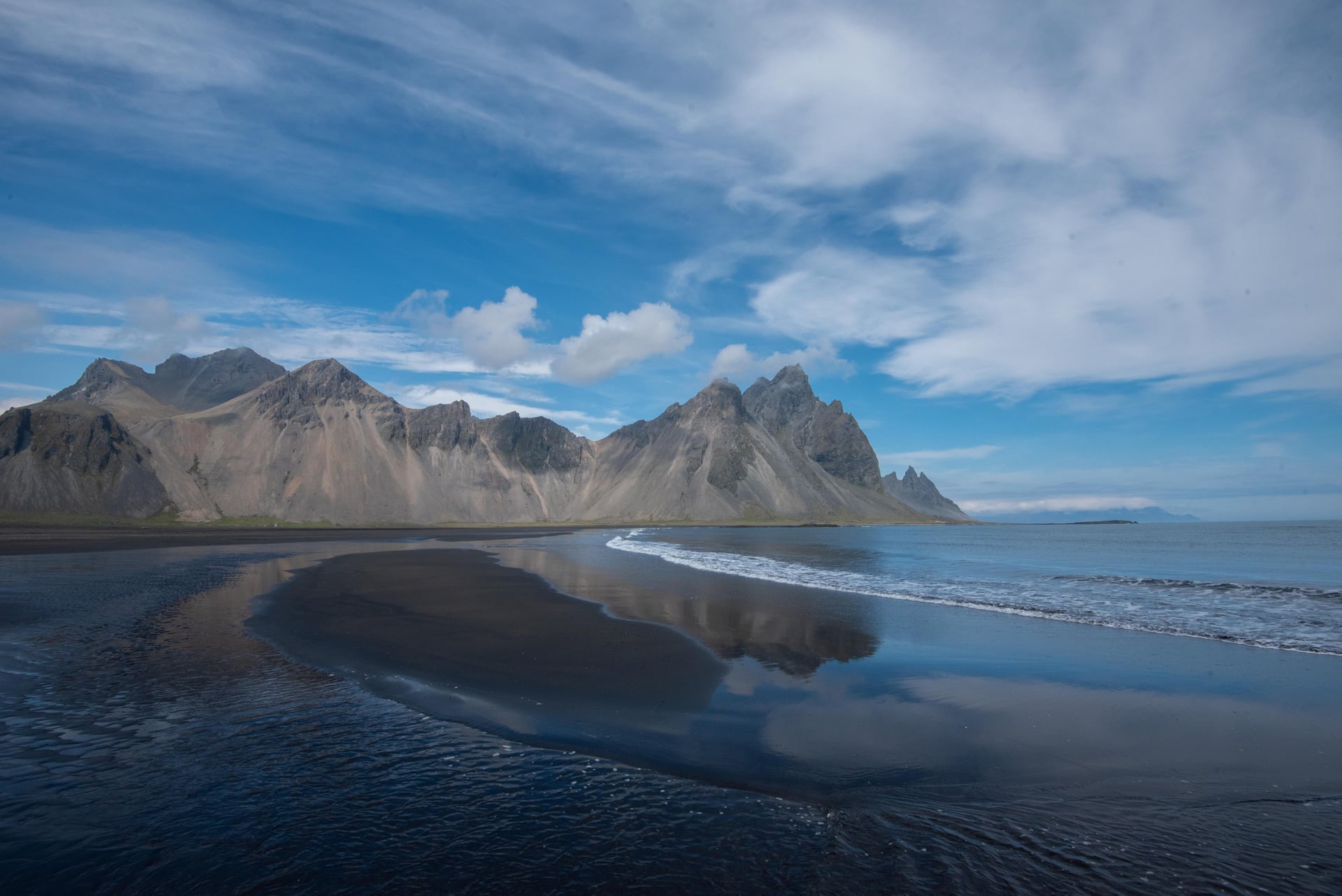
Stokksnes is one of those Icelandic coastal places that many people think they already know because they have seen Vestrahorn rising behind its black dunes. But the peninsula itself has a different personality from the mountain. Vestrahorn is the dark vertical presence in the background. Stokksnes is the exposed foreground world of sand, surf, military memory, roads, weather, and long Atlantic edges. If you write only about the mountain, you miss the place that makes the mountain legible. If you stand only looking at the classic reflection shot, you miss the fact that Stokksnes is not merely a frame for a landmark. It is its own destination, with its own atmosphere and history.
Visit South Iceland folds Horn and Stokksnes into one destination page, which is useful because the landscape really does work as a connected whole. The official text notes that during the Second World War the Horn area became a British army base, and that later a NATO radar station was established at Stokksnes, south of Horn. That historical layer matters because Stokksnes does not feel like untouched wilderness, even though it photographs like it sometimes does. The peninsula has been watched, occupied, crossed, and used strategically. The tension between wild appearance and human history is part of its power.
The Atlantic edge is central to the experience. Visit South Iceland says that at Stokksnes you can feel the power of the Atlantic Ocean as the waves hit the rocky shore with massive force. That description is more accurate than it might first sound. The place is not calm in the way some black-sand or lagoon landscapes are calm. Even when the weather seems visually quiet, Stokksnes often feels active. Wind moves through the grass and dunes, tide redraws the flats, and the sea keeps reminding you that the peninsula is exposed. This is one reason the place stays in memory so strongly. It feels open in every direction except the one where the mountain holds the horizon.
What makes Stokksnes especially satisfying for travelers is that it is a place of movement rather than one fixed viewpoint. The famous images tend to flatten it into a single compositional formula: black dunes, shallow water, and Vestrahorn behind. In person, however, the peninsula keeps shifting. Walk a little and the dunes change shape. Turn and the radar structures begin to matter. Move farther and the shoreline becomes rougher and less reflective. The beach, the headland, the grassy stretches, and the mountain all speak differently depending on where you stand. That makes Stokksnes ideal for a slower private stop rather than a quick park-and-shoot visit.
The access structure is also part of the place now, and it should be written honestly. The Vestrahorn site's Viking Café page makes clear that this is the human threshold for entering the area. The café has grown from a small shed into the practical gateway for the peninsula, and the site around it now shapes how visitors encounter Stokksnes. This does not cheapen the place. In fact, it can make the visit more legible. You pass through a managed edge before stepping into a landscape that otherwise feels cinematic and half-unruled. That contrast between organization and exposure gives the peninsula a distinctive tone.
The afterlife of imagination matters here too. The Vestrahorn site explains that the so-called Viking Village on the peninsula was originally built in 2009 as a film set for a project that was never completed and later used again for other productions. That means it is not heritage in the archaeological sense, but it still belongs to the story of Stokksnes. The peninsula has become a place where people repeatedly try to stage myth, fantasy, and old worlds against a landscape that already seems ready-made for them. That says something true about Stokksnes even when the structures themselves are recent and artificial. The land invites projection.
This is where Stokksnes differs most clearly from a simple scenic turnout. It holds several forms of time at once. There is deep settlement memory in the broader Horn area. There is twentieth-century military and radar history. There is the contemporary tourism layer, shaped by the café, the road, and managed access. There is the newer cinematic and visual afterlife of the film set. And beneath all of it there are the wind, the waves, the moving dunes, and the dark forms of the coast that make all these human layers seem temporary.
Photographically, Stokksnes is one of those places that improves when you stop chasing only perfection. Yes, in the right light the wet ground can give you reflections. Yes, Vestrahorn can look almost impossibly sharp behind the foreground. But the peninsula is often at its strongest when the image is less polished: blowing sand, gray surf, a broken horizon, people small against the grass, or the radar silhouette quietly interrupting the romance. Those elements make the place more truthful. Stokksnes is not only beautiful. It is exposed, strategic, and a little severe.
The weather works almost like an editor here. Bright light can make Stokksnes look expansive and graphic, emphasizing line and contrast. Cloud lowers the mood and draws more attention to the textures of shore and dune. Rain or mist can blur the mountain and leave the peninsula itself carrying more of the emotional weight. In strong wind, the place becomes almost tactile. You do not just observe it; you feel it pushing back. That makes it one of the best Southeast Iceland stops for travelers who enjoy atmosphere as much as landmark recognition.
Wildlife and coast also keep the peninsula from becoming a mere visual set. Visit South Iceland notes that seals can sometimes be found on the stretch of sand if you are lucky. That little detail matters because it reminds us that Stokksnes remains an ecological edge as much as a cultural one. Even the places most over-photographed in Iceland tend to recover some dignity when you remember they are still lived in by tide, birds, animals, and weather. Stokksnes has that dignity.
From a route-planning perspective, Stokksnes works beautifully near Höfn because it gives a Southeast Iceland itinerary something different from glacier lagoons and national-park hiking. Jökulsárlón and Fjallsárlón are about floating ice and slow melt. Skaftafell is about routes inward through a protected mountain-glacier landscape. Stokksnes is about edge: edge of sea and sand, edge of visibility and fog, edge of history and image culture. It broadens the emotional range of the region.
Stokksnes deserves to be understood on its own terms because many travelers searching for it are not asking only about Vestrahorn. They are asking about the beach, the peninsula, the Viking Village, the access arrangement, the radar history, and whether the foreground landscape itself is worth the detour. The fuller answer is yes. Stokksnes is more than the mountain behind it. It is the reason the mountain feels cinematic at all.
What stays with many visitors after Stokksnes is often a sense of edge rather than a single image. The dunes shift. The surf keeps striking. The mountain behind seems immovable, but the foreground is all change. Human traces remain, yet the place still feels ruled by weather. That combination gives the peninsula its charge. Stokksnes lingers because it is not only photogenic. It is one of Southeast Iceland's most convincing meetings between exposure, memory, and moving coastal land.