Iceland Travel Guides
Stuðlagil: Basalt, River Memory, and the Valley That Finally Opened
A fuller private guide to Stuðlagil, with its towering basalt columns, changed river story, Jökuldalur context, crossing history, and the reason this East Iceland canyon feels both newly revealed and deeply old.
GlaciGo Iceland / May 2026 / 11 min read
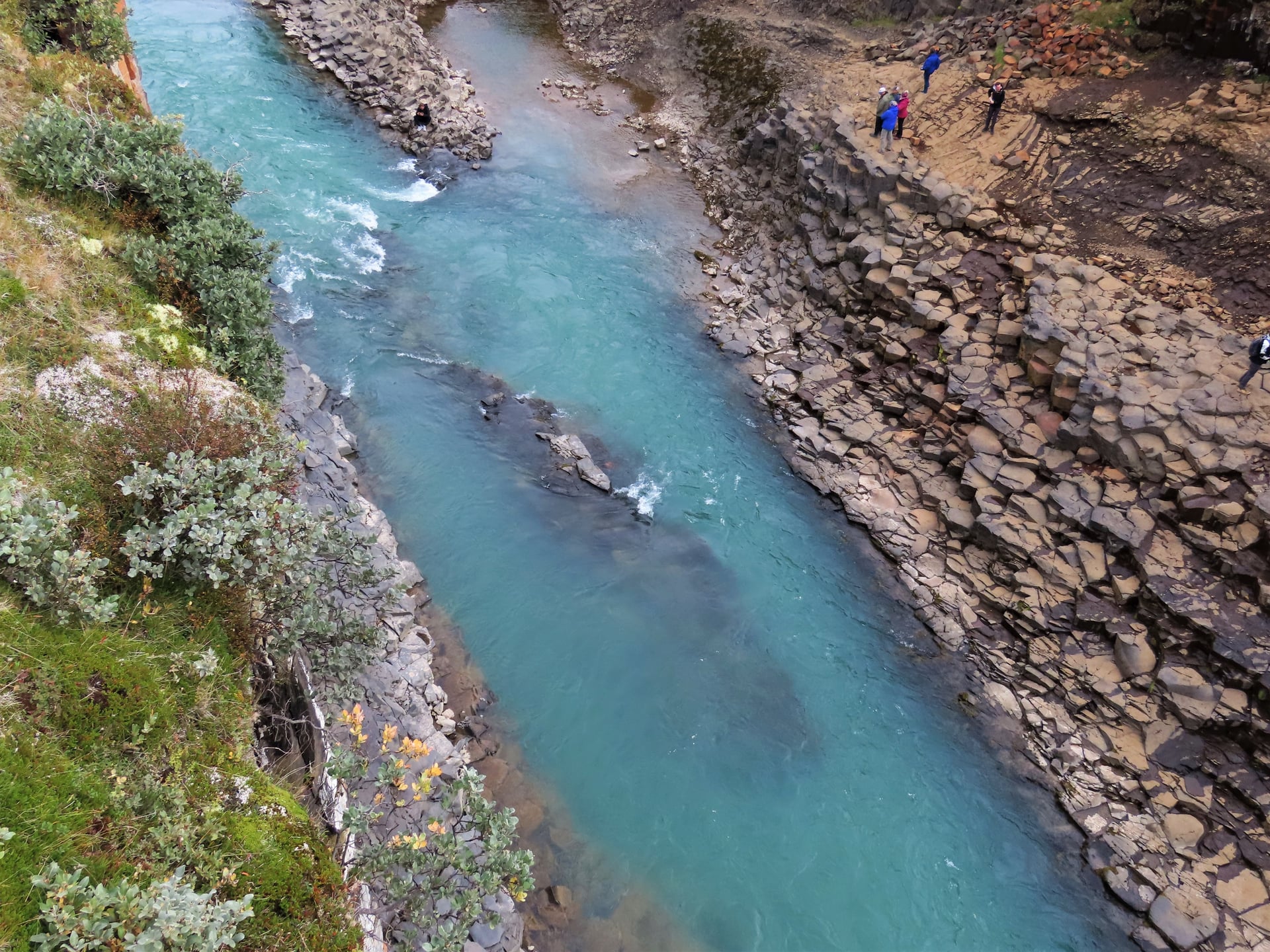
Stuðlagil is one of those Icelandic places whose beauty arrived in public consciousness almost all at once, even though the canyon itself had been there for ages. That suddenness matters. Many tourists meet Stuðlagil first through photographs: a narrow ribbon of blue-green water, dark basalt walls rising like organ pipes, and hikers standing at the bottom of a canyon that seems too geometric to be accidental. But the real story is more interesting than a social-media discovery tale. Stuðlagil is about a river that changed, a valley that had long lived with that river in a very different mood, and a landscape whose most photogenic form only became broadly visible after major hydropower works altered the flow of Jökulsá á Dal, or Jökla.
Visit Austurland describes Stuðlagil as one of the largest and most beautiful basalt column formations in Iceland, and it helps immediately to treat that statement with seriousness rather than as tourism exaggeration. The canyon walls on both sides of the river extend along a long stretch, with columns reaching roughly 20 to 30 meters in height. These are not decorative little fragments of columnar basalt tucked into a roadside cliff. They create a full architectural space. The effect is not merely that the rock is patterned. It is that the canyon feels built, almost as if some patient and indifferent intelligence had assembled a ceremonial corridor out of dark stone.
Geologically, the place is rich enough to deserve a slower reading. According to Visit Austurland, the gorge lies just below the confluence of Jökulsá and Eyvindará, where a basalt dike cuts through the Jökulsá riverbed, and an intrusive layer from this dike is believed to form Stuðlagil. That detail gives the canyon a different character from places that are only appreciated as river scenery. Stuðlagil is not just a river passing through pretty rock. It is a place where the cooling logic of basalt, the structural grain of an intrusion, and the cutting force of water have ended up perfectly legible together. The columns stand because magma once cooled, contracted, and split itself into joints. The canyon reads so clearly because the river later exposed and emphasized that geometry.
The scientific explanation of columnar basalt is also part of the poetry here. As basalt continues cooling after solidifying, it contracts and separates into polygonal columns, often hexagonal. Those columns stand perpendicular to the cooling surface. In Stuðlagil, that basic volcanic rule becomes visible at a monumental scale. A visitor does not need to know the term columnar jointing to feel the pleasure of that order, but understanding it deepens the experience. It turns the canyon from a beautiful accident into a visible memory of lava becoming stone with almost mathematical discipline.
And yet geology alone does not explain why Stuðlagil feels so contemporary in the Icelandic imagination. The emotional hinge in the story is hydrological. For a long time, Jökla was known as a powerful, murky glacial river carrying enormous loads of sediment. Visit Austurland notes that it was once considered the murkiest river in the country. That older river hid much of what tourists now come to admire. When water from Jökla began flowing into the Hálslón reservoir after the Kárahnjúkar hydropower development, the volume and character of the river downstream changed dramatically. Much of the glacial water was redirected through tunnels toward Fljótsdalur, and the canyon below became far more visible and accessible.
This makes Stuðlagil one of the more complicated beauty stories in Iceland. Its fame is inseparable from a large infrastructure project that changed a river system. There is no need to turn that into a simplistic judgment in either direction. What matters for a thoughtful traveler is simply to understand that the canyon's modern visibility is tied to a very recent human intervention in the watershed. The turquoise-blue or blue-green water many visitors hope to see is not some timeless postcard constant. Visit Austurland notes that the color changes with season and conditions, and that during overflow periods and snowmelt the water can turn grey-brown again. In other words, the famous color is real, but it is conditional. Stuðlagil is not fake when it turns darker. It is just showing more of its river history.
That river history is one of the most humanly interesting parts of the place. Before dams, tunnels, and improved roads, Jökulsá was not an aesthetic feature first. It was an obstacle. Visit Austurland explains that the river's strength, volume, and turbidity made it hard to ford and difficult to cross reliably. Bridges came slowly. A documented man-made bridge existed already by the mid-sixteenth century at Brúarás, and later bridges followed, including a concrete bridge in 1931. At Klaustursel, an iron bridge was built in 1908 and still stands. Even more evocative are the old cable cars once used to cross narrow gorges, with a wooden box pulled by hand from bank to bank. That image belongs in the article because it reminds us that local life in Jökuldalur was shaped by labor, distance, and ingenuity long before visitors arrived with drones and camera straps.
This older crossing history gives Stuðlagil a deeper emotional texture. What many tourists experience as revelation was, for valley residents, part of a harder practical world. The river that now frames photographs once separated farms, delayed travel, and demanded stubborn local solutions. Seen this way, Stuðlagil becomes more than a hidden gem story. It becomes part of a broader Jökuldalur narrative about endurance on the edge of a difficult river landscape.
The local setting matters just as much as the canyon itself. Visit Austurland places Stuðlagil near the farms Grund and Klaustursel in upper Jökuldalur. The canyon is therefore not suspended in some untouched fantasy wilderness. It belongs to an agricultural valley. Sheep are still moved down from the mountains in autumn, birds nest in the area from spring into early summer, and the roads are shared not only by tourists but also by farmers, tractors, and the everyday rhythms of a lived landscape. The official Studlagil Canyon site also emphasizes this point when it describes route 923 as a narrow rural road used by farm traffic, cyclists, reindeer, and local vehicles. That context matters because it changes the tone of a visit. You are entering a region with its own working life, not a purpose-built attraction zone.
For tourists, another important distinction is how the canyon is actually experienced. Visit Austurland makes clear that Stuðlagil can be viewed from both banks, but the two encounters are meaningfully different. The north or west side near Grund offers observation platforms, maintained access, and a shorter, more immediate overview from above and along safer walking routes. The east side via Klaustursel and the path toward Stuðlafoss is the route many people know from close-up images at river level. That side asks for more walking and a little more patience, but it offers the feeling of descending into the canyon's physical scale rather than simply looking at it. A good article should not pretend one side is the only correct choice. They serve different temperaments: one gives clarity and accessibility, the other gives intimacy and effort.
The nearby Stuðlafoss also deserves mention because it quietly broadens the experience. Just below the main canyon area, Fossá flows over a columnar basalt layer and forms a waterfall where the basalt appears almost like steps. This helps visitors understand that Stuðlagil is not a single isolated miracle. It belongs to a wider basalt-rich river environment. The eye starts to notice a regional logic instead of one famous photo spot.
Season also changes the meaning of the place more than many quick guides admit. The official canyon site notes that access and conditions differ through the year, that the road has limited winter service, and that visitors should check road and weather conditions before setting out. Visit Austurland adds that the area is delicate and that people should stay on marked paths, especially during nesting season for pink-footed geese and other birds. This is not merely a safety paragraph. It actually fits the spirit of Stuðlagil. The canyon teaches, better than many famous Iceland sites, that beauty does not eliminate responsibility. The more the place is photographed, the more discipline is required from the people who come to see it.
From a travel-writing point of view, Stuðlagil succeeds when it is described as a place of revelation rather than spectacle alone. The canyon feels memorable not just because it is beautiful, but because it lets people witness a landscape in layers: volcanic formation, glacial river history, infrastructural change, farming life, access politics, and the modern desire to find something that still feels newly discovered. That combination is rare. Many places in Iceland are immediately grand. Stuðlagil is more interpretive. It becomes richer the more context you allow into the frame.
Studlagil is more than basalt columns and blue water. Travelers need the fuller picture: the practical access, the geology, the photographic appeal, and the reason it became widely visible only after the river changed. That distinction matters. Studlagil is one of East Iceland's most striking canyons, but it is also a story about a changed river and a lived valley.
What stays with many visitors after Stuðlagil is not only the shape of the rock, though that shape is unforgettable. It is the strange feeling of seeing something both ancient and newly revealed. The basalt is old. The river carved for a long time. The valley's people adapted over generations. But the version of Stuðlagil that much of the world now recognizes belongs to the present. That tension gives the canyon its peculiar emotional charge. It is a place where time, geology, and modern change all remain visible at once, and that is why it lingers in the mind long after the photographs have been taken.