Iceland Travel Guides
Stykkishólmur: Harbor Light, Bay Memory, and the Shape of a Town
A fuller private guide to Stykkishólmur, with harbor identity, old houses, Breiðafjörður orientation, Library of Water, church history, and the wider civic depth that makes this town more than a ferry stop.
GlaciGo Iceland / May 2026 / 10 min read
Stykkishólmur is one of the few towns in Iceland that can feel both clearly useful and unmistakably poetic at the same time. It is a working harbor, a ferry point, a gateway to Breiðafjörður, a place of weather, boats, warehouses, and daily routine. But it is also one of those settlements where the physical arrangement of sea, hill, church, old houses, and islands in the bay creates a mood that stays with people longer than many technically bigger attractions. A strong article about Stykkishólmur has to keep both truths alive: this is a town you use, and a town you remember.
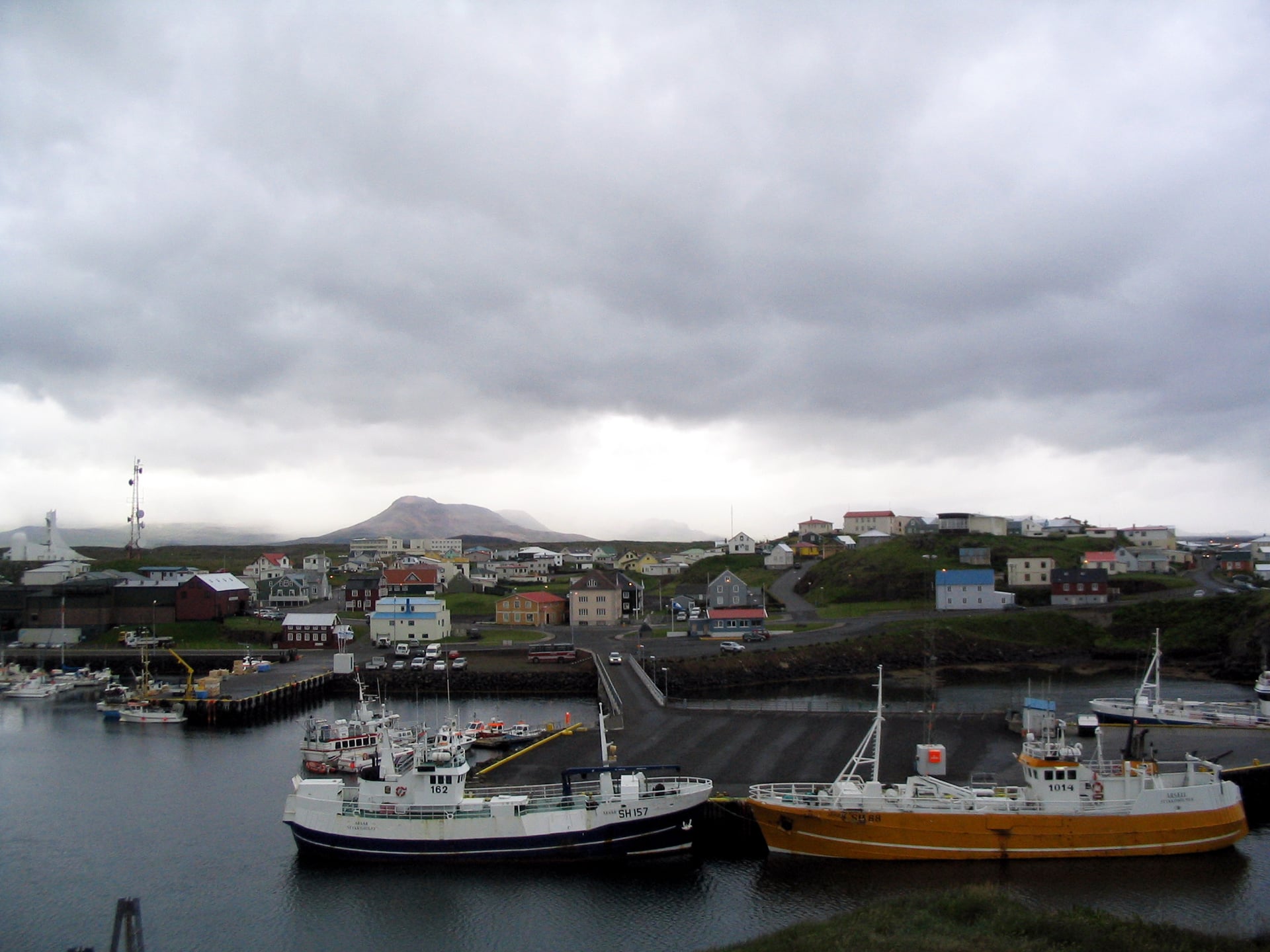
West Iceland's official description starts in the right place: Stykkishólmur stands on the northern side of Snæfellsnes and is known for its beautiful and well-preserved old houses, while also serving as the gateway to the islands of Breiðafjörður. That pairing matters. The town is not charming by accident. Its architecture and harbor identity belong to its role in the bay. Stykkishólmur faces one of Iceland's most intricate marine landscapes, and the town's personality comes from that long conversation with islands, crossings, and sea routes.
Breiðafjörður is central to understanding the place. A town on an ordinary coast might turn inward once you leave the harbor. Stykkishólmur keeps looking outward. The bay scatters the eye into distance, island after island, and the settlement seems built for that habit of orientation. Even the pace of the town feels shaped by it. Ferries, boats, sea air, and the practical fact of departure all give Stykkishólmur a slightly different rhythm from inland Icelandic towns. It is a place of edges and onward movement, but without the harshness that often comes with exposed Atlantic coasts.
This harbor logic is one reason Stykkishólmur feels so different from the more theatrical Snæfellsnes stops. Many places on the peninsula are about dramatic landforms first: glacier, stacks, crater, gorge, black beach. Stykkishólmur is more civic and maritime. The beauty comes through arrangement rather than raw force. Old houses hold their line against the water. The church rises above town not as an isolated monument, but as part of a recognizable urban silhouette. The harbor collects working life, tourism, and memory without collapsing into a caricature of any of them.
The church is a good example of this layered effect. The official Stykkishólmskirkja site notes that the current church was inaugurated on 6 May 1990, while the older church at Aðalgata 5 was built in 1879 and served the town for more than a century. That chronology matters because Stykkishólmur's visual identity is not only old-world picturesque. It contains a conversation between old timber-town continuity and more recent architectural ambition. The church on the promontory is one of the most recognizable signals of the town, but it becomes more meaningful when set beside the surviving older church and the preserved house fabric below.
Another important layer comes from the town's cultural institutions. West Iceland's page on the Library of Water explains that Vatnasafn is Roni Horn's long-term project in a former library building in Stykkishólmur. It is difficult to imagine a more appropriate artwork for this town. Weather, water, atmosphere, and observation all belong deeply to life around Breiðafjörður, and the Library of Water makes those elements conscious rather than merely background. The project suggests that Stykkishólmur is not only a scenic harbor. It is a place where climate, perception, and local experience can be thought about with unusual seriousness.
The same West Iceland source notes that interviews were conducted with around a hundred people from Stykkishólmur and the surrounding area about the weather. That detail is beautiful because it captures something essential about Icelandic coastal life. In a town like this, weather is not small talk. It is memory, practical knowledge, mood, and a way of reading the world. Stykkishólmur has enough visual beauty that outsiders might mistake it for a purely aesthetic place. But the weather archive hidden inside the town's cultural life reminds us that it is also a place of lived attentiveness.
Stykkishólmur's religious and institutional history adds another, quieter register. The historic material connected to the Fransiskus house records that Catholic sisters arrived in the 1930s to build a monastery, chapel, and hospital for the region. That story matters because it shows Stykkishólmur not just as a local harbor town but as a service center with a wider moral and social radius. The town did not only move goods and people through the bay. It also gathered care, religion, and regional responsibility into itself. That tends to deepen a place's feeling, even when visitors do not know the whole history on arrival.
There is also a literary-historical halo nearby through Helgafell, just south of town. West Iceland's own material on the holy mountain describes it as a place of pagan roots, regional assembly, monastery, faith, and continuity. Even when a visitor stays mostly in Stykkishólmur itself, the presence of Helgafell in the wider municipal landscape subtly enlarges the town's historical field. Stykkishólmur is not a harbor town floating free of deeper Icelandic memory. It sits within a district where religion, saga inheritance, and older learning traditions remain close at hand.
For tourists, one of the best things about Stykkishólmur is that it rewards ordinary movement. You do not need a big reveal. Walk the harbor. Notice the old houses. Climb toward the church. Watch the changing light over the bay. Let the town behave like a town rather than demanding a single headline attraction. This is often where visitors relax into it. Stykkishólmur does not insist. It accumulates.
That accumulation also makes it strong on a private itinerary. It can function as a base, a pause, an overnight, a ferry connection, a museum town, or simply a change of texture after a day of peninsula landscapes. Because it is genuinely inhabited rather than purely touristic in feel, it gives a different kind of satisfaction. You leave with the sense not only of having seen a place, but of having briefly entered its tempo.
Stykkish?lmur is much richer than a quick ferry-town label suggests. Travelers may come wondering whether it is worth staying in, whether it is only a transit point, what gives it its charm, and how it fits into a Sn?fellsnes trip. The deeper answer is that Stykkish?lmur may be one of the peninsula's most complete human-scale destinations: maritime, historic, architecturally coherent, culturally alive, and always in conversation with the bay.
What stays with many travelers after Stykkishólmur is a feeling of composed openness. The town is small, but it faces a very large world of water and islands. It is practical, but not plain. It is pretty, but not empty. That balance is hard to achieve and even harder to fake. Stykkishólmur has it honestly. That is why it lingers.