Iceland Travel Guides
Svartifoss: Basalt Geometry and the Pleasure of Arrival
A fuller private guide to Svartifoss, with basalt-column geology, trail context, architectural influence, and the distinct rhythm of reaching it on foot.
GlaciGo Iceland / May 2026 / 9 min read
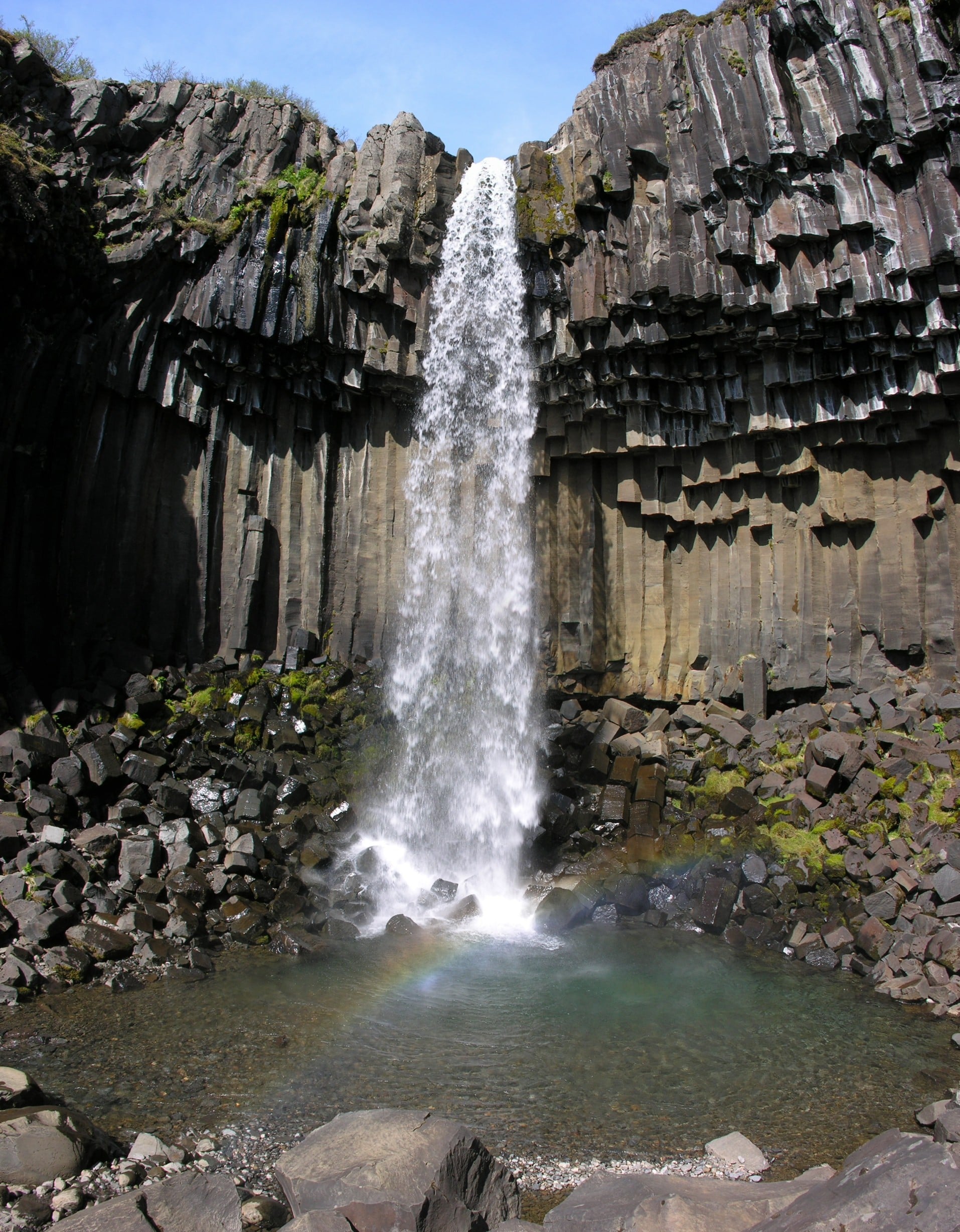
Svartifoss is one of those waterfalls that people often remember first as a shape rather than a movement of water. Before the mind files it under waterfall, it notices the frame: dark basalt columns, geometric and severe, rising around a white drop that seems almost too delicate for the architecture behind it. That tension is what makes Svartifoss different. It does not rely on sheer height or overwhelming force. Its power comes from composition. The waterfall feels as though nature paused long enough to arrange stone and water into something almost ceremonial.
Visit South Iceland describes Svartifoss as one of the unique waterfalls of South Iceland and notes the essential facts clearly: it is about 20 meters high, it lies in Skaftafell within Vatnajokull National Park, and it is bordered on both sides by tall black basalt columns. The official national park material goes further and explains why those columns look the way they do. According to Vatnajokull National Park, the basalt formations at Svartifoss were created around 300,000 years ago, when lava flowed down the Skaftafellsheidi plain and filled an old riverbed. As the lava slowly cooled, the rock contracted and split into columns standing perpendicular to the cooling surface. That geology matters because it changes the waterfall from a pretty sight into a readable event.
Once you know that, the place begins to feel like a lesson in natural structure. Water is the moving element, but the drama is carried equally by cooling rock. The basalt columns do not merely decorate the waterfall. They define its emotional register. They make Svartifoss feel almost architectural, one reason it is so often singled out from among Iceland's many waterfalls. The name 'Black Falls' starts to make intuitive sense even before you translate it. The darkness is not gloom here. It is form.
That sense of form is one reason Svartifoss has had a cultural life beyond the trail itself. It is widely cited in Icelandic travel and architecture writing as one of the natural inspirations behind basalt-informed design language in Iceland, especially in connection with Hallgrimskirkja in Reykjavik. Even when that connection is repeated in a simplified way, the larger idea is still useful: Svartifoss helps explain how Icelanders have looked at their own geology not only as scenery, but as a source of visual thought. The waterfall is beautiful, yes, but it is also instructive. It teaches proportion, rhythm, repetition, and contrast.
The walk to Svartifoss is part of the experience and should not be treated like dead time between parking lot and photo stop. Visit South Iceland says the hike begins at the visitor centre in Skaftafell and takes about 1.9 kilometers or roughly 45 minutes one way. Vatnajokull National Park's Svartifoss route material adds another important dimension: the route through the forest is a meaningful experience in every season, and the wider S2 circuit can include views of Hundafoss, Magnúsarfoss, Sjonarsker, and the old sod house at Sel. This helps distinguish Svartifoss from roadside waterfalls. You earn it gradually, through woodland, slope, and smaller encounters, so the final composition lands with more weight.
That gradual approach is one reason the waterfall works so well on a private itinerary. Many Iceland stops are built around instant spectacle. Svartifoss introduces a different rhythm. You leave the service zone, begin walking, and allow the landscape to narrow toward one destination. Along the way, the wider logic of Skaftafell starts to reveal itself: sheltered vegetation, altitude change, smaller falls, and the sense that this part of southeast Iceland is not only about raw exposure, but also about transitions between softness and severity.
It also helps that Svartifoss is not oversized. If it were much taller, the basalt amphitheater might become secondary. If it were much wider, the delicate vertical emphasis might weaken. At around twenty meters, the scale is almost exactly right for what the place is trying to do. The water descends in a way that keeps your attention moving between the fall itself and the columns beside it. You do not only watch the drop. You read the surrounding structure.
This is one of the places where tourism language often slips into the word 'iconic,' and for once the word is not entirely lazy. Svartifoss is iconic not because it is the biggest, but because it is one of the clearest examples in Iceland of a natural scene with instantly recognizable design logic. A person may forget the names of ten other waterfalls and still remember this one as the waterfall with the basalt walls. In search behavior, that matters. In actual experience, it matters too. The image fixes itself quickly in memory.
Photographically, Svartifoss is more demanding than it first appears. The obvious frame is strong and almost unavoidable: full waterfall, dark columns, plunge basin, broken rock below. But precisely because that frame is so well known, the better photographs often depend on restraint. A tighter emphasis on column pattern. The white line of water against the black hexagons. Broken basalt at the base echoing the vertical walls above. Or a composition that includes a little of the surrounding slope to remind viewers that this is still a waterfall reached on foot through a larger national-park landscape, not a freestanding monument dropped into a studio backdrop.
Season changes the emotional tone of Svartifoss significantly. In greener months, the contrast between dark rock and surrounding life makes the waterfall feel almost theatrical, as though the vegetation were holding back to let the columns dominate. In colder months, when the palette narrows and the air hardens, the site can feel more severe and sculptural. Because the route itself is part of the experience, weather and trail condition also shape the visit more than they would at a purely roadside stop. That is not a drawback. It is part of why the article should describe Svartifoss as an encounter rather than just an object.
There is also a useful way to separate Svartifoss from Skaftafell in writing, even though the two are inseparable on the ground. Skaftafell is the wider sheltered world of trails, farm history, glacier rivers, and human scale under ice. Svartifoss is one distilled expression of that world: a place where volcanic process becomes visual order and where the walk itself teaches you to arrive more carefully. The waterfall belongs to Skaftafell, but it is not swallowed by it. It still has its own voice.
Svartifoss works best as a place-specific stop rather than a footnote in a broader Skaftafell plan. Travelers naturally want to know how long the walk takes, what makes the basalt columns special, whether the waterfall is worth the approach, and why it feels different from Iceland's larger falls. The answer lies in the combination of arrival, geometry, geology, and cultural influence.
What stays with many visitors after Svartifoss is not simply that it was beautiful, but that it felt composed at several scales at once. Lava cooled into columns hundreds of thousands of years ago. Water now falls through that frame in a single clean descent. People walk a forest trail to stand before it for a few minutes and then continue on. Ancient geology, short human attention, one waterfall holding both. That is the deeper elegance of Svartifoss. It is not grand in the same way as the largest Icelandic falls. It is more exact, and sometimes exactness lasts longer in memory.