Iceland Travel Guides
Svörtuloft Lighthouse: Red Signal, Black Cliffs, and the Edge of Snæfellsnes
A fuller private guide to Svörtuloft Lighthouse, with its black-cliff setting, land-and-sea naming logic, volcanic coast, bird-cliff atmosphere, and end-of-road feeling on Snæfellsnes.
GlaciGo Iceland / May 2026 / 10 min read
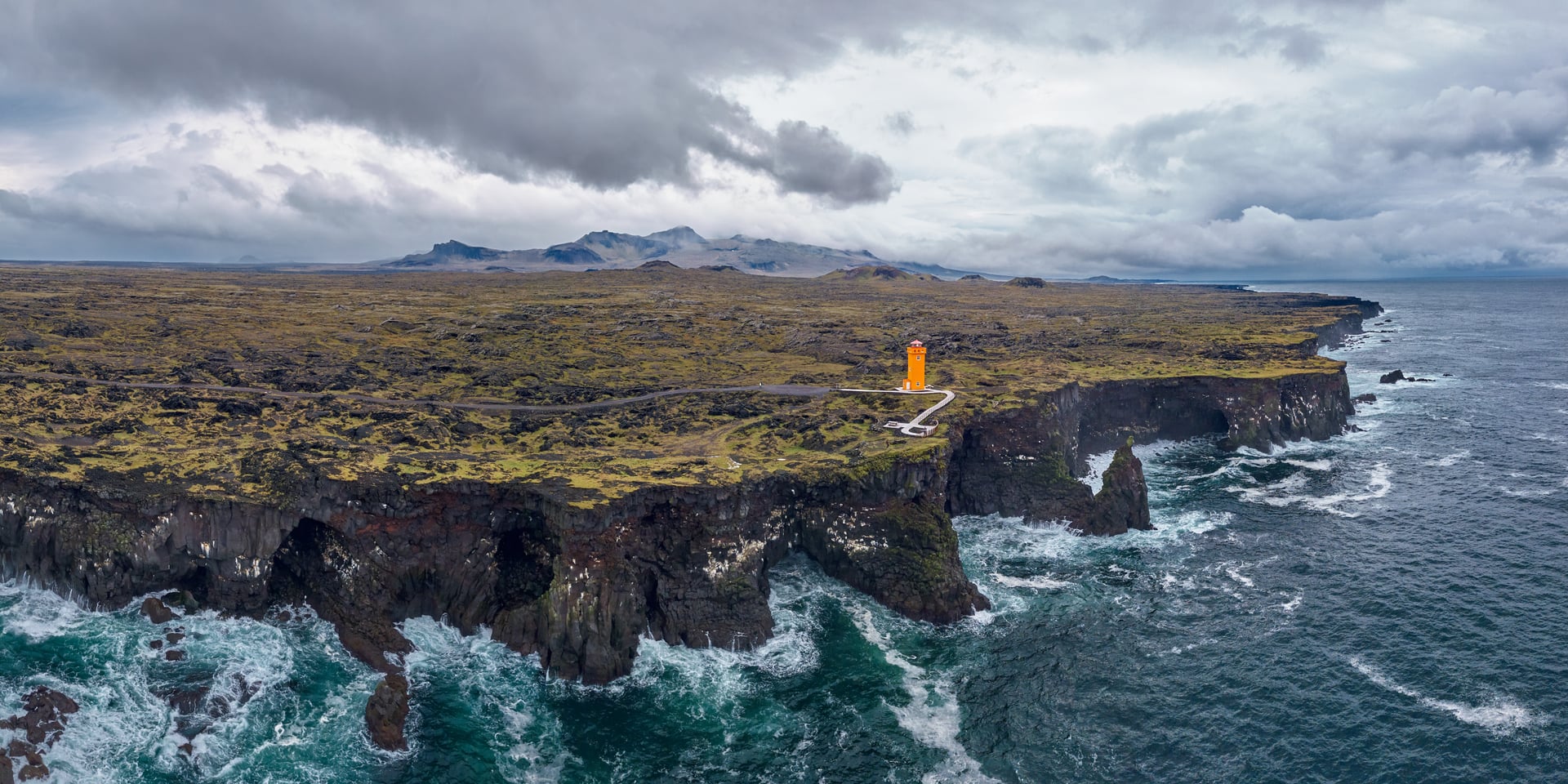
Svörtuloft Lighthouse is one of those places in Iceland where color does almost all the work at first. The lighthouse is bright, warm, almost playful in tone, while everything around it feels severe: black cliffs, Atlantic exposure, seabird country, wind, distance, and the sense that the road has reached one of its last meaningful edges. That contrast is so strong that many visitors remember Svörtuloft first as an image. But if you stay a little longer, it becomes more than a photograph. It becomes one of the clearest places on Snæfellsnes to feel how lighthouse logic, volcanic coast, and open-ocean mood fit together.
There is also an important naming detail that helps the place make more sense. West Iceland's official listing uses the land name Skálasnagaviti and explains that the lighthouse stands on the cliff Saxhólsbjarg, which is called Svörtuloft from the sea. That small distinction matters more than it first appears. It tells you that this headland has been read differently depending on where you approach it from. From land, it is one named place. From sea, it is another. That is a deeply coastal kind of truth, and it suits a lighthouse article especially well. This is not simply an isolated red building at a scenic point. It is part of a maritime geography with different names, different bearings, and different meanings depending on whether you are looking from road or water.
West Iceland keeps the description short but effective: the lighthouse is located on the cliff and is popular because of its extraordinary surroundings and extreme nature. That may sound almost too simple, yet it is exactly right. Svörtuloft is not a complicated stop in the ordinary tourist sense. The power comes from the surroundings. The coast is dark, sharp, and exposed. The lava cliffs stretch outward with a stripped, nearly elemental feeling. The lighthouse does not dominate that environment so much as punctuate it. Its real achievement is visual and psychological. It gives the end of the headland a fixed point without softening the severity of the place.
This is one reason Svortuloft benefits from a fuller explanation rather than a brief lighthouse mention inside a bigger Snaefellsnes route. traveler questions here is usually image-driven at first: people want to know where the red lighthouse is, whether the drive is worth it, and what else is nearby. But the stronger answer is that Svortuloft works as one of the peninsula's clearest end-of-road experiences. It is about arriving at a place where the road, the cliff, and the ocean all seem to run out together. That emotional structure is what makes the stop memorable.
The Commons file record for one of the best-known photographs describes Svörtuloft plainly as the lighthouse at the westernmost end of Snæfellsnes. Even without over-literalizing that phrase, it captures the sensation accurately. The site feels terminal in the best sense. You have gone far enough that normal inland logic weakens. The Atlantic begins to take over the imagination. Even on a calm day, the place feels like a contact zone between Iceland and much larger weather.
The volcanic geology around the lighthouse gives that feeling its physical form. Wikimedia's structured categorization around the site ties Svörtuloft to lava platforms, magmatic dikes extending as reefs, and volcanic landforms of the Snæfellsjökull system. You do not need to turn the visit into a technical geology lecture to appreciate what that means. The headland looks the way it does because fire once built the platform and the sea has spent time cutting, exposing, and clarifying it. Black coastal cliffs and a red lighthouse are not just pretty contrasts. They are the visible result of Iceland's usual argument between eruption and erosion.
This gives Svörtuloft a different personality from other Icelandic lighthouses. Some are defined mostly by open green headlands, some by fishing-town context, some by iconic solitude on sea stacks or peninsulas. Svörtuloft is more severe and more volcanic. It feels less domestic than Garðskagi and less purely maritime-historical than Reykjanesviti. Here, the dominant impression is the collision of lighthouse order with black geological edge.
The seabird layer matters too. Public references to Svörtuloft consistently treat it as cliff country rather than merely a roadside lighthouse. That matters because bird cliffs change how people behave, how they listen, and how they understand the scale of the coast. A lighthouse beside a broad meadow feels one way. A lighthouse above dark cliff faces used by birds feels another. Even when the birds are not the main purpose of the stop, they belong to the site's identity. The place reads as habitat as much as as infrastructure.
The drive out there is part of the experience. Like many of Snæfellsnes's best western-edge places, Svörtuloft feels stronger because you do not simply stumble into it from a main highway. You move through a sequence: the peninsula narrows, the built world thins, and the mood shifts from regional travel to edge travel. This is important because good lighthouse experiences are often about approach as much as object. By the time you see Svörtuloft, you are already prepared to receive it as a marker of remoteness rather than just a building.
Nearby places such as Skarðsvík, Saxhóll, and the broader Snæfellsjökull National Park frame the lighthouse especially well. West Iceland places Skálasnagaviti naturally among those neighboring stops, which makes sense. Svörtuloft is rarely the only stop in this western-end chapter of a Snæfellsnes route, but it often becomes one of the most emotionally distinct ones. A yellow beach, a crater, a lava coast, and a red lighthouse create a sequence that helps visitors understand just how varied this corner of the peninsula can be within a small geographical area.
Photographically, Svörtuloft is almost impossible to approach badly at a basic level, because the color contrast is already so strong. But the deeper challenge is avoiding cliche. The best images usually respect the scale of the headland and let the lighthouse remain part of a larger composition of cliff, sea, and sky. If you isolate it too tightly, the place can start to look like a simple postcard object. The real power is in seeing how small human guidance systems look against the black coast they are meant to serve.
The mood changes dramatically with weather, perhaps more than visitors expect. In bright conditions, the red tower can feel cheerful, almost graphic. In fog, wind, or low cloud, the site becomes much more serious. The lighthouse begins to look less decorative and more necessary. That shift is one of the strongest reasons to value the stop beyond its Instagram familiarity. Svörtuloft is not just photogenic. It is atmospheric in a way that reminds travelers why such structures exist at all.
That functional truth matters. A lighthouse is not placed here to beautify the cliffs. It is placed here because coasts like this are difficult, dark, and consequential. The scenic value we now enjoy comes after the practical reason. Remembering that gives the stop more dignity. The red lighthouse becomes not simply a visual icon but part of a long system of reading coastlines, guiding movement, and negotiating hazard.
Svortuloft benefits from a fuller explanation because too many summaries flatten it into one line about a red lighthouse on a black cliff. That is true, but it leaves out the land-versus-sea naming distinction, the volcanic-coastal setting, the bird-cliff atmosphere, the end-of-road quality, and the reason the stop feels stronger in person than in a single photo. The better description is that Svortuloft is one of Snaefellsnes's clearest edge experiences: a lighthouse stop where geology, ocean, and orientation all become visible at once.
What stays with many visitors after Svörtuloft is usually not the building alone. It is the feeling of having reached a place where Iceland becomes very simple again: cliff, sea, wind, birds, lava, horizon, and one bright human marker holding its position against all of it. That is why Svörtuloft lingers. It reduces the landscape to essentials without making it feel empty. Instead, it makes it feel exact.