Iceland Travel Guides
The Cave Víðgelmir: A Guided Way into West Iceland's Underground World
A fuller private guide to The Cave Víðgelmir, with its guided lava-cave format, preservation logic, geology, archaeology, tour pacing, and place inside a West Iceland itinerary.
GlaciGo Iceland / May 2026 / 10 min read
The Cave Víðgelmir is one of those Iceland experiences that works best when you understand that you are not simply visiting a cave. You are entering a carefully guided translation of a cave: a volcanic place that would otherwise be too dark, too fragile, too complex, and too easy to misunderstand if left entirely to chance. The difference matters. Víðgelmir itself is one of West Iceland's great natural sites, but The Cave is the specific visitor experience that allows most travelers to encounter it in a way that is structured, legible, and still atmospheric.
That separation between place and experience is useful for planning. V??gelmir is the lava tube itself, while The Cave V??gelmir is the guided visitor experience that shapes how most travelers encounter it. Someone considering the tour usually wants practical, human answers: what the route feels like, how guided it is, how easy the walking is, and what kind of mood the cave creates once you go inside.
The Cave's own official homepage makes the core offer very clear. This is a 1.5-hour guided visit into one of the world's biggest lava caves, with a strong emphasis on learning how immense natural forces sculpted the land. West Iceland's tourism site supports the same picture and adds an important qualitative note: unlike the stereotype of caves as dark, tight, and uninviting, Víðgelmir is unusually spacious and accessible. Together, those two points define the experience well. The tour is not a technical caving expedition. It is an interpretive underground walk through a major lava tube, designed to be memorable without pretending to be an adrenaline challenge.
That design matters because Víðgelmir is naturally dramatic enough that it does not need artificial adventure language. The Cave's official materials describe the beauty of the lava cave as lying in its colors and formations, things that once hid in darkness but are now made visible through guided access. That is a useful way to frame the experience. The tour is not about conquering an extreme environment. It is about being allowed to see what would otherwise remain unreadable. Walkways, lighting, helmets, and guides are not there to flatten the cave into a theme-park version of itself. At their best, they make the underground world understandable without stripping it of mystery.
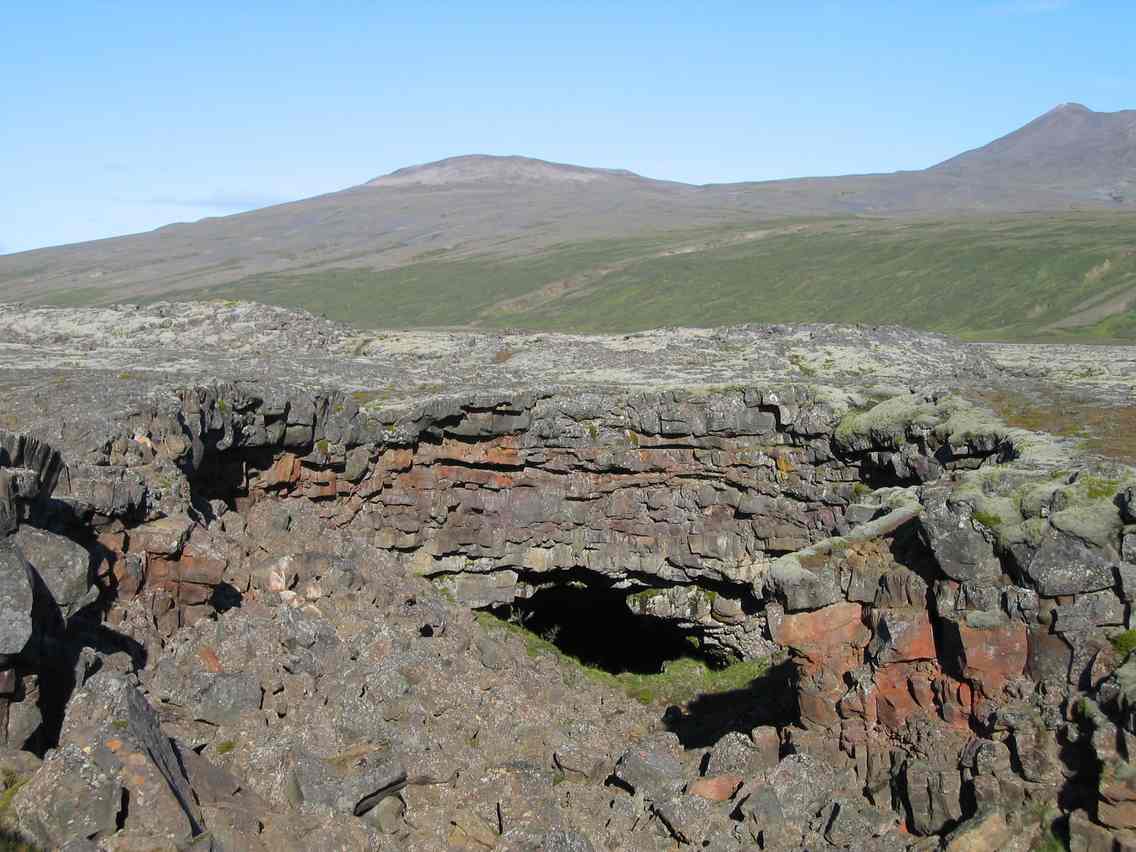
The geology gives the tour its backbone. The Cave's official "About the Cave" page says Víðgelmir lies in Hallmundarhraun, the largest lava field in Borgarfjörður, and that four of Iceland's five biggest known caves are found in that lava field. It also explains that the eruption behind Hallmundarhraun is usually dated to around the year 900 and may have lasted years. That geological timescale transforms the tour from a simple walk into a lesson in creation. You are not walking through a decorative hole in the ground. You are moving through the hollow artery of a major early-Icelandic lava event.
But what makes The Cave memorable is not geology alone. It is the guided pacing that lets visitors notice how lava behaves when it has hardened into architecture. Broad chambers, collapsing textures, strange colors, ice, delicate formations, and immense open volume all reveal themselves in sequence. A self-guided visitor with a flashlight might see only surfaces. A well-structured guide helps the cave become a story: eruption, flow, cooling, sealing, rediscovery, preservation, and modern access.
The preservation story is especially important to the identity of the tour. The Cave explains that Víðgelmir stayed unusually well preserved because ice gradually closed the cave in the 1960s, effectively sealing it by 1972. It was reopened in 1994 and then protected again with a metal gate the following year. That history helps explain why the cave still feels rich rather than exhausted. The experience you are buying into is shaped by conservation as much as by tourism. The cave remained intact because access was interrupted, and modern access now depends on controlled guidance rather than casual entry.
This is one of the strongest arguments for treating The Cave as a serious tourism product rather than just a ticket desk attached to a landmark. Good nature tourism in Iceland often depends on exactly this kind of mediation. A guide does not merely tell you facts. The whole operation creates the conditions under which the landscape can be visited without being ruined. In a lava cave, that matters intensely. Fragile formations, uneven ground, darkness, and human curiosity are not naturally compatible. The Cave exists in the middle of that tension, trying to preserve wonder while preventing damage.
There is also a cultural layer built into the experience, even when the tour is primarily geological. The Cave connects Hallmundarhraun to the troll Hallmundur in Grettis saga, which gives the wider lava field a narrative presence older than the modern visitor industry. That saga shadow helps the tour feel grounded in West Iceland rather than generic. The cave is not only underground spectacle. It belongs to a district where lava, folklore, farms, outlaw memory, and saga imagination have long shared the same map.
The archaeological side deepens that sense of depth. The Cave notes that archaeological remains were found within Víðgelmir and other caves in Hallmundarhraun, though much remains uncertain. When a guide brings that up inside the cave, the effect is stronger than reading it on a panel outside. Suddenly the space stops being only volcanic. It becomes human too. The question is no longer just how the cave formed, but why people once came into it and what relationship they had with this underground landscape in a much harsher, less equipped age.
One of the practical strengths of The Cave Víðgelmir is that it fits beautifully into a West Iceland day without taking over the whole day. The official location page tells visitors to look for Fljótstunga, The Cave, or Víðgelmir, and the site is easy to combine with Húsafell, Hraunfossar, Barnafoss, Reykholt, Krauma, and the rest of the Silver Circle logic. That matters. The tour is substantial enough to feel like a destination, but compact enough to sit inside a fuller regional itinerary. Some guided experiences in Iceland swallow the day. This one usually sharpens it.
That makes it especially valuable for travelers who want one structured anchor in a largely self-shaped route. A West Iceland day can otherwise become a series of scenic pull-offs and short walks. The Cave changes the rhythm. You arrive on time, gear up, listen, descend, and enter a shared underground environment with a beginning, middle, and end. That structure often makes a route feel more complete. It gives the day one chapter that is not improvised, and because it is literally underground, it changes the emotional register of everything around it.
The tone of the experience is worth being honest about too. This is not the right cave tour for people looking for wild crawling, technical caving, or a half-day of mud and difficulty. It is also not a shallow tourist conveyor belt if approached with the right expectations. The best way to describe it is interpretive and atmospheric. You walk through a major lava tube with guidance, safety gear, and built access, but the cave still gets to keep some of its darkness, strangeness, and scale. In fact, many travelers remember that balance more vividly than they would remember a more extreme but less understandable outing.
Photographically, the tour has its own logic. The Cave's promotional material understandably emphasizes the colors and rock formations, and that is accurate, but visitors should also understand that cave photography lives by different rules than waterfall or mountain photography. This is a world of artificial light meeting ancient darkness, of textures rather than panoramas, of scale that is difficult to communicate unless a person appears in the frame. The strongest memories often come less from the perfect photo and more from the sensation of being lit inside a space that was once sealed by ice and formed by fire.
The Cave V??gelmir is clearest when the cave and the visitor experience are not collapsed into one vague idea. V??gelmir is the place; The Cave is the curated way most people encounter that place: a guided lava-cave experience shaped by preservation, interpretation, access design, lighting, and regional route logic. Once that distinction is made, the stop becomes much easier to understand and plan.
What tends to stay with visitors after The Cave Víðgelmir is not only the scale of the lava tube but the feeling of having been introduced to it well. The experience works because it respects both the cave and the traveler. It does not ask the cave to become safe by losing its identity, and it does not ask visitors to become experts before entering. It meets in the middle, with guidance, structure, and enough atmosphere left intact that Víðgelmir still feels like a real underground world. That is exactly what a good Icelandic nature experience should do.