Iceland Travel Guides
The Settlement Exhibition: Reykjavík Before the City Learned Its Own Name
A fuller private guide to The Settlement Exhibition, with its in-situ 10th-century longhouse, pre-871 wall fragment, Aðalstræti setting, and the reason this Reykjavík museum changes how the whole city feels afterward.
GlaciGo Iceland / May 2026 / 9 min read
The Settlement Exhibition is one of the best places in Reykjavík to feel time change scale under your feet. Above ground, you are in the oldest part of the capital, surrounded by cafés, bars, government buildings, souvenir shops, and the easy movement of a modern walkable city. Below ground, you meet the remains of one of the earliest known houses in Reykjavík and a fragment of wall older still. That shift is what makes the museum special. It is not simply a place that tells you about Iceland's settlement period. It lets the present city open and briefly reveal the structures buried beneath its own daily life.
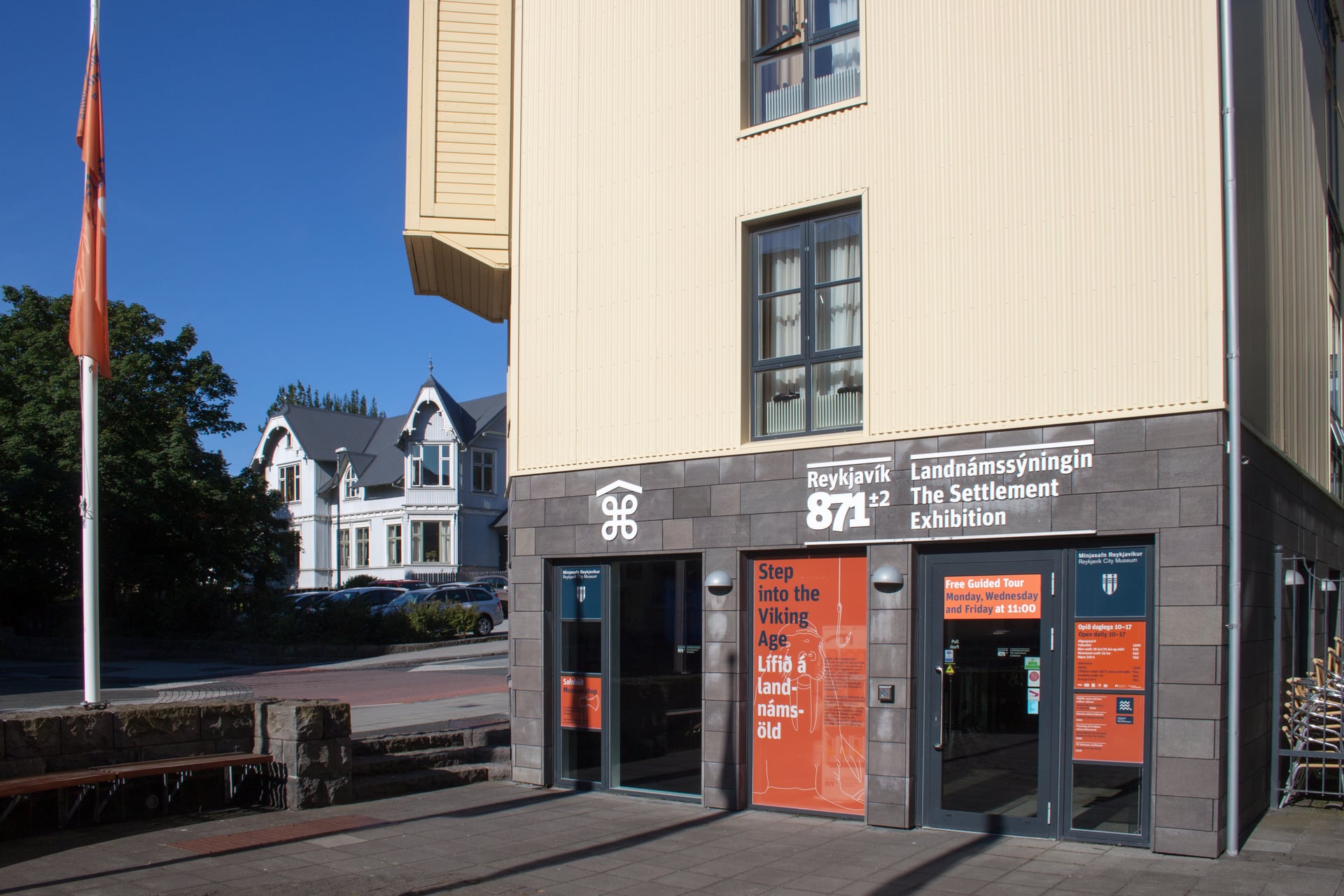
Visit Reykjavík describes the exhibition at Aðalstræti 10 and 16 as tracing the city's development from the settlement period to the present day, stretching underground from the archaeological remains of a 10th-century Viking longhouse to the oldest surviving building in Kvosin. That structure matters because it broadens the experience beyond a single ruin. The Settlement Exhibition is not only about one dramatic archaeological find. It is about continuity: from farm to village, from town to city. In a city where many travelers understandably focus on restaurants, design shops, church towers, and waterfront walks, this museum offers a deeper orientation. It tells you what Reykjavík is standing on.
The center of the older part of the exhibition, at Aðalstræti 16, is the longhouse discovered in 2001. This detail matters not only because the building is old, but because it was preserved in situ. You are not looking at a relocated reconstruction placed in a museum gallery for convenience. You are standing over the actual remains where they were found. That gives the whole experience a different emotional gravity. Many museums ask you to imagine context. Here, the context is physically present. The city literally built around the evidence instead of removing it from place.
Visit Reykjavík also notes that north of the longhouse, archaeologists found a wall fragment that predates the house and dates from before 871. This is one of Iceland's oldest archaeological remains, and it is hard to overstate how important that is to the tone of the exhibition. Icelandic settlement history is often told through texts, especially the Book of Settlements and the sagas. Here, the story becomes material. Turf, wall lines, domestic space, and datable remains turn what could seem like remote narrative into something architectural and immediate. The phrase Reykjavík 871 plus-or-minus two has become famous for good reason. It takes an era that can feel legendary and gives it measurable physical presence.
That move from legend to material evidence is one of the museum's strongest gifts for tourists. Iceland is full of places where stories are attached to landscapes: þing sites, churches, waterfalls, lava fields, and fjords. The Settlement Exhibition works differently. It is quieter, but also more grounding. It says: before Reykjavík became a capital, before it became a neat design-forward northern city, it was a farm landscape occupied by settlers making choices about shelter, resources, labor, and adaptation. The museum narrows history down to household scale, and that intimacy is part of what makes it memorable.
The exhibition's use of multimedia and archaeological interpretation, as described by Visit Reykjavík, is important too. A museum like this could easily become dry if it relied only on bare remains and labels. Instead, it helps visitors reconstruct the world around the structures: daily work, environment, early livelihoods, and the relationship between the first inhabitants and a new country. This matters because the best historical museums do more than preserve objects. They restore proportion. They remind visitors how much of ordinary life in the past was built from repetition, resourcefulness, and uncertainty rather than heroic abstraction.
The newer extension into Aðalstræti 10 gives the exhibition another layer that many casual summaries miss. According to the official description, this part carries the story forward into later chapters of Reykjavík's development. That progression is crucial. Without it, the museum would be fascinating but sealed off in the Viking Age. With it, the exhibition becomes a civic timeline. The visitor is moved through different periods of life in the city, learning how a settlement becomes an urban place. In a city that often feels young, this is a powerful recalibration. Reykjavík did not appear all at once. It accumulated.
One reason The Settlement Exhibition works so well on a Reykjavík itinerary is that it changes how the whole city reads afterward. You come out of the museum and the old center no longer feels merely picturesque. Streets like Aðalstræti and nearby corners around Kvosin begin to feel stratified. The city above ground acquires depth. This is especially useful for travelers who otherwise experience Reykjavík mainly as a base between excursions. A museum visit here can turn the capital from logistical backdrop into historical subject.
It also helps that the museum is compact in the best sense. This is not a giant national institution demanding a full day and a certain academic stamina. It is concentrated. That makes it ideal for visitors who want real substance without museum fatigue. The smallness suits the subject. Settlement-era Reykjavík was not grand. It was local, practical, and close to the ground. The exhibition's scale preserves that intimacy rather than overwhelming it with spectacle.
There is a subtle emotional intelligence to the museum as well. The longhouse remains are powerful partly because they are incomplete. Visitors are asked to bridge the gap between fragment and life. That act of imagination is not a weakness. It is the point. You look at turf walls, foundations, preserved lines of occupation, and the narrative framework around them, and slowly the city ceases to feel merely contemporary. The museum encourages a very Icelandic kind of historical attention: one that moves between text, place, material evidence, and environment.
For tourists who are especially interested in architecture or urban history, The Settlement Exhibition is also one of the best places to understand why Reykjavík looks the way it does. The official city museum framing emphasizes development over time, and that matters. The capital's modest height, harbor orientation, concentration in Kvosin, and expansion outward all make more sense when you first understand its earliest pattern of inhabitation. This museum gives that baseline. It is not trying to dazzle you with scale; it is trying to make the city intelligible.
The Settlement Exhibition is richer than a simple museum listing. Travelers want to know whether it is worth visiting, what is actually on display, whether it is mainly about Vikings, and how it differs from broader national-history museums. The clearest answer is that this is where Reykjavik's early history becomes physically visible inside the living center of the city.
What stays with many visitors after The Settlement Exhibition is not only the fact that they saw a Viking-age longhouse. It is the more unsettling and satisfying realization that modern Reykjavík is thin in the best possible sense. Beneath restaurants, politics, traffic, and tourism lie the traces of first habitation, and the distance between then and now is smaller than it first appears. The Settlement Exhibition lingers because it takes the oldest part of the capital and makes it feel newly inhabited by memory.