Iceland Travel Guides
Vestmannaeyjar: Harbor Life, Puffins, and the Exposed Soul of the Islands
A fuller private guide to Vestmannaeyjar, with island history, fishing life, puffins, Surtsey, eruption memory, and the human pulse that makes the Westman Islands unforgettable.
GlaciGo Iceland / May 2026 / 10 min read
Vestmannaeyjar is one of those Icelandic destinations that immediately feels more inhabited than the postcard version of Iceland usually allows. Even before you sort out the geography, the place has a human pulse: a harbor full of working boats, houses gathered tightly against sea and wind, cliffs alive with birds, volcanic slopes within walking distance of town, and a feeling that island life here was never decorative. That is what makes Vestmannaeyjar so compelling. It is visually dramatic, of course, but its deeper charm comes from the way nature, work, memory, and community all stay visible at the same time.
Visit South Iceland's town guide provides the basic frame cleanly. The Westman Islands, or Vestmannaeyjar, are a group of islands off Iceland's south coast, made up of 15 islands as well as around 30 cliffs and skerries. Heimaey is the only island inhabited year-round. That simple fact matters because it shapes the entire feel of a visit. Vestmannaeyjar is not one island with a few side rocks. It is an archipelago whose everyday center happens to be one inhabited island facing an entire volcanic and seabird world around it.
The same official material also preserves the origin story of the name. In Landnáma, the medieval settlement book, the slaves of Hjörleifur Hróðmarsson fled to the islands after killing him, and Ingólfur Arnarson pursued them there. Because those slaves were Irish, and thus known in Norse terms as the West Men, the islands became the Westman Islands. Whether visitors arrive interested in medieval naming or not, this matters because the name Vestmannaeyjar is not generic. It is a name tied to conflict, migration, and the early human imagination of Iceland's edge.
History keeps returning here in unusually sharp episodes. Visit South Iceland notes that three times the population of the islands took dramatic blows, and one of the most haunting was the 1627 raid when people were captured by pirates from Algeria. The South Iceland islands page and the Sagnheimar museum page describe this event in even more vivid local terms, preserving the memory of what Icelandic history usually calls Tyrkjaránið, the Turkish Raid. The point is not only to add historical color. It is to understand that Vestmannaeyjar has long lived with exposure. Ships can bring trade, connection, and livelihood. They can also bring violence, uncertainty, and loss. The islands have never been sheltered from history.
Sagnheimar is especially useful here because it broadens the identity of the islands beyond eruption memory alone. Its official description presents the unique story of Vestmannaeyjar through themes such as the Turkish Raid, the fishing life, Mormon emigration, the Westman Islands legion, and Þjóðhátíð. That list is revealing. Vestmannaeyjar is not only about birds and volcanoes. It is also about seafaring risk, faith, migration, civic self-image, and festival culture. In other words, it has the density of a real place, not just the clarity of a tourist attraction.
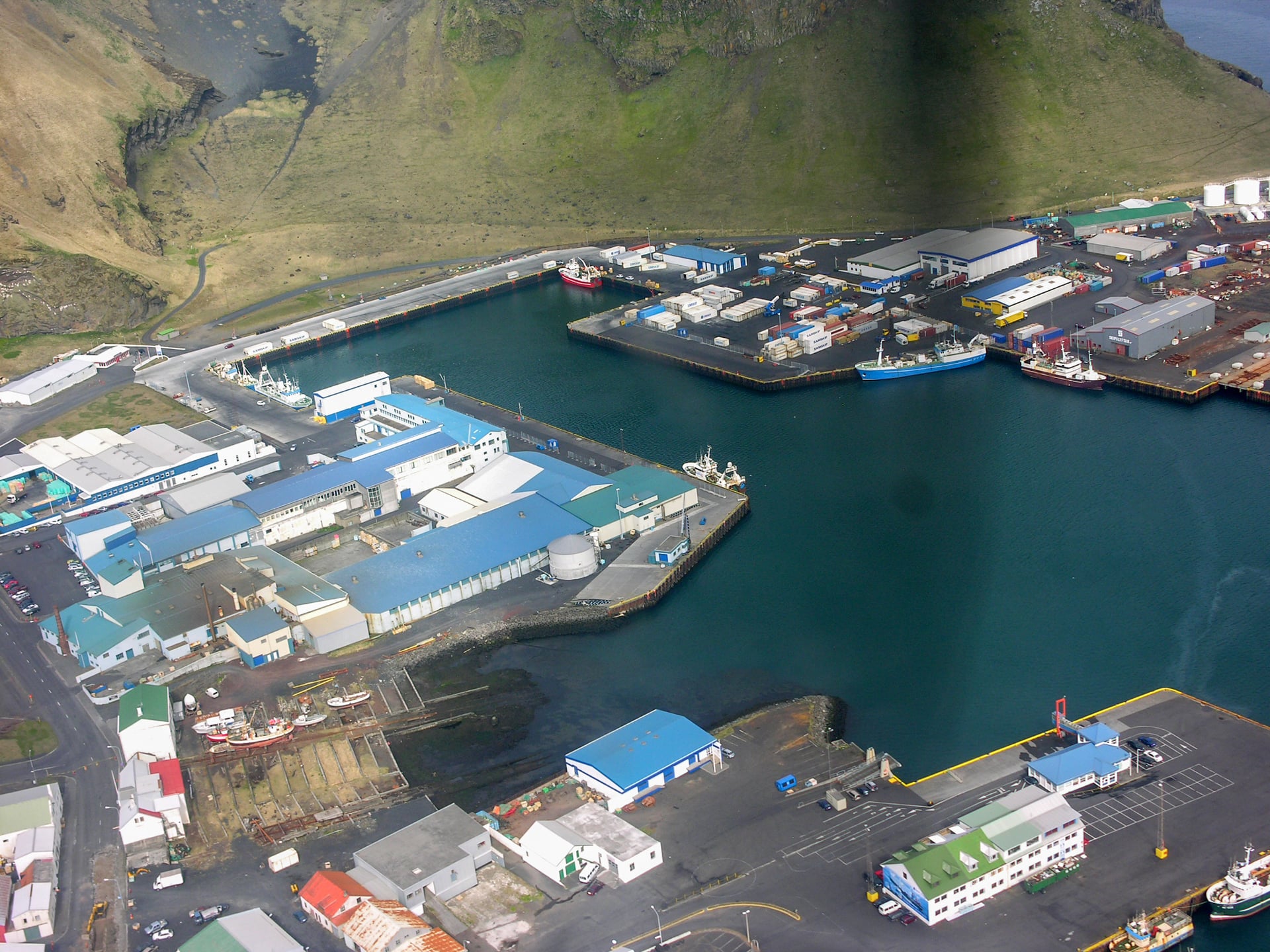
Fishing remains central to that reality. Visit South Iceland's islands page says the economy of Heimaey is primarily based on commercial fishing, with over 50 fishing vessels working out of Vestmannaeyjar and hundreds of people employed directly on boats and in fish processing. That matters because it keeps the harbor from becoming a scenic backdrop. The harbor is the operating heart of the town. Even travelers who come for puffins, hiking, or the 1973 story are ultimately visiting a living fishing community whose rhythms are still shaped by work at sea.
Then there is the birdlife, which gives Vestmannaeyjar one of its most famous faces without exhausting its meaning. The official South Iceland islands page states that the puffin colony in Vestmannaeyjar is the largest in the world and describes how millions of Atlantic puffins return each spring and summer. It also does something better than mere promotion: it explains local practices, from long-standing ethical traditions around harvesting to the now-famous way island children rescue lost young puffins and help send them back toward the ocean. That detail is wonderfully human. It captures how wildlife here is not sealed off from community life, but woven into it.
The same official page also evokes one of Vestmannaeyjar's oldest skills: cliff-hanging, the rope-based movement over dramatic rock faces historically tied to seabird life and egg gathering. This is exactly the kind of detail that keeps the islands from feeling interchangeable with other puffin destinations. Vestmannaeyjar is not just a place where birds happen to be visible. It is a place where generations learned to live with cliffs physically, culturally, and economically. The landscape did not merely decorate life. It trained it.
Geologically, the islands feel young in the clearest possible sense. South Iceland's material describes the archipelago as formed by volcanic eruptions and notes that Surtsey, the youngest island, emerged from the sea in 1963 and later became a UNESCO World Heritage site. Eldfell followed on Heimaey in 1973, transforming the inhabited island in full public memory. This gives Vestmannaeyjar a special kind of volcanic identity. In many parts of Iceland, volcanic history is impressive but remote. Here, new land has appeared almost within living conversation. The islands make geology feel not ancient but ongoing.
That is why it is important not to let the 1973 eruption consume the entire article. Eldfell and Eldheimar deserve their own dedicated treatment, and they already have it. But a fuller Vestmannaeyjar guide should show how the eruption fits into a larger island character rather than replacing it. The islands were storied before 1973 and remained many-sided after it. Today, volcanic memory sits beside fishing, festivals, bird cliffs, boat tours, family life, and restaurants like Slippurinn that have become part of the modern identity of Heimaey. This blend of old severity and new confidence is one of the reasons the islands feel so alive.
A visit by sea helps all of this land properly in the body. Arriving by ferry or by boat tour gives Vestmannaeyjar the right scale. The cliffs, stacks, harbor mouth, and clustered town appear in sequence rather than all at once, and you begin to understand why the islands feel both exposed and self-contained. The roadless outer islands sharpen the sense that Heimaey is not just a town by the sea. It is a settlement inside an island system with weather, wildlife, and open water pressing in from all sides.
Photographically, Vestmannaeyjar is unusually generous because it offers several kinds of image without forcing them into one formula. You can photograph the harbor and boats, the steep volcanic slopes above town, seabird cliffs, the view toward outer islands, lava and homes in the same frame, or the softer human moments of a place that still feels used rather than staged. The strongest pictures usually resist treating the islands as pure wilderness. Vestmannaeyjar becomes more interesting, not less, when people, boats, roads, and buildings remain in the frame.
The emotional scale of the islands changes with the season too. In summer, there is birdlife, movement, late light, and a sense of social openness that suits boat trips and long evenings. In rougher weather, the islands feel more compact and more elemental. The harbor becomes more obviously essential. The houses look more protective. The cliffs feel less like attractions and more like the walls of a difficult world. That seasonal flexibility is one reason Vestmannaeyjar holds repeat value better than many destinations that can be fully consumed in one good-weather afternoon.
Vestmannaeyjar benefits from careful explanation because travelers are not only searching for how to get there. They want to know whether the islands are worth a full overnight or a separate trip from the South Coast, what the balance is between puffins, history, hiking, and eruption memory, and whether the destination feels like a real place or a one-note excursion. The stronger answer is that Vestmannaeyjar is one of Iceland's richest island destinations precisely because it never collapses into one theme. It is volcanic, historical, maritime, ecological, and personal all at once.
What stays with many visitors after Vestmannaeyjar is not a single sight, but a composite feeling: boats in the harbor, birds on the cliffs, the knowledge of 1973 under the streets, the old raid stories, the tightness of island streets, and the sense that people here have spent centuries making a life on the exposed side of Iceland. That is why the islands linger. Vestmannaeyjar does not feel like a remote spectacle detached from human meaning. It feels like a real island world that has learned, again and again, how to hold its ground.