Iceland Travel Guides
Vestrahorn: Black Dunes, Dark Rock, and the Hard Beauty of Stokksnes
A fuller private guide to Vestrahorn, with its gabbro peaks above Stokksnes, early settlement memory, WWII and radar history, black dunes, reflections, and the reason this southeast Iceland icon feels harder and deeper than a simple photo stop.
GlaciGo Iceland / May 2026 / 10 min read
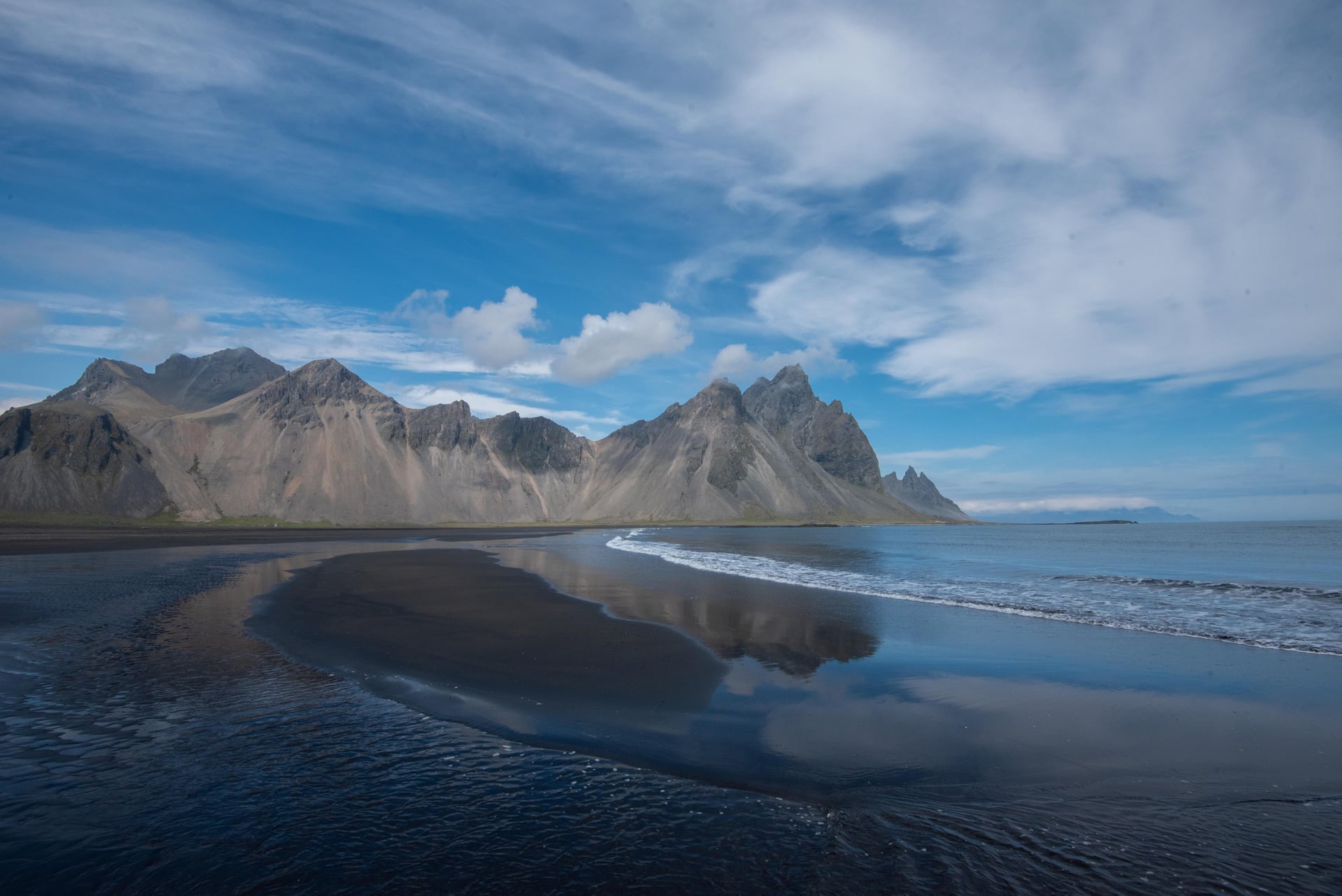
Vestrahorn is one of the most photographed mountains in Iceland, but photographs tell only part of the story. They capture the black dunes, the sharp dark peaks, the temporary reflections, and the moody weather that seems designed for dramatic edits. What they often flatten is the feeling of standing there in person. Vestrahorn is not beautiful in a soft or decorative way. It has a stern, metallic presence. The mountain rises out of Stokksnes like something forged rather than eroded, and the Atlantic, the sand, the wind, and the old radar history around it all keep the place from becoming a simple postcard. A strong article about Vestrahorn has to preserve that hardness.
Visit South Iceland places the Horn area just below Vestrahorn, around a ten-minute drive from Höfn, and immediately gives the visitor something more interesting than a photography label. The settlement farm Horn was one of the earliest farms in Iceland, built by Hrollaugur, son of Rögnvaldur Earl of Møre in Norway. That matters because it roots the landscape in deep settlement memory before the modern era of cameras, access fees, and image culture. Hornafjörður itself takes its name from this older geography. In other words, Vestrahorn belongs not only to visual tourism but to one of the older inhabited storylines of southeast Iceland.
Geologically, the mountain is also more unusual than it first appears. Visit South Iceland describes it as a 454-meter-high mountain composed of unstratified plutonic rock, mostly gabbro with some granophyre. That small technical note changes the mood of the place. Vestrahorn does not read like the more familiar basaltic cliffs and waterfalls that define so much of Icelandic travel imagery. Its darker, sharper form comes from deeper-born rock, and that gives the mountain a denser, more severe character. It feels less like a façade and more like a body. For many travelers, that is part of the fascination even if they do not know the geological vocabulary. The mountain seems heavier than it should.
East of the main mass lies Brunnhorn, the striking outcrop that stretches toward the sea and is often nicknamed Batman Mountain because of its shape from certain angles. It would be easy to let that nickname dominate the whole article, but it is more useful as a small example of how strongly Vestrahorn stimulates projection. People arrive and immediately start naming shapes, reading silhouettes, and turning the headland into image and character. The landscape invites that. It is theatrical without feeling artificial.
And yet the best way to understand Vestrahorn is through the relationship between mountain and foreground. Stokksnes matters as much as Vestrahorn itself. The headland's black sand, tidal pools, wet flats, sea grass, and wind-shaped dunes create the visual language that makes the mountain famous. Without that foreground, Vestrahorn would still be impressive. With it, the place becomes one of the most photographically responsive landscapes in the country. Every change in tide, cloud, and light redraws the scene. Some travelers get mirror reflections. Others get blown sand and low cloud. Others get bright sunlight that makes the mountain look almost less believable because it loses some of its menace. Vestrahorn is one of those places where weather does not merely alter conditions; it changes personality.
That sensitivity to mood is a big reason the mountain stays in people's minds. Many Iceland sites are reliably beautiful. Vestrahorn is more interpretive. It can feel cinematic, desolate, elegant, brooding, or unexpectedly calm depending on the hour and the wind. A traveler might arrive expecting the famous reflection shot and leave remembering instead the sound of air moving through the dunes or the way the mountain's edge disappeared into passing rain. This is part of what makes it strong on a private itinerary. It is not a place that asks only to be seen. It asks to be read.
Visit South Iceland also gives the site a historical layer that many quick guides miss. During the Second World War, the Horn area became a base for the British army, and later a NATO radar station was established at Stokksnes. That detail matters because it complicates the landscape in a useful way. Vestrahorn is not some untouched wilderness fantasy. It is a place where military watching, Atlantic exposure, settlement history, and modern tourism all overlap. The radar presence at the edge of such a dramatic scene gives the area an almost Cold War aftertaste, reminding the visitor that even Iceland's most seemingly mythic landscapes have lived through strategic modern history.
This is one of the reasons Stokksnes feels richer than a simple beach turnout. The road, the station history, the managed access through the Viking Cafe property, and the visible traces of human framing all shape the experience. Rather than diminishing the site, they can actually make it more interesting if handled honestly in the writing. Vestrahorn works because the wildness is real, but it is encountered through a human threshold. You pass through a piece of land that is owned, remembered, and organized before you step into the dunes and the long views.
The Vestrahorn site itself adds another contemporary layer through the so-called Viking Village. Its own description makes clear that this is not an archaeological reconstruction but a film set built in 2009 for a movie that was never shot, later used in 2021 as a location for Netflix's The Witcher: Blood Origin. That distinction is important. A careful article should not romanticize the village as authentic Viking heritage. But it should notice what its existence says about the place. Vestrahorn has such a naturally mythic atmosphere that people keep trying to stage old worlds inside it. The film set is artificial, yes, but it also reveals something true about the landscape: it invites saga-like projection almost too easily.
Handled carefully, the Viking Village can still belong in the article without hijacking it. It works best as a side note about imagination and reuse, not as the center of the destination. The real subject remains the meeting of mountain, shore, and weather. Still, the village helps explain why Vestrahorn appeals not only to landscape photographers but also to travelers drawn to atmosphere, fantasy aesthetics, and the sensation of standing somewhere that already looks half invented.
Wildlife gives the site another welcome correction to overly stylized travel writing. Visit South Iceland notes that seals can often be seen on the stretch of sand if you are lucky. The official Vestrahorn site also points to birds and, more occasionally, arctic foxes in the area. These details matter not because every visitor will see them, but because they remind us that Stokksnes is not merely a visual stage for humans. It is a working coastal edge, exposed and inhabited. The mountain may dominate attention, but the place is still ecological, windy, tidal, and alive.
For tourists, one of the practical strengths of Vestrahorn is accessibility. The official site notes that the gravel road is manageable with an ordinary car in normal conditions, though winter can change that calculation. That accessibility is part of the site's fame, but it also creates a small paradox. Vestrahorn looks remote and difficult, yet it can be reached with relative ease from Höfn. This is a gift for travelers, especially photographers, but it also means the article should emphasize pacing. The place improves when you do not treat it like a quick stop. Walk the dunes. Shift angles. Look back toward Brunnhorn. Watch how the pools change. Give the mountain time to stop being a known image and become a place again.
Vestrahorn is often searched and imagined through overlapping ideas: the mountain itself, Stokksnes beach, black-sand reflection photography, the Viking Village, and the route from H?fn toward the Eastfjords. The clearer answer is that Vestrahorn is not one simple attraction. It is a mountain, a peninsula experience, a managed coastal landscape, and a layered cultural site all at once.
What stays with many visitors after Vestrahorn is rarely just one perfect frame. More often it is a feeling of edge: edge of mountain and sea, edge of dune and tide, edge of settlement memory and military memory, edge of realism and fantasy. The black sand keeps shifting. The sky refuses to settle. The peaks look almost too sharp for the softness around them. Vestrahorn lingers because it feels less like a landmark you tick off and more like a mood you briefly managed to enter.