Iceland Travel Guides
Viðey Island: Monastery Memory, Modern Art, and Reykjavík's Quietest Escape
A fuller private guide to Viðey Island, with its monastery history, Viðey House and church, birdlife, Richard Serra's Milestones, Yoko Ono's Imagine Peace Tower, and the quiet reason this Reykjavík island feels so much bigger than it is.
GlaciGo Iceland / May 2026 / 10 min read
Viðey Island is one of the easiest day escapes in Reykjavík and also one of the easiest to underestimate. The ferry ride is short enough to feel almost casual, but the mood shift is immediate. The harbor noise drops away, the city starts to look like a far shoreline rather than a place full of errands, and the island opens into meadows, paths, sea light, birds, and a slower sense of time. Many visitors come because of the Imagine Peace Tower or because they want a quiet walk near the capital. Both reasons are fair. But Viðey becomes more interesting when you understand that it is not just a pretty island near Reykjavík. It is one of those Icelandic places where settlement history, ecclesiastical power, experimental farming, modern public art, and contemporary leisure all share the same small piece of land.
The Reykjavík City Museum describes Viðey as holding a cherished place in the hearts of Reykjavík residents and as a long-standing center of culture, nature, and outdoor recreation. That is a useful starting point because it explains the island's character better than many travel clichés do. Viðey is not a wilderness island in the dramatic Icelandic sense. It is a city island with a deep memory. You go there not for raw extremity, but for proportion: a manageable landscape with enough history and atmosphere to keep unfolding as you walk.
That history runs remarkably deep. Archaeological evidence places habitation on Viðey back in the settlement period, and the written record becomes clearer in the early medieval centuries. The most important turning point came in the 13th century, when Þorvaldur Gissurarson established Viðey Monastery, consecrated in 1226 and attached to the Augustinian order. According to Reykjavík's official history page for the island, the monastery eventually became one of the wealthiest in Iceland, controlling more than one hundred farms. That matters because it changes how you read the landscape. The silence of Viðey today can make it feel marginal, but for centuries it was tied into networks of religion, landholding, literacy, and authority. It was not peripheral at all.
This monastic layer is one of the reasons Viðey feels more textured than a simple picnic island. Even though the monastery itself is gone, the idea of it remains present. A traveler who knows that monks once lived, worked, and administered property here begins to see the island differently. The ferry no longer drops you onto an empty green refuge. It drops you into a site where Icelandic institutional history once had real weight. For tourists interested in how Iceland grew culturally before modern Reykjavík existed, this matters a great deal. Viðey helps show that the story of the capital region did not begin with cafés and concrete, but with older structures of faith, land, and learning.
After the Reformation, the island changed role again, and in the 18th century it entered one of its most important later phases under Skúli Magnússon, the royal treasurer often called one of the foundational figures in Reykjavík's early development. The city history notes that Skúli revived Viðey as a large farm, had Viðey House completed in 1755, and later saw a stone church consecrated there in 1774. These are not small details. Borgarsögusafn describes Viðey House and Viðey Church as two of the oldest buildings in the country, and Visit Reykjavík highlights Viðey House as the oldest stone house in Iceland. That gives the island an architectural significance that many first-time visitors do not expect from a ferry outing.
Viðey House matters for more than its age. It represents a moment when Icelandic ambition, Danish influence, administration, and material craft met in one highly visible project. Visit Reykjavík attributes the building to Danish architect Nicolai Eigtved, and even from the outside it changes the emotional center of the island. A white, composed house standing in this broad, grassy setting feels almost improbably formal. It suggests a dream of order placed in the middle of sea weather. Nearby, Viðey Church keeps the island's religious continuity visible in a quieter register. Together, house and church stop Viðey from becoming merely scenic. They make it legible as a place where power once wanted a permanent shape.
Skúli's time on the island was not only architectural. Reykjavík's official page notes that he revived eiderdown production and experimented with forestry and grain cultivation. That detail is small, but it says something essential about Icelandic history. So much of the country can be read as an argument with conditions: weather, soil, remoteness, scarcity, and possibility. In Viðey, those arguments happened close enough to the capital that they now feel almost intimate. The island was not just admired. It was worked, tested, and asked to yield. That practical layer sits beneath the calm visitors enjoy today.
The 19th and early 20th centuries added still more complexity. The city history records that Magnús Stephensen operated a printing house in Viðey from 1819 to 1844, linking the island to another kind of influence: not only agricultural and administrative, but intellectual. Later, in 1909, the so-called Millionaire's Company transformed part of eastern Viðey into a fish-processing settlement with piers, industrial buildings, and workers' housing. Much of that settlement disappeared at the start of the Second World War, yet foundations and traces remain. This is one of the most rewarding things about walking on Viðey if you do it slowly. The island is full of changes in use. Monastic island, elite farm, productive island, industrial outpost, recreational refuge: all of these identities belong to the same ground.
Then there is the natural character of the island itself, which is gentler than many of Iceland's famous landscapes but no less important for that. Visit Reykjavík describes Viðey as rich in birdlife, wildflowers, and panoramic views, while Reykjavík's official site points to eider ducks, fulmars, greylag geese, snipes, oystercatchers, and many other regular visitors. The same official page also makes a geological point that often gets overlooked: Viðey preserves visible effects of an old central volcano active roughly 2 to 3 million years ago, with tuff, basalt, and striking formations such as those at Eiðisbjarg. That geology matters because it keeps the island from becoming merely pastoral. Even here, in one of Reykjavík's softest-looking landscapes, the ground is still part of Iceland's volcanic story.
Modern art gives Viðey another of its strongest identities. For many travelers, this is the island's great surprise. Richard Serra's Áfangar, or Milestones, was created for the Reykjavík Arts Festival in 1990 and later gifted to the Icelandic people. Visit Reykjavík explains that the work consists of nine pairs of columnar basalt pillars placed to frame specific landmarks and destinations. The piece does not sit on the island like a decorative interruption. It teaches you how to look. As you move between the basalt pairs, the landscape starts behaving like a sequence of deliberate alignments: mountain, city, sea, horizon. Serra's work is powerful precisely because it uses Icelandic material and open space without trying to overpower either one.
The other artwork most travelers know before arriving is Yoko Ono's Imagine Peace Tower. Official Reykjavík sources describe it as a beacon for world peace, conceived in memory of John Lennon and first inaugurated on October 9, 2007. The light rises from a white stone base engraved with the words 'Imagine Peace' in multiple languages. It is illuminated annually from Lennon's birthday on October 9 until December 8, the anniversary of his death, and also on selected other dates such as the winter solstice period and around the spring equinox. What matters in person is that the work feels less like a monument than an event. It exists partly in the anticipation of lighting, in the boat ride, in the darkness, and in the shared upward attention of everyone standing nearby. Even travelers who are not especially drawn to celebrity memory often find the setting unexpectedly moving.
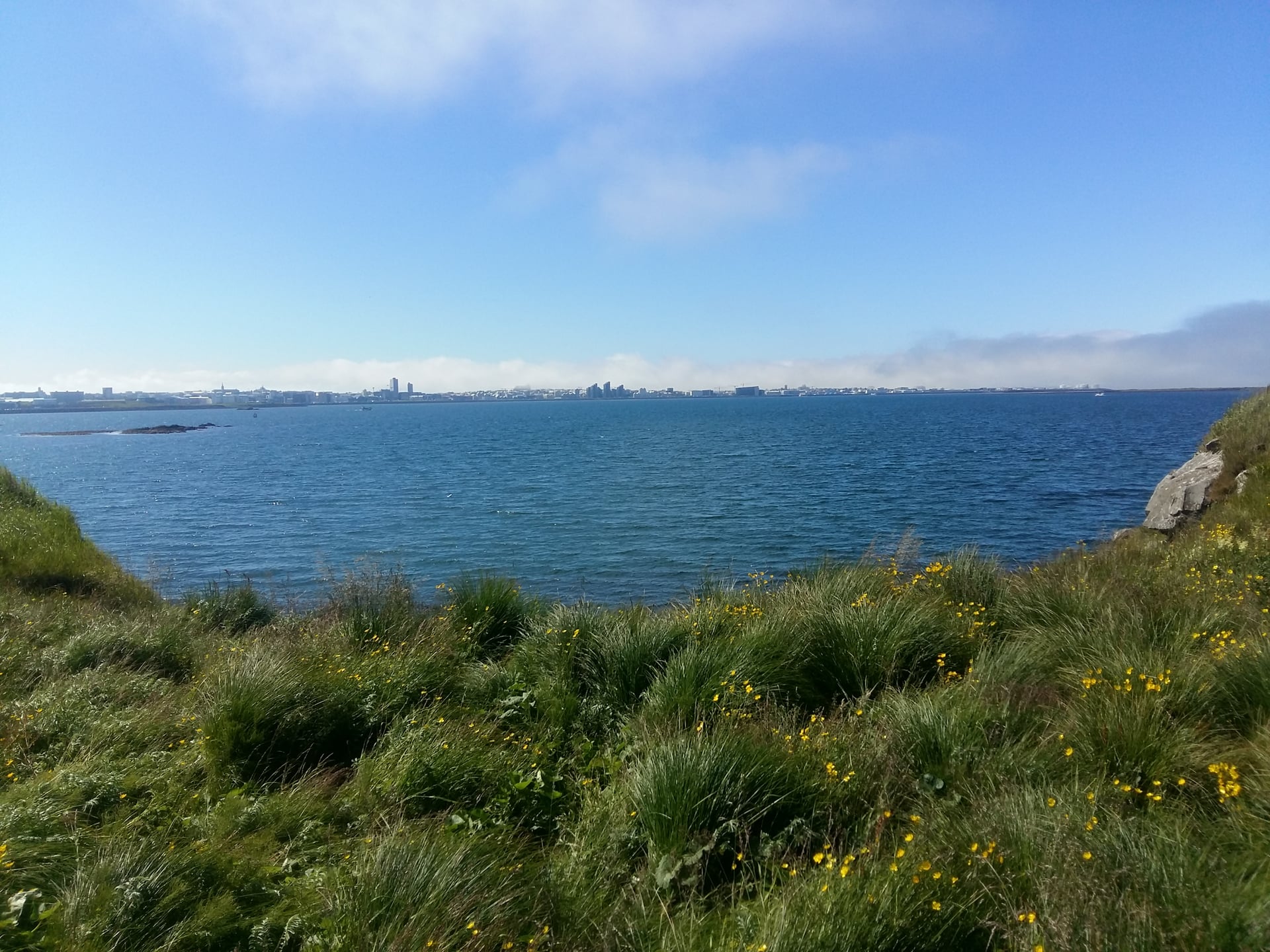
What makes Viðey especially good for tourists is that all these layers remain walkable and human in scale. You do not need a full expedition mindset, a major physical effort, or a long transfer out of town. You need time. The island rewards the traveler who walks without rushing to check off only the biggest sights. A good Viðey visit usually includes some drift in it: a pause by the shore, a detour toward an artwork, a moment looking back at Reykjavík across the water, a stretch of path where nothing happens except wind and bird calls. That is part of the island's value. So many Iceland itineraries are built around motion, distance, and the next headline stop. Viðey offers a different rhythm and, for many people, a needed one.
It also works beautifully as a corrective to the common idea that meaningful Iceland travel must always mean leaving urban space behind completely. Viðey is within Reykjavík, but it does not feel trapped by the city. Instead, it shows how the capital's cultural life extends outward into an island where art, history, and ecology stay in conversation. That makes it especially strong for travelers with a half day in Reykjavík, families who want a place with room to roam, repeat visitors looking for something quieter, and anyone whose trip needs one stop that feels more reflective than spectacular.
Videy Island gathers several visitor motives in one quiet place: ferry ride, Imagine Peace Tower, public art, monastery memory, birdwatching, and a half-day escape from central Reykjavik. Thin listings can make that sound scattered, but the island works because those layers stay calm together. Videy is historical without becoming heavy, artistic without becoming self-conscious, and peaceful without feeling empty.
What stays with many visitors after Viðey is not one single landmark but a subtle rebalancing of Reykjavík itself. The city looks different from the island, and the island changes how the city is remembered when you return. You come back more aware that Iceland's capital is not only streets and buildings, but also bays, ferries, old estates, monastic memory, basalt sculptures, migrating birds, and a beam of light rising into the dark. That is why Viðey lingers. It feels close to Reykjavík, but it also quietly explains it.