Iceland Travel Guides
Vík í Mýrdal: Village Life Between Katla and the Atlantic
A fuller private guide to Vík í Mýrdal in South Iceland, with village history, Katla context, maritime memory, and the human side of the South Coast.
GlaciGo Iceland / May 2026 / 10 min read
Some places on the South Coast are experienced as impacts. You step out of the car, take in the view, feel the wind, and move on with your day slightly rearranged. Vík í Mýrdal works differently. It does not overpower you in one instant. It gathers force the longer you stay. At first it can look like a convenient base near famous sights: a village with shops, fuel, beds, coffee, and a church on a hill. But then the larger truth begins to settle in. Vík is one of those Icelandic places where the landscape is never only scenery. It is the frame around daily life, local memory, and practical survival.
Visit South Iceland describes Vík as Iceland's southernmost village, situated in the center of Katla UNESCO Global Geopark, bordered by Mýrdalsjökull to the north and black sand beaches to the south. That placement matters. Vík is not simply near dramatic geology; it lives inside a geologically restless district. Katla lies beneath Mýrdalsjökull, the Atlantic presses against the coast, and the black sands remind you that eruptions, floods, and sediment are not abstract textbook processes here. They are the forces that shaped the ground the village stands on.
The official South Iceland material also points out one of the most revealing facts about Vík: it is Iceland's only seaside village without a harbour. That line stays with people because it sounds like a contradiction. How does a coastal settlement become a village of the sea without the shelter of a port? The answer is part of Vík's character. The coast here is beautiful but rough, and the black-sand shoreline is not naturally generous to boats. So the village developed in constant negotiation with the ocean rather than in confident control over it.
Katla Geopark's local history material makes that human story even clearer. It explains that Vík's development as a trading place began after growing dissatisfaction among people in Mýrdalur with the long and difficult journeys required to reach older trading centers such as Papós or Eyrarbakki. In 1883, two farmers started trade on the site by importing necessities from Britain. It is a wonderfully grounding detail. Behind today's hotels, bakeries, and tour desks is a much older village logic: people needed a closer place to exchange goods, sustain farms, and stay connected on a difficult coast.
The same Katla Geopark history notes that growth was gradual and that in 1916 a company was formed to buy the ship Skaftfellingur for transporting goods to and from Vík. Even that improvement came with difficulty, because loading and unloading cargo on a harbourless coast was never easy. This matters because it shifts Vík out of the generic 'cute Iceland village' category. It was not built on ease. It was built on persistence. Trade, fishing, and transport all had to adapt to a shoreline that did not cooperate.
That maritime tension is preserved beautifully at the Katla Visitor Centre and the Hafnleysa Maritime Museum. Visit South Iceland explains that the visitor centre is housed in the historic Brydebúð building in the old heart of Vík, where guests can learn both the geology of Katla Geopark and the history of shipwrecks and disasters on the black beaches of South Iceland. The museum invites visitors to imagine fishermen fighting the waves of the harbourless south coast. That phrase is valuable because it gives the village emotional depth. The sea near Vík is not just photogenic foreground. It is a force that shaped labor, fear, skill, and memory.
For travelers, this is one of the reasons Vík feels more substantial than a service stop. The village has enough infrastructure to make a South Coast day practical, but it also has enough history to resist being reduced to practicality. You can refill a tank, buy groceries, get warm, and continue east or west. Yet if you stay attentive, the place starts speaking in fuller sentences. The old trading story. The ship Skaftfellingur. The museum of harbourlessness. The knowledge that people here lived with a shore famous for beauty and danger long before visitors arrived with cameras.
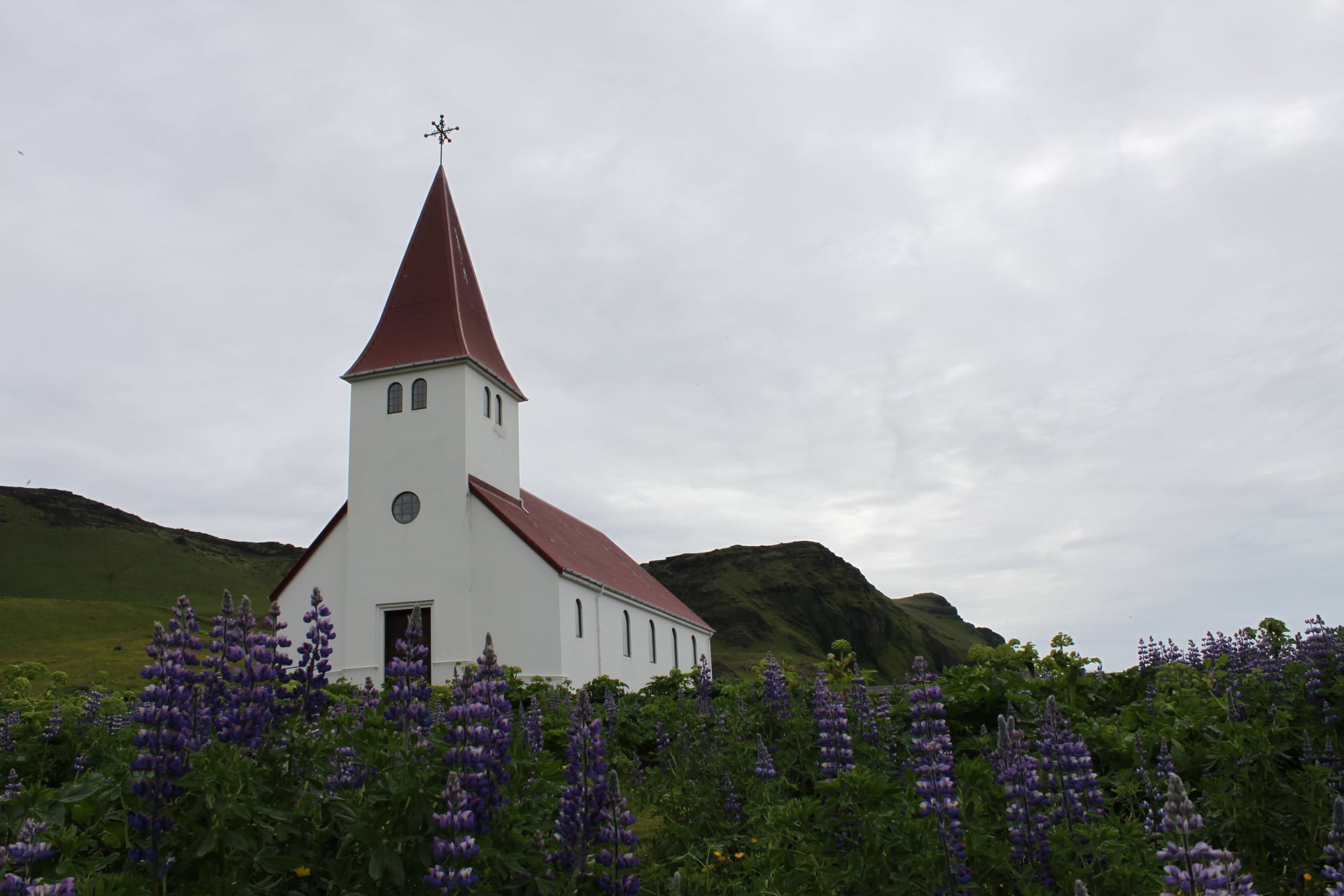
The visual symbol of Vík is often the white church above the village, standing on the hillside with a red roof and a clean, almost improbable silhouette against green slopes or dark weather. It photographs easily, which is one reason it spreads so well across travel imagery. But even when you do not tell the church's full history, its placement says something essential. It sits slightly above the settlement, looking over houses, road, sea, and the open stretch toward Reynisdrangar. In a village shaped by exposure, that elevated calm becomes part of the emotional architecture of the place.
Then there is the surrounding geography, which keeps Vík from ever feeling sealed off as a town in the ordinary sense. North of the village lies Mýrdalsjökull and the Katla volcanic system. To the south are black beaches and heavy Atlantic surf. Nearby are Dyrhólaey, Reynisfjara, Reynisdrangar, and the routes toward Sólheimajökull, Þakgil, and the wider South Coast. Vík therefore functions less like a standalone destination and more like a human anchor inside a large and volatile natural system. It is where people sleep, eat, orient themselves, and decide how to approach the landscape around them.
That is why Vík works especially well in a private itinerary. On a rushed ring-road drive, it can become a name attached to a coffee stop. On a better-paced day, it becomes the place where the South Coast starts making emotional sense. Reynisfjara explains the raw edge of the ocean. Dyrhólaey explains the structure of the coast from above. Sólheimajökull explains retreating ice. But Vík explains how human life fits between those forces. Without that layer, the route risks becoming a sequence of impressive exposures rather than a region people actually inhabit.
Visit South Iceland and Visit Vík both emphasize that the area supports a striking range of outdoor activity, from glacier walks and ice-cave trips to horse riding, ATV rides, paragliding, snowmobiling, and hiking. Those options matter commercially, but they also reveal something deeper about place identity. Vík is not passive in relation to its environment. The village has turned proximity to glacier, beach, cliff, canyon, and volcano into a living local economy. The best version of tourism here is not detached from local life. It is one of the ways local life now continues.
Culture matters too, especially when it is easy for international visitors to imagine the South Coast only in terms of waterfalls and black sand. The Katla Visitor Centre offers a Vík Culture Walk and a Vík Treasure Quest, which is a small but telling detail from the official description. It suggests a community interested not only in being passed through, but in being read. The village wants visitors to notice its stories, its old center, its geology, and the human layer that sits underneath the better-known attractions.
Even Vík's food and craft life can become part of that reading when approached with some sensitivity. Visit South Iceland's local listings point to businesses like Katla Wool, which explicitly describes itself as continuing a local textile tradition, and to restaurants and breweries rooted in the village rather than pasted onto it from nowhere. These details should not be romanticized too heavily, but they do matter. They show that Vík is not merely performing Iceland for guests. It is still, in visible ways, a working community adapting its traditions to a new economic era.
Because Vík is so often paired with Reynisfjara in search results, it is worth being precise about the difference. Reynisfjara is a natural attraction with serious danger and overwhelming visual drama. Vík is the settlement that gives that coastline a human counterpoint. It is where visitors can step back from the spectacle and understand what it means for people to live beside such a coast. The black sand does not stop at the edge of the famous beach. It belongs to the whole district's history, hazards, and identity.
There is also a psychological reason many travelers remember Vík so clearly. The village often arrives at exactly the moment a South Coast journey needs modulation. After waterfalls, wind, cliffs, and surf, people need somewhere that gathers the day without flattening it. Vík can do that. It offers warmth without dullness, structure without banality, and enough openness in the landscape that the drama never entirely disappears. You can sit with coffee or soup and still feel that glacier, volcano, and ocean are very close.
Vik deserves to be understood on its own terms, not only as a base for nearby sights. Travelers come with practical questions about where to stay, how to structure a South Coast day, and whether the village is worth time beyond Reynisfjara. A good visit answers those questions by showing the village as both useful and meaningful: small, exposed, historic, and deeply tied to Katla, Myrdalsjokull, black sand, and the harbourless coast.
What remains after a thoughtful visit is usually not one singular attraction, but a composite memory. The church on the hill. The sense of exposure at the edge of town. The knowledge that this is a coastal village without a harbour. The old Brydebúð building holding stories of geology and shipwrecks. The long relationship between trade, weather, black sand, and endurance. In that sense, Vík í Mýrdal may be one of the most human places on the South Coast. Not because it is separated from nature, but because it shows so clearly what it means to live inside it.